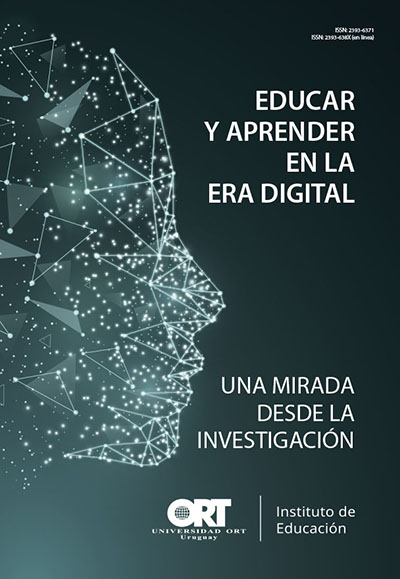
What challenges does teaching and learning in the digital age present? How are today’s teachers trained with regard to the integration of technology? What can we learn from a policy like the Ceibal Plan to continue building a vision for the future? What factors influence the integration of digital technologies into teaching approaches?
These are just some of the questions that the book *Educating and Learning in the Digital Age: A Research Perspective* seeks to address.
This publication, released by the Institute of Education at Universidad ORT Uruguay in February 2020, examines the integration of technology into the Uruguayan education system.
The chapters are based on a selection of graduate theses completed as part ofthe Doctor of EducationandMaster of Education programs, as well as on the findings of various projects carried out by the Institute of Education.
A significant contribution to research
“A polyphonic collage where research and professional trajectories converge. Epistemological, disciplinary, and political perspectives that are essential today for a field such as educational technology.”
That is the contribution of *Educating and Learning in the Digital Age*, in the words of Dr. Carina Lion—a professor of Education and Technology and of Computer Science and Education in the School of Arts and Sciences at the University of Buenos Aires.
As he stated in his foreword to the book, the work is a “collection of fruitful research, backed by empirical data and characterized by methodological and analytical rigor.”
Dr. Denise Vaillant, academic secretary of the Institute of Education and editor of the publication, wrote the foreword. In it, she stated that the book constitutes “an invitation to reflect on and analyze a range of topics, such as technological innovations, the changes brought about by the integration of technology, and the impact of technological environments on teaching strategies.”
“Instead of the rhetorical question: ‘How does technology impact education?’, the book we are presenting poses two much more interesting questions: ‘Do people learn with the help of technology?’ And if so, ‘what?’, ‘how?’, and ‘when?’” Vaillant noted.
What can you find in the book?
In the chapter “Digital Literacy, Academic Performance, and Socialization Among Students from Different Backgrounds in Montevideo,” Maximiliano Diel—a graduate of the Master’s in Education program at Universidad ORT Uruguayset out to understand the meanings that high school students in Montevideo ascribe to digital literacy, as well as to explore its connection to academic performance.
Enzo Puglia, for his part, surveyed teacher education students at the teacher training colleges in Montevideo regarding the skills they had developed during their training in relation to the pedagogical use of digital technologies in classroom practice. The chapter by the graduate of the Master’s in Education program was titled “Digital Skills in Teacher Education: What Is the Perception of Future Teachers Upon Completing Their Training?”
“Teachers’ Pathways and Models for Integrating ICT into Teaching Practices” was the contribution by Wellington Mazzotti Díez, a graduate of the Doctor of Education Universidad ORT Uruguay at Universidad ORT Uruguay. Specifically, the author described the factors that influence the integration of digital technologies into teaching approaches and outlined the different pathways teachers follow when integrating ICT into the classroom.
More than a decade after the implementation of the Ceibal Plan, Verónica Zorrilla de San Martín—a doctoral student in education at Universidad ORT Uruguayand John W. Moravec—a researcher and founder of Education Futures LLC—asked themselves: Are ICTs being used in a meaningful way for students, their families, and their communities? That was the question that guided their work in “The Ceibal Plan: Uruguay built it and implemented it. What now?”
The aim of “Data-Driven Preadolescence: Insights and Lessons Learned from an Intervention in Uruguay and Australia” was to provide insights and share lessons learned from an ongoing research project—conducted in Uruguay and Australia—on the process of preadolescents’ digital literacy on social media. The study was conducted by Lourdes Cardozo Gaibisso—a professor and tutor at the Institute of Education—Luci Pangrazio—a researcher at Deakin University—and María del Carmen Azpiroz—director of International Relations at Universidad ORT Uruguay.
“Progress and Challenges in the Use of Digital Technologies in Secondary Education” was the chapter authored by Eduardo Rodríguez Zidán and Claudia Cabrera Borges—members of the academic team at the Institute of Education—in collaboration with Juan Pablo Zorrilla Salgador—a professor in the School of Administration and Social Sciences at Universidad ORT Uruguay. The paper described a series of significant experiences in ubiquitous learning in secondary education in Uruguay.
Finally, the paper by Denise Vaillant, Eduardo Rodríguez Zidán, and Gustavo Bentancor—a doctoral student in education at Universidad ORT Uruguayis included. “The Incorporation of Digital Tools and Platforms in Mathematics Education” examined the use of digital tools and platforms in mathematics education during the first cycle of secondary school.