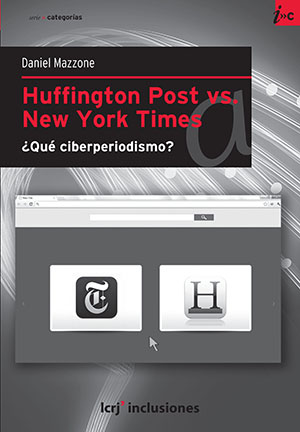
“Huffington Post vs. New York Times:What Is Digital Journalism?”is the latest book by Daniel Mazzone, who holds a master’s degree in journalism and is a professor of digitaljournalismat Universidad ORT Uruguay in Universidad ORT Uruguay. In this interview, conducted ahead of the book launch, we discuss this work and his research on the media.
You have extensive experience in digital journalism. When did you get started?
In the second half of 1995, the management ofEl Paístasked me with developingEl País Digital, which we launched in March 1996. I led the project until 2005. Many of the questions I seek to answer in my media research Universidad ORT Uruguay from that period and from my courses at Universidad ORT Uruguay .
How has digital media changed in recent years? How have media formats that originated, for example, in print, transitioned to the digital platform?
Changes in traditional media—over nearly two decades of online journalism—have been slow because, in general, their owners view the future through the lens of the old practices of journalism that emerged with the Industrial Revolution. Changes are being introduced gradually, not at the pace dictated by the various factors that are shaping the new media ecosystem.
This attitude is understandable, given that the profitability of print editions does not automatically translate to digital editions. How can we ask companies to abandon a business model that has been so profitable? It is a natural resistance.
However, there is a problem. A study by the Columbia University Graduate School of Journalism, conducted by Chris Anderson, Emily Bell, and Clay Shirky, clearly indicates that this business model has no future. What lies ahead? That is precisely what we are investigating.
Are the changes taking place in digital communication due solely to the development of new technologies, or also to the new role that the public is assuming?
It is a widespread mistake to focus solely on technology—a point highlighted by theorists such as Pierre Lévy and Manuel Castells, to name just two from different fields, namely communication and sociology. It is common to hear talk of the “impact of new technologies,” a war-like metaphor that suggests technology comes from outside society, when in fact it is society itself that produces it.
So what exactly is this change? What has been changing over the past several decades is a mode of production that emerged in the 19th century with the Industrial Revolution, characterized by centralized, hierarchical, closed, and authoritarian structures that concentrated decision-making in small elite circles.
That organizational structure, which governed society as a whole and not just journalism, also shaped the media ecosystem by concentratinggatekeeping in thehands of a few thousand media outlets (theWorld Association of Newspapers, or WAN, has fewer than 20,000 members) and a few tens of thousands of editors—a situation that led to scandalous errors: the coverage of the Iraq War by major American media outlets; media concentration in empires like Rupert Murdoch’s, which culminated in the aberrant practices ofNews of the Worldin 2011; the Jayson Blair scandal in 2004, and the even more scandalous celebration of BBC star presenter Jimmy Savile, who died last year at the height of his glory, with grand tributes, without the general public knowing about the allegations against him regarding hundreds of cases of sexual abuse, many of which involved minors as victims. This is merely a brief summary of the significant revelations with which the old ecosystem coexisted.
And that is what is changing. Traditional production methods are becoming decentralized, and networks organized in a mesh-like structure are emerging, while the sequential nature of the print format is being replaced by the randomness of databases, which now shape the discourse.
It could be argued that certaingatekeeping tasks, such as the selection and generation of information, have shifted to the public, thereby opening up an ecosystem that visibly expands the possibilities for information. These practices are what Manuel Castells refers to as“mass self-communication.”
On the other hand, the text—once a closed entity in the author’s hands—is giving way to hypertext, where the reader is in control, entering and exiting it at will. These are some of the cultural changes that are as monumental as they are unstoppable, and they are already underway.
In this context, the public’s role is shifting toward that of information producers. It is clear that posting a photo of an accident or reporting on a development in one’s neighborhood does not turn anyone into a journalist, but there is a shift in attitude which, to the extent that it is expressed on a mass scale, in turn changes the role of journalists and the media. The journalistic elite will have a new role in the new ecosystem. Traditional media will no longer have a monopoly on information production; it is now also in the hands of anyone who chooses to engage in it.
What is your position on this?
I study these phenomena because I believe they are of fundamental importance to the life of a contemporary society. But that does not mean I agree with everything that is happening. Nor does it mean I fail to recognize the enormous risks that any change of this magnitude entails.
We are in the midst of a colossal transition. Just think about what the Industrial Revolution must have been like—the radical urbanization of the 19th century, the rise of factories, the massing of workers around industrial centers, the slums, the poverty, the times when Kant warned business leaders that human beings should never be treated as mere means and therefore could not be reduced to appendages of machines. Well, we are witnessing changes of that magnitude. Those media outlets from the mid-19th century—theNYTwas founded in September 1851,La Naciónin 1860, andEl Díain 1886—have come a long way, undergoing multiple shifts in discourse, and today they face the ultimate test. Not all will survive, as evidenced by the widespread disappearance of traditional media. And none of this is negative or positive a priori.
The final say will rest with the key players, just as it did during the shift in the music industry’s business model. That industry forced music lovers to follow their artists through vinyl, then cassettes, and finally CDs, remastering time and again works that had long since paid for themselves—albums containing 15 or 20 tracks, of which listeners were interested in just one or two. Today, you can buy music by the track or on a flat-rate basis.
What is happening to the public amid these changes?
Some people believe that the public wants “everything for free,” when in reality what they want is the best service at reasonable prices. As in the case of the music industry, the media has also failed to live up to its old promise of “delivering everything you deserve to know.” Myths such as objectivity and infallibility have fallen, and the public has intuitively begun to select its own new influencers. Audiences create networks and communities where they recommend the content that best satisfies them. We must remember that it was the users who brought the media to social media, not the other way around.
Why did you choose to use The Huffington PostandThe New York Timesas examples when discussing online journalism?
For several reasons. The main one is that theNYTrepresents one of the pinnacles of Western journalism and has been online since 1994, whilethe HuffPostwas, as early as 2008, a rising phenomenon. I should have bet that it would continue to grow, and it was a good decision. In other words, between them, they created a scenario in whichgatekeeping, proposals for the social construction of civil truth, the social production of meaning, and the business model were polar opposites. And most strikingly: they were competitors, that is, they were vying for huge segments of a shared readership.
For the first phase of the research, between 2009 and 2010, I examined nearly 1,000 front pages from both publications, and in the second phase, in 2012, nearly 2,000—to the point where, on some days, I used software to download a front page from each publication every 30 minutes. Finally, I conducted an in-depth analysis of about 70 front pages, which allowed me to summarize the main characteristics of two ways of processing information.
During an interview with Jaime Clara, he said thatthe Huffington Postdoes anything but journalism. Why, then, did he choose it as a case study, given that his research focuses on online journalism?
TheHuffPostpositions itself as a news outlet that produces information. When I first looked into it, it was ranked tenth on Alexa’s media rankings, three or four spots behind theNYT. By the second phase, in 2012, it had risen to the top of the rankings and had surpassedthe NYTin terms of unique users. And all this after starting out in 2005 as a political analysis blog. There is something there worth studying.
As for the news model—which is what your question refers to—it is based on aggregation rather than original news production. It is also driven by ideological priorities (its criticism of major banks is a top priority), to which it subordinates issues of unquestionable public interest, as my research demonstrated. The Haiti earthquake (in January 2010) was pushed off the front page in favor of coverage of financial issues.
Another interesting finding that emerged from the research was that, althoughHuffPostwas a new media outlet, its editorial decisions are just as centralized as those of traditional media. Since it does not produce its own content, it blatantly uses editorials from other media outlets—including those ofthe NYT—as I have documented. This is not the kind of journalism we recommend in our classrooms.
How do you interpret the trends in Uruguayan digital media?
In my view, Uruguayan society lost its bearings many decades ago and has been unable to find the means to reposition itself in the world. The collapse of the education system and the inability to resolve logistical problems—which are always strategic in nature (railways, ports, highways)—are just two examples of the quagmire that has us trapped. The Uruguayan media are not immune to the cultural crisis that is impoverishing us at our very core. We are producing journalism that leaves many issues unresolved, which also speaks to a society increasingly divided into factions that do not build shared truths but instead foster division into two or more explanations that end up separating us into increasingly irreconcilable tribes. This behavior cannot lead us to anything good.
Journalism often confuses social violence with sensational crime reporting and reduces the complexity of the issue to a mere superficial and sensationalist description of a crime. I could list dozens of important topics that our media covers only in specialized sections, in yet another example of widespread decline.
Journalists' salaries have been devalued to the point of making us believe that journalism is a menial job, when in fact it is a profession that must be dignified, including—and fundamentally—in material terms.
More specifically, the Uruguayan digital journalism industry is adapting to these changes as best it can. Traditional media outlets continue to rely on the analog model—which remains their main source of revenue—while acknowledging that the future lies in digital media.
I think the most interesting developments are taking place amongbloggers, on platforms like Twitter, and in certain digital media outlets that aren’t derived from traditional media. However, there are some traditional media outlets (radio, TV channels, newspapers) that are making enormous efforts, with some astute achievements. But it seems that these two spheres—that ofbloggersand that of digital media—operate separately, without intersecting.
That is where I believe there is a vast, untapped resource that, since we haven’t studied it, remains unknown. Generally speaking, it could be said that neither thebloggingsphere has matured enough to become a valid interlocutor—beyond a few brilliant sporadic appearances—nor does the sphere of new and traditional media seem willing to cede ground. This is surely a transitional situation in which unpredictable changes are to be expected.
To the extent that it can come to understand itself and create opportunities for coordination and collaboration, the field of communication may be called upon to play a pivotal role in the search for paths that will allow us, as a society, to reposition ourselves in this world with which we must imperatively interact in contemporary terms.
Why is it necessary to study and reflect on the behavior of the media?
Academia can—and should—play a role in bridging the gap between the worlds of bloggers, social media, and traditional online media. Media studies can help connect traditional forms of communication with the innovative ideas of younger generations. The lack of communication between these two spheres does not serve society’s best interests.
The failure to understand the role that communication plays today is also evident in the aggressive manner with which certain politicians often stir up tensions with—sometimes furious—attacks on the media, as if the media were to blame for the social unrest that is taking hold in societies across our region. Attacking the media for problems that are overwhelming society as a whole may be an easy solution, but it is counterproductive.
The instability we are witnessing has a great deal to do with the transition from a society organized according to a conception of time and space rooted in the 19th century to this new, network-based society of the 21st century.
For all these reasons, it is important to study the media, as UNESCO also recommended in 2002: it suggested “media literacy” and clarified that this did not mean educating with or through the media, but rather learning about and understanding them in order to develop citizens with critical thinking skills who are capable of independently evaluating news content.
I hope that this book I am presenting will help create the conditions for these issues to begin to be included in the agenda of journalistic debates.