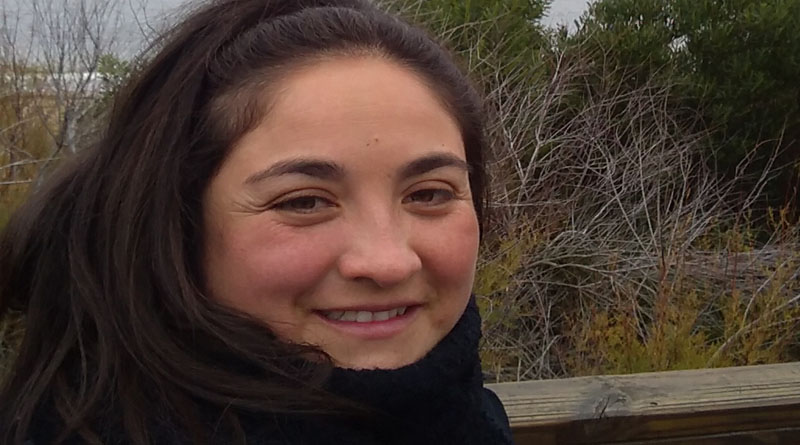
Paz González Vallejos, a student in the Doctor of Education program at Alberto Hurtado University and Diego Portales University in Chile, completed an internship at the Institute of Education as part of a scholarship from her university.
Starting on May 15, 2016—and for a month—he was in Uruguay conducting research on the challenges of teacher training and teacher educators.
In a conversation with González Vallejos, he described his experiences both in the country and at Universidad ORT Uruguay. He also shared his views on the Uruguayan education system and highlighted some differences between it and the Chilean system.
What is your educational background and work experience?
I am an elementary school teacher, or “maestra,” as they say in Uruguay. I worked in schools for a while and, at the same time, continued my studies toward a master’s degree with a concentration in learning disabilities. After that, I worked as an instructor at universities, teaching pre-service teacher training courses.
Have you always been interested in research?
Yes, it’s always been an area that has interested me. My field of research is initial teacher education. I’m also very interested in beliefs about teaching and learning—that is, the ideas that students, teachers, and teacher educators hold regarding teaching and learning.
How did the opportunity to come to Uruguay come about?
While studying the beliefs of the various stakeholders in initial teacher education—as part of research projects—one of the conclusions I reached was that there was one individual about whom very little information was available. That individual was the teacher educator.
So I enrolled in the Doctor of Education program to study that individual’s beliefs, specifically in the context of their professional development in the field of science.
I started reading a lot of literature in English, because there is a small—but interesting—body of research on the subject.
To gain a broader and more contextualized perspective, I decided to visit Universidad ORT Uruguay work with Denise Vaillant. Some time ago, she wrote her doctoral dissertation on university teaching and the role of the instructor. So I went to her to help me develop a Latin American theoretical framework and integrate it with the Anglo-Saxon one.
What did you know about Uruguay, and specifically about the Uruguayan education system?
Very little. I knew a few facts: that it was a sparsely populated country, and that education was free, secular, and compulsory.
Going to Uruguay was really helpful because reading about something isn’t the same as talking about certain things with people. It’s not the same to say, “Teachers are trained at teacher training colleges here,” as it is to go to a class and meet the teachers and some of the students. That face-to-face interaction is incredibly valuable.
What were you doing in Uruguay?
I was trying to understand how teacher training works here, because it’s very different from the Chilean system. When I arrived, I got in touch with people at the Institute of Education and attended a few classes in the Master’s in Education program. I spoke with many people at the teacher training colleges who were training teachers, and I also attended a class there. It’s always enriching to learn how things work in other countries, as it helps you gain a different perspective.
What differences did you notice between the education systems in Uruguay and Chile?
It’s very different; it has a different profile. First of all, Uruguayan teachers aren’t trained at the university level. They also don’t have contact with other degree programs because they attend a specialized institute. I’m not saying that’s good or bad—it’s just different.
I really like the connection they have with the field. The fact that the teachers in the teacher-training programs are school principals is quite interesting to me, from a Chilean perspective. In Chile, there isn’t such a strong link between teacher training and schools; rather, teachers and principals aren’t necessarily involved in teacher training.
As for the curriculum, I took a closer look at some of the programs, and it seems to me that they cover a lot of material. It remains to be seen whether students will be able to get through it all, but it’s a very demanding program, with classes and practical training in the afternoon.
What do you think are the main challenges in the field of education in Uruguay?
I believe that one remaining challenge is research, the training of researchers, and funding for educational research.
There are many—and very interesting—initiatives being carried out in Uruguay, both at the school level and in early childhood education. For example, the Ceibal Plan. I think they have some good aspects, but there is little systematization of what is being done. It is important for these initiatives to be published so that everyone can learn about them and benefit from them.
I also believe that Universidad ORT Uruguay a significant contribution to research through itsMaster’s and Doctoral programs in Education. I hope they continue to support the training of more research specialists, as this is a very valuable contribution.
What are your thoughts on the experience?
It was a very positive experience on every level. First of all, on a personal level, because fending for yourself in another country is a form of personal growth. On a professional level, I learned a great deal about how both the school system and initial teacher training work.
What enriched me the most were the connections I made with the people who work and study at the university. I am very grateful to both Denise Vaillant and the Institute of Education for the opportunity to work and study that they gave me. I hope that research on the topic I am working on can continue, and that we can form more partnerships and conduct more joint research between the two countries.