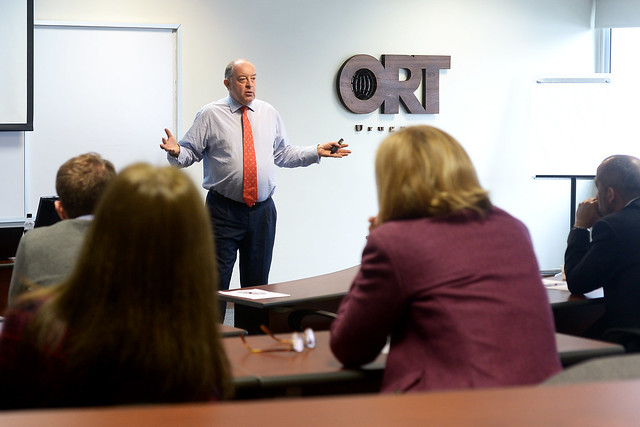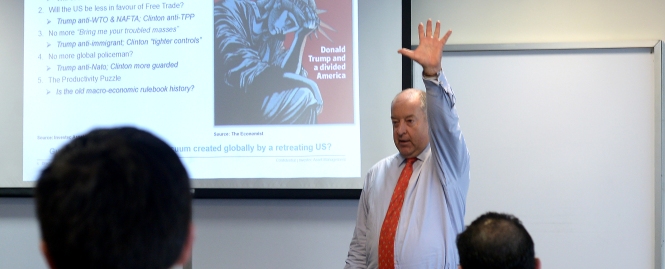
“It’s the twilight of oil and the dawn of solar energy,” said Dr. Michael Power during the conference “The End of the World as We Know It.” The event took place on Tuesday, August 30, 2016, at the Pocitos Campus and was organized by the Graduate School of the Faculty of Administration and Social Sciences.
Power, who holds a Ph.D. in Economics from the University of Cape Town, has held various positions at leading financial institutions, including Anglo American, NM Rothschild & Sons/Smith New Court, and Baring Asset Management.
At the event, Power addressed several issues with significant implications for the global landscape in the short term, such as Brexit, the situation in the United States, and the rise of emerging markets.
Brexit: Leaving the Hotel California
“The European Union (EU) is like the Hotel California: you can check in any time you like, but you can’t check out,” he said, referring to Brexit. According to the expert, the United Kingdom left the hotel by breaking through a hole in the wall, which could prove appealing to other countries if its experience proves successful.
The speaker said that countries that could have left the bloc earlier—Portugal, Spain, Italy, and Greece—did not do so because they would lose the subsidies they receive from Germany. This is the same reason why Northern Ireland and Scotland might be tempted to return.
Power argued that the discontent of a significant segment of the British population—fueled by an anti-establishment populism that took root among rural, older, and economically disadvantaged people—created the conditions necessary for the UK’s departure from the EU.
“Organizations like the United Nations and the OECD are starting to annoy people,” he said. “Which country will be the next to check out of the Hotel California? That’s the big question right now.”
In Power’s view, if the United Kingdom prospers over the next five years, more countries will follow in its footsteps. This is a major concern for EU officials. In his opinion, Austria is the most likely candidate, although a possible exit by Italy cannot be ruled out.
United States: Elections and Instability
Regarding the situation in the United States, the speaker said he was certain that Donald Trump would lose the presidential election. However, he noted that the candidate had paved the way for other potential populist presidential candidates to reach the White House.
At the same time, he asserted that the U.S. will face a number of challenges and questions, regardless of who wins. According to Power, Trump and Clinton’s conservative views on immigration and integration with other countries could spell the end of the United States as the “global policeman.”
“The United States needs to boost productivity,” he said, adding that it should follow Japan’s example. Regardless of the domestic political landscape in November, all signs point to the United States ceding its international leadership to a rapidly rising power: China.
China: Overproduction and Demand
Power explained that China is undergoing a number of changes that are exponentially increasing its potential, while also facing a host of challenges. While overproduction remains the primary challenge to be overcome, the easing of capital controls and the strength of the private sector point to a promising outlook.
According to the speaker, China is shifting from being a production-driven country to one led by consumption. He cited the global expansion of Alibaba and the use of AliExpress as examples; he also noted that one in ten tourists worldwide is from China, which underscores the importance and potential of the Chinese market.
Emerging Markets: Opportunities and Alternatives
Given the challenges currently facing the European Union and the United States, "opportunities are multiplying for emerging markets." In this regard, Power noted that there is a clear distinction between regions rich in natural resources (countries in the Americas and Africa) and those that excel in manufacturing (Asian countries).
According to the expert, emerging markets offer greater diversity than developed markets. This difference could be further accentuated by the shift in the energy mix that would result from the adoption of renewable energy.
“It’s the twilight of oil and the dawn of solar energy,” Power said, adding that installing solar panels in homes is not only politically correct but also makes good economic sense. “I can’t imagine anything that would benefit poor countries more than free energy,” he said.
The end of capitalism?
The current global landscape of change has far-reaching implications, which the speaker discussed at the close of the conference. The current situation differs greatly from the world as it stood in the late 1980s.
According to Power, we must ask ourselves whether capitalism as an economic system has come to an end—a development that would pose a serious threat to the so-called “Davos man.” Is this the end of the billionaires who tell millionaires what the middle class thinks?
Toward the end, Power offered some advice on building a global investment portfolio. Focusing on geographic diversification, paying attention to growth in the world’s major cities, addressing the risk of inflation in Europe, and monitoring currency exchange rates against the dollar were among the points mentioned by the expert.
Photo gallery: