Uruguay is no exception, says Brian Majlin, academic coordinator of Journalism and Cultural Communication at Universidad ORT Uruguay. “The growing conflict between family clans involved in drug trafficking in various parts of the country, as well as the influx of Brazilian criminal factions across the border, are shaping a new landscape for journalistic coverage of security issues.” Furthermore, it must be taken into account that “regional organized groups use Uruguay as a transit route for large quantities of drugs bound for Europe.”
In the tradition of good journalism, it has always been regarded—and even held in high esteem—as a force capable of bringing hidden truths to light, acting as a check on power, and setting limits on the actions of governments and citizens.
Brian Majlin, Esq.
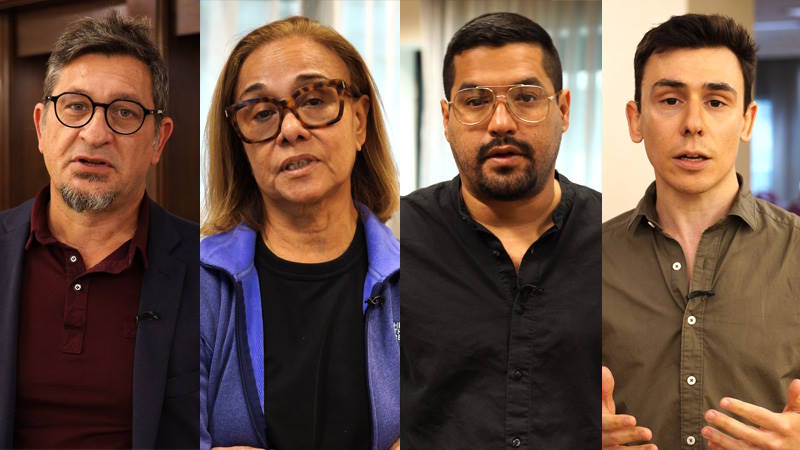
It is in this context that the School of Graduate Studies and professional development the International Journalism Seminar on Security and Organized Crime, where four journalists specializing in security shared their knowledge and experience with local media professionals:Oscar Martínez —editor-in-chief of the Salvadoran digital newspaper El Faro and a columnist for major media outlets in Spain and the United States—, Germán de los Santos —correspondent for the Argentine newspaper La Nación and member of the editorial team at Radio Aire in Santa Fe—, Ana Arana —investigative journalist and independent editor specializing in coverage of organized crime—and Guillermo Losa —journalist at Telemundo, dedicated to covering police and judicial issues—.
https://www.youtube.com/watch?v=IPOXPoV-D8g
In the age of social media and news stories condensed into 30-second segments, one of the challenges facing journalism is the ability to explain to the public and delve deeply into the causes and consequences of a phenomenon as significant as organized crime.
https://www.youtube.com/watch?v=FcfuvQoCHLM
“The sophistication of organized crime, its modus operandi, and advances in information technology” make it essential for journalists to engage in continuous professional development, Majlin argues. Journalists need to stay up to date and acquire new tools for their work in an increasingly violent environment.
https://www.youtube.com/watch?v=iwOloHrXfwY