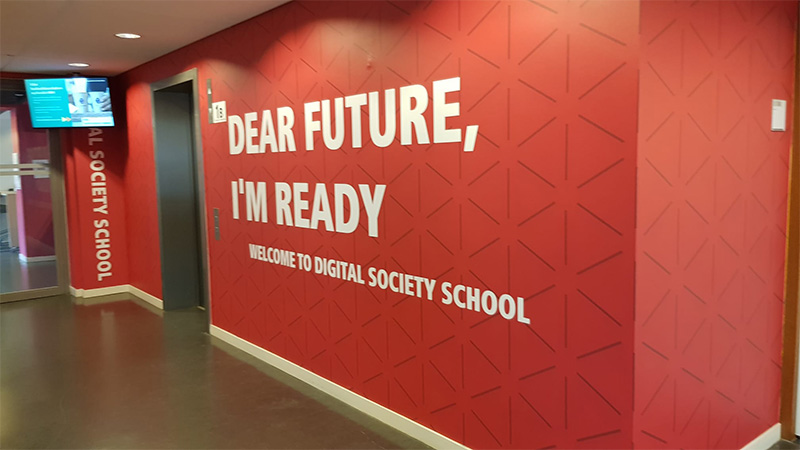
The academic visit to Amsterdam University of Applied Sciences (AUAS, Amsterdam, Netherlands) took place from June 13 to 17, 2022. Participants included Alejandro Erramún, MFA, academic coordinator of the Bachelor’s Degree in Animation and Video Games and the Bachelor’s Degree in Multimedia Design, and Eduardo Hipogrosso, Dean of the School of Communication and Design.
The visit was part of the International Academic Mobility Project under the Erasmus+ Program, which is being carried out by Universidad ORT Uruguay AUAS.
It was organized by the School of Communication and Design and ORT’s Academic Projects Coordination Office.
As an Erasmus+ scholar, Erramún’s academic exchange involved joining a class and providing feedback to the students:
It’s really important for everyone—not just for me as someone going on an exchange—to benefit from the perspectives of students from other parts of the world with different backgrounds, to see what they’re working on, and to provide feedback based on my own experiences.
Spotlight onDigital Design
Dr. Héctor Bajac, academic secretary of the School of Communication, visited AUAS in April, “with slightly different objectives,” Erramún noted, “given our respective roles.”
In fact, Erramún focused on the fact that AUAS offers a Digital Design program at both the bachelor’s and master’s levels. With this in mind, they met with the program directors for each degree track and with several coordinators of the so-called minors: in their third year, all students have the opportunity to pursue minors, which consist of several courses taken over the course of a semester. The professor explained that the minors are “quite open,” since they can be taken at any point in the program and represent a minor specialization, such as, for example, a minor in speculative design or in design methodologies to develop creativity focused on design thinking. Currently, Erramún noted, a Fashion Design student is participating in an exchange program at AUAS through Erasmus+ and is not taking a minor in Fashion, but rather one related to creativity.
It was very, very enriching. From my perspective, reaching an agreement would be very beneficial because it would open the door for the entire faculty to pursue different minors; for example, someone studying Communication could easily work in speculative design, or whatever they choose.
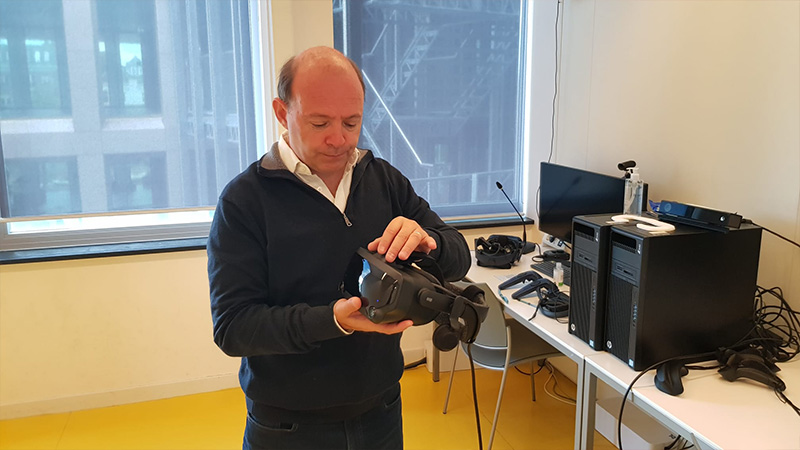
As part of the planned activities, Hipogrosso and Erramún attended several classes: given the stage of the semester, they observed project presentations, specifically the pitching sessions. During these sessions, the students explained what they had done for each of the companies they worked with and what solutions they had proposed.
Eduardo and I had to provide feedback based on our respective backgrounds —whether in business, application development, logic, or solution implementation—across various areas.
“I was very fortunate to serve on the panels for the final projects of the Master’s program in Digital Design—a very, very intense experience,” Erramún said. “I was assigned three students; each one presented about 40 or 50 pages—not that many, but the level of depth is very, very intense. Suffice it to say that for the three students, including the entire interview, feedback, and everything else, it took us nine hours of work.”
Each project presented consisted of five parts, and each member of the panel was assigned one or two of them.
“It was a wonderful experience because you had to conduct interviews, talk to the teachers, reach a consensus on the grade, provide written feedback, and then discuss it with the students. And since each teacher’s approach was quite different, everyone focused on their own part: my job was to convince the other two (about the grade). It was a truly rewarding experience in every way.”
Thinking about methodologies and sustainability
Erramún noted that AUAS has division called Green Office, which is responsible for environmental and sustainability issues. There, together with university students who wish to participate, they are working to incorporate the UN’s 17 Sustainable Development Goals into various courses across the entire university.
The SDGs and sustainability are key for the country.
“I bring a certain methodology with me: at AUAS, they work more closely with industry because they have well-known companies right next door.” Perhaps due to differences in scale, that can’t be replicated in Uruguay, explains Erramún, but we should certainly value “this university’s approach to industry and keep in mind that there are areas we need to gradually place greater emphasis on.” Since this is the Netherlands, sustainability is undoubtedly the key issue at the national level.
To illustrate this, he shared an example. When someone goes to the university cafeteria, the coffee costs an extra euro, and you get a reusable plastic cup with NFC (near-field communication).
When you finish your coffee, you place the cup in a machine, which recognizes it as valid—belonging to a specific brand—and gives you a euro back. So, instead of throwing the paper cup away, you return it and get your euro back. And you decide whether you want it credited to your credit card, Google Play, or the Apple Store.
Erramún noted that the Multimedia Design program also works with NFC:“We’re on par with them; we’re not lagging behind, and that’s why I think our students would really benefit from the cultural exchange that comes with going to a place like the Netherlands.”