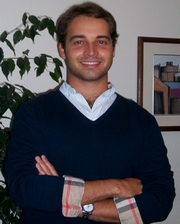
 Name: Juan Ignacio Scasso Roche
Age: 25
High School: Stella Maris School
Degree Program: Bachelor of Arts in Economics
Year of graduation: 2008
Job Title: Analyst at Towers Watson
Interview published in May 2011.
Juan Ignacio began studying for a Bachelor’s degree in Economics at Universidad ORT Uruguay 2004. His first job was an internship at the Uruguay XXI Institute in 2006, where he worked with the International Trade Centre in collaboration with the World Trade Organization and the United Nations Conference on Trade and Development. He then completed another internship as a Research Assistant for the Finance Department of the School of Management and Social Sciences, and has been working at Towers Watson since December 2008.
- Why did you decide to study at Universidad ORT Uruguay?
- I chose ORT for several reasons. First, the university was already well-known and highly regarded academically in Uruguay and Latin America. The second reason was that the university fosters an environment of creativity and innovation, thanks to the fact that much of its academic offerings are focused on new fields and technologies, and because it is a very diverse environment. Finally, its ability to adapt and understand the job market, as I found the curriculum for the Bachelor’s Degree in Economics to be the best available in Uruguay.
- How did you come up with the idea of pursuing a bachelor's degree in economics?
- One of the main reasons I want to study economics is that I see it as a broad field of study that encompasses various disciplines and, as such, serves as a foundation for my other interests. I believe economics acts as an "umbrella" that covers most of my interests, ranging from geography and culture to international politics and economic integration.
- How did the race go for you?
- Everything at ORT is organized around the student, providing them with every possible tool to fully develop their potential without worrying about issues unrelated to their professional growth. These tools are partly related to the infrastructure, such as the selection of books in the library, the computer labs, or the small class sizes. However, the main reason I believe students can focus entirely on their studies is the support provided by everyone who works at ORT. They are not only excellent professionals, but above all, they are excellent people and colleagues.
- What do you remember about the race?
- What I remember most is the study group that formed. We studied together almost all the time and would meet at the library for marathon study sessions. Even after graduating, I still see many of them, and I made some of my best friends at ORT. I also remember the days when studying was practically all I did, but the satisfaction of earning my degree made it all worth it.
- When did you start working? Where? What did you do?
- My first job was in 2006, an internship at Uruguay XXI—Uruguay’s investment and export promotion agency. There, I had the opportunity to work with the International Trade Centre, in collaboration with the World Trade Organization and the United Nations Conference on Trade and Development, to help develop Uruguay’s export promotion strategy. Thanks to this internship, I realized my interest in economic issues related to trade, geography, and economic integration, which largely shaped the direction of my professional career.
- Have you changed jobs?
- After my internship at Uruguay XXI, I took on another internship as a research assistant for the university’s Finance Department. In this role, my main task was to assist in the preparation of a study on the valuation of companies in emerging markets. This sparked my interest in research, largely thanks to the encouragement of the department’s then-chair of finance.
Since December 2008, I have been working at Towers Watson, an international human resources consulting firm; the Uruguay office focuses on economic research. In recent years, I have worked on a wide variety of projects, ranging from articles on the Russian aerospace industry to corporate news stories of greatest media significance, as well as the internationalization strategies of Chinese multinational companies. In addition to developing my research skills and working with leading economists, I was able to participate in and lead projects for clients seeking to evaluate the best locations for investment.
- Do you think your degree prepared you for the job market?
- Absolutely. The university’s greatest strength was giving us the tools to adapt to the demands of the job market. I think one of the ways the university helped us gain a better foothold in the job market was through the required courses that encourage students to be proactive and work as a team.
- What are your plans for the future?
- In the future, I plan to continue developing my research skills. I am currently evaluating various options for pursuing a master’s degree abroad in mid-2011; this would be my first step toward potentially pursuing a Ph.D. My goal is to establish a career in consulting for businesses and institutions.