
The Master of Business Administration (MBA) program at ORT’s Graduate School of Business was ranked 16th in América Economía magazine’s 2022 Latin American MBA Ranking, which was published on May 31 of this year. This is the program’s highest-ever ranking; it moved up seven spots in this edition and has been the only program in the country to rank among the region’s best for more than 25 years.
The MBA program ranked highly in the "Current Average Income" indicator —which measures the average income earned by graduates three years after completing the program—ranking 11th place.
It also received special recognition in Network Power, an indicator based on the career paths of graduates, alumni networks, and the number of significant ventures launched by graduates in recent years. In this category, the MBA program ranked 10th.
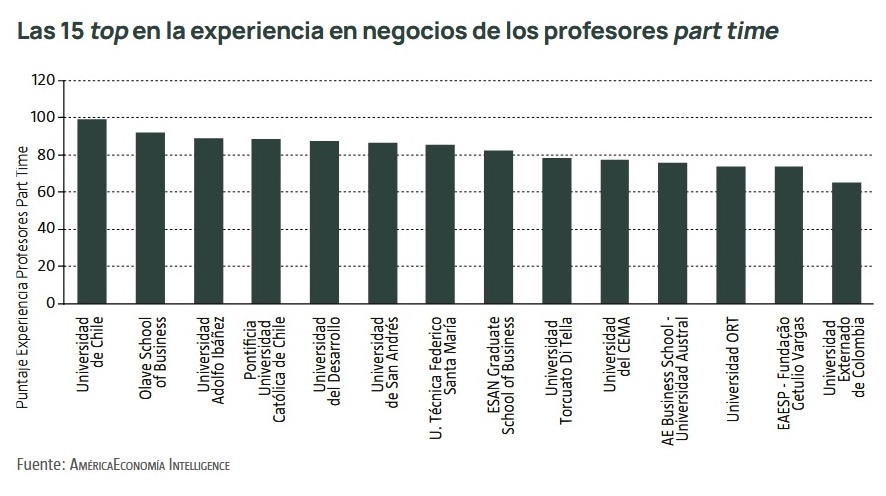
It also ranked 12th in terms of the business experience of its part-time faculty (practitioners).
A gateway to the world
In addition to this distinction, the MBA program at the Graduate School of Business is accredited by AMBA, one of the world’s three leading accrediting bodies.
It has a dual-degree agreement with the Master's in International Business program at Florida International Universityand has wide range of opportunities to gain international experiences.
It was ranked among the best in the region by the QS Executive MBA Rankings and the Eduniversal Ranking of the Best Masters & MBAs, while the Business Analytics MBA was recognized in the QS Business Masters Rankings: Business Analytics 2022.
How the ranking is determined
This year's ranking was based on the following indicators:
Academic strength (30%), a composite measure consisting of:
- Academic qualifications, which assess the average quality of full-time faculty based on their academic degrees and the prestige of their alma mater, as well as the ratio of full-time faculty to students.
- Experience, which ranks the top 10 part-time professors based on their professional backgrounds.
Knowledge production (14%):
- The study examines the three-year output of papers indexed in the Web of Science Core Collection, with explicit affiliation to the participating business school, productivity per faculty member at the respective business school, and the average impact factor.
- The faculty's output over the past three years , including books, book chapters, and case studies published by a list of highly regarded external publishers.
Internationalization and diversity (16%):
- Internationalization, which measures the international connections established by the school based on accreditations, memberships, overseas campuses, dual degree programs, and exchange programs with top institutions.
- Diversity, which assesses the distribution of men and women—with a preference for a 1:1 ratio—among deans, directors, and faculty, as well as the geographic diversity of the nationalities of international faculty and students, the universities where visiting faculty earned their degrees, and scholarships for students.
Mains power (20%):
- Graduate Career Trajectories, which evaluates the 10 most recent graduates and the 10 most distinguished alumni based on their professional careers.
- Alumni networks, which include alumni associations and career placement offices established by the business school.
- Startups, which takes into account the number of significant startups launched by graduates in recent years.
Return on investment (20%):
- Current average income, which measures the average income earned by alumni three years after completing the program.
- Change in income before and after the MBA, which measures the increase or decrease in the alumnus's total income three years after completing the program.
- Revenue-to-cost ratio, which measures the ratio of the average income of alumni three years after graduation to the average total cost of MBA programs.
- Career mobility, which takes into account the proportion of graduates who report having experienced positive changes in their career paths after completing the MBA.
- Job offers received in the short term: the percentage of graduates who report having received a job offer within three months of completing their graduate program.
- Jobs secured through MBA networks: the percentage of graduates whose current job was obtained through the school’s formal placement program or contacts made during the MBA program.
- Level of satisfaction with the MBA program: graduates' assessment of what they learned in the program and how it prepares them to enter the job market.