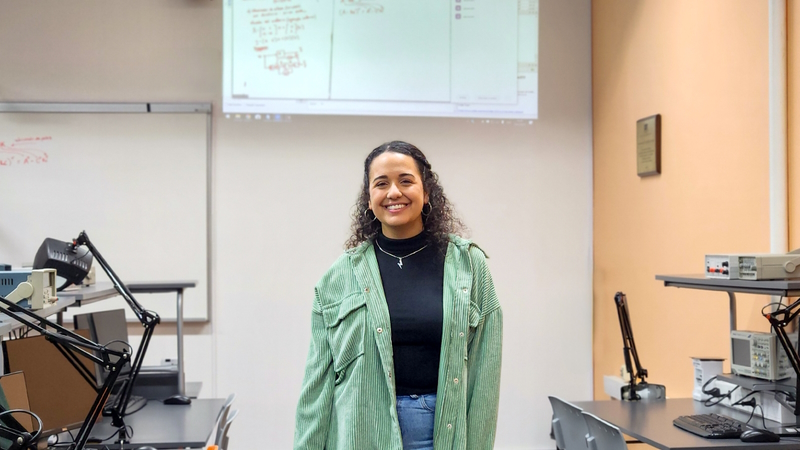
Victoria lives in Canelones, the city where she attended school through high school and from which she commuted every day during her undergraduate studies at Universidad ORT Uruguay. When it came time to choose what to study, only one thing was clear to her: it was going to be engineering, because she really liked math. She wasn’t quite sure what the next step would be, but she ended up becoming an electrical engineer—a decision that was partly a matter of chance and partly a way of carrying on a legacy.
She arrived at college interested in electronic engineering, but discovered that—just that year, in a matter of weeks—the electrical engineering program was set to begin, and that she could be part of the first class of students in a program with an innovative approach that had excited her.
"Of all the engineering disciplines, electrical engineering struck me as the most magical and part of everyday life, yet at the same time the hardest to understand. To this day, I still find it amazing that turning a turbine can make a light come on," says Victoria, who has lived with these feelings for as long as she can remember. "My father works for an electric utility company; he maintains the power grid, and my brother is an electrical engineer. One has a lot of practical experience and the other has a background in theory, physics, and mathematics. So yes, I’ve always been immersed in the field," the engineer acknowledges.
As she recalls, the first year of the program’s inaugural cohort had fairly large classes, but most of the students were from the Electronics and Telecommunications Engineering and Electrical Engineering programs —since it was the first year the program was offered—there were fewer students, and she was studying alongside her two travel companions: Allen and Eugenia.
The interaction between the professor and the students was face-to-face, and the relationship with the faculty was always very direct.
Victoria experienced the exciting process of developing the program alongside her colleagues, who closely followed its evolution during the early years as it took shape.
This consolidation has made the program a hands-on one, with project-based courses in nearly every semester, which means that students are constantly discovering new technologies, tackling problems, solving them, and integrating those technologies into their solutions.
There is also a course on electrical power transmission based on a program developed by faculty members in the program: Dr. Fernando Paganini, Vice Dean of Research at the School of Engineering, and Enrique Briglia, Ph.D., Professor of Electrical Engineering and Energy Management, who also served as her thesis advisors, along with Dr. Andrés Ferragut, a faculty member who also contributed to the project. According to Victoria, "the program is used to optimize and control the operation of the power grid, physically speaking, beyond economic costs."
His thesis was a project for a 40-space parking lot equipped with single-phase and three-phase chargers for electric vehicles. The goal, beyond the electrical installation, "was to optimize the network in order to reduce costs, and to balance and reduce energy consumption, while ensuring that the chargers are always available for use." We can find these types of needs in various contexts, for example, at a shopping mall, where cars are constantly coming and going, and the network must always be available.
He admits that his motivation for this research project stemmed from the widespread interest in electric mobility, the commercial interests of various industries, and the fact that "it's the way of the future" in the near future.
In addition to being a graduate, Victoria has been a professor in the university’s School of Engineering for over two years, following an offer from Freddy Rabin, her Algebra 1 professor, who always noticed her explaining concepts to her classmates in class. “At first I was a little nervous, so I waited a semester before taking the plunge. I started as a teaching assistant for a couple of semesters, and then I began teaching some courses myself: Fundamentals of Mathematics, Algebra 1 and 2, Differential Equations, and a few others," she explains.
Being the first woman to graduate with a degree in electrical engineering from Universidad ORT Uruguay Victoria not only with pride but also with a sense of fulfillment.
"At the time, I felt a lot of pressure because of the high expectations surrounding the first graduation, but I also felt very supported by my professors and many people at ORT. All my nervousness disappeared once I finished defending my thesis; I felt satisfied that I had achieved my goal."