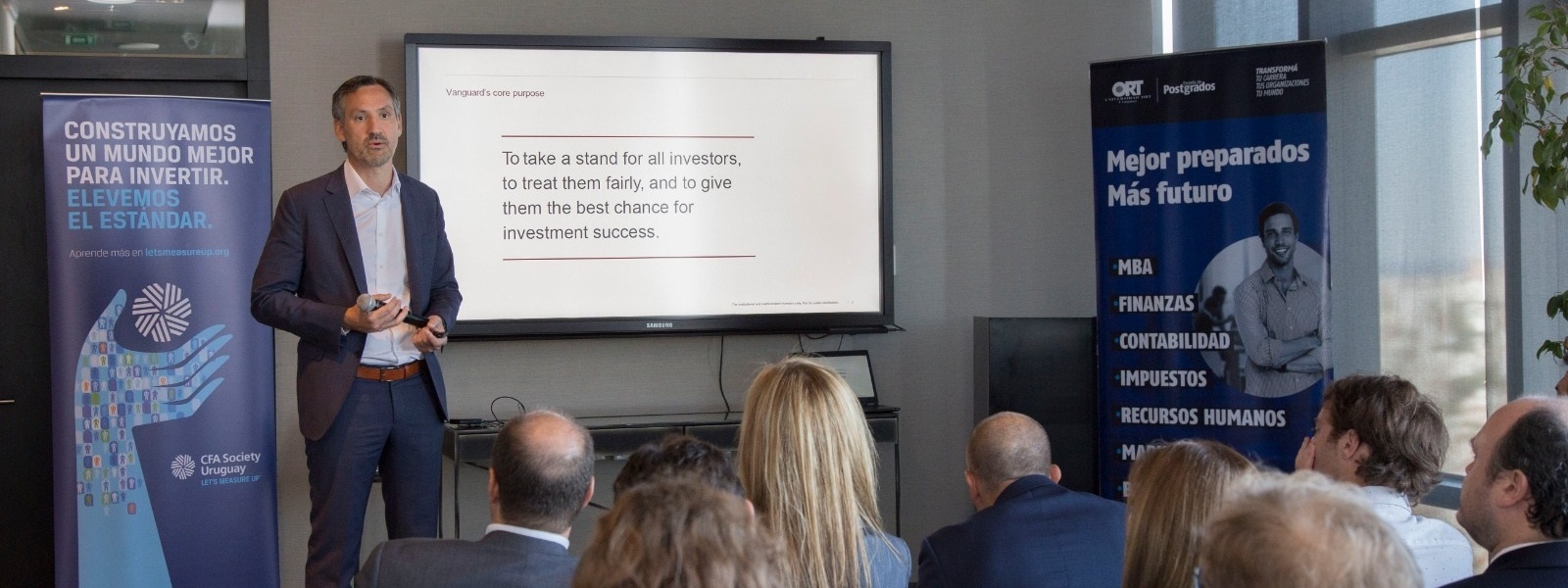
Vanguard is the world's largest mutual fund company, currently managing approximately $5.9 trillion. In Mexico, the firm's Country Head is Juan Hernández, a graduate of ORT's Specialization Diploma in Finance. In mid-December, the executive gave a talk at Piso 40 in the WTC, at the invitation of the university and the CFA Society Uruguay.
“Active or Passive Management?” was the title of Hernández’s lecture, in which he discussed a topic that is revolutionizing the world of investing due to its low cost: exchange-traded funds (ETFs). The event took place on December 10, 2019, and was part of the Management and Business Lecture Series organized by ORT’s Graduate School of Business.
In fact, Vanguard is a company that has built its success on passive investing—it is now the world’s second-largest provider of ETFs—since, unlike active investing, it seeks to track market indices rather than select individual assets.
“People are switching from more expensive funds to cheaper ones,” Hernández explained. The decision, he added, isn’t about choosing between active and passive management, but between high and low costs.
According to Vanguard’s Country Head in Mexico, the past 20 years have not been good for active management, where “for one person to gain more, someone else has to lose.”
“There are many highly capable people constantly monitoring the financial markets. They are always making decisions about stock prices. That’s why, while it is possible to generate alpha (return on a financial asset) in the market, it’s harder than it used to be,” said the graduate of the Specialization Diploma in Finance program at Universidad ORT Uruguay.
This happens because investors in an index will earn returns based on the average of the industry that the index represents; some returns will be above that average and others below it, making it impossible for everyone to earn returns above the average, as that would cause the index to rise.
For Hernández, the key to adopting an active management approach is due diligence. One must be cautious about costs and the manager’s capabilities, and it is vital not to be swayed by myths such as the idea that active management is more successful in bear markets.
The expert predicted that the ETF industry will continue to grow in the near future and that the trend toward investing in lower-cost vehicles—and, as a result, higher returns—will continue.
Vanguard has generated the highest inflows of the current decade thanks to its unique client-focused model, which aims to pass on all economies of scale to investors by leveraging large volumes to achieve lower costs.
“What is the most powerful predictor of alpha? Costs,”Hernández concluded, which is why a balance between low-cost and high-cost strategies is necessary.