The Chair of Multimedia and Digital Arts at the School of Design and the José Pedro Varela Pedagogical Museum invite you to the exhibition “Pedagomedia: Technology in Connection with Museums.”
This is an artistic project utilizing cutting-edge technology in an educational setting, carried out by students in the Bachelor’s Degree in Multimedia Design as part of the Digital Art Workshop 2 course, taught by Fabián Barros, academic coordinator of the Bachelor’s Degree in Design, Art, and Technology.
It was the museum that approached ORT so that the multimedia design students could work on its cultural collection.
The first phase involved the “Digital Territory” project, which consisted of conceptualizing and experimenting with digital images based on a survey of the museum’s immediate surroundings. The second phase featured the collaborative work “Virtual Territory,” a group activity conducted in class under the guidance of teachers Fabián Barros and Federico Márquez. The third phase included guided tours led by Elizabeth Brites, a teacher at the Pedagogical Museum. “Based on this survey, the students divided into groups to work on concepts and experiment with content until they arrived at their final proposals. All these stages included various opportunities for presentation and evaluation in class, where the projects were refined through discussions with the students,” explained Barros.
When asked about the importance of collaborative work, Barros stated: “While this experience is part of a course focused on the creation of digital artworks, the application of a methodological process based on individual, group, and collaborative projects with specific goals is essential for the professional success of future graduates.”
In an era where the paradigm of multidisciplinarity, self-directed learning, and collaborative work shapes the way we think about and carry out our professional practice, learning together through hands-on experience becomes an invaluable educational tool for both teachers and students.
Finally, the professor of Multimedia and Digital Arts emphasized the importance of collaborating with an institution like the José Pedro Varela Pedagogical Museum “on a real-world project that will be on public display.”
It was a major challenge that both students and teachers tackled with dedication, commitment, and a sense of responsibility. It gave us the chance to work on curriculum content while also broadening our horizons and deepening our knowledge of new areas, such as the history of education in our country. In short, it was an opportunity for professional growth for everyone.
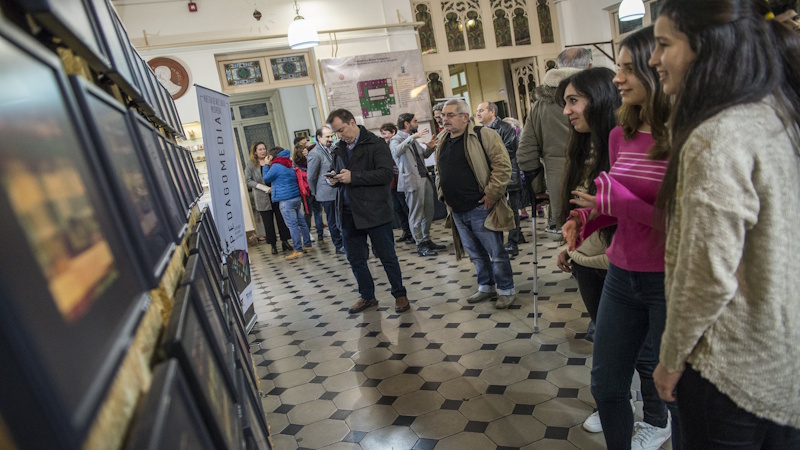
Works by Pedagomedia
Digital Space
Video installation - Group exhibition
Reflection on the museum’s immediate surroundings through the classification, conceptualization, synthesis, and manipulation of collected images. The objective was to explore the concept of “territory,” approaching the museum from the perspective of its immediate surroundings: from the outside in. A five-block radius centered on Plaza Cagancha was defined. The students collected images and explored concepts that were later reinterpreted artistically, experimenting with digital tools for algorithmic representation, animation, interaction, and distortion.
Virtual territory
Sculpture for Virtual Reality - Group Exhibition
Building on the concepts identified in the previous project, the students worked alongside instructor Federico Márquez. In this case, the project involves a sculpture designed for immersive environments (i.e., virtual reality) using Google’s Blocks platform and programmed in the Unreal Engine environment to be viewed on smartphones with virtual reality headsets. It will be the first virtual sculpture exhibited in a museum in our country.
Vitreaux Varela
Interactive installation - Group work (Romina Melián, Sofía Peralta, Sabina Correa)
The goal was to explore the significance of José Pedro Varela and his contribution to education in Uruguay through an interactive installation where participants could engage with various objects and view animated content.
Habitat
Interactive video mapping - Group project (Micaela Llovera, Matías Deangel, Valentina Álvarez)
Using animal skeletons from the museum's collection, a series of interactive video presentations was developed to showcase the characteristics and habitats of these animals.
A Look Back
Video Installation - Group Work (Mauricio De Castro, Nicolás Muscio, Ramiro Villarreal)
The goal is to recreate a specific moment in the museum’s history by projecting silhouettes of students from the girls’ boarding school that once operated in the building. The idea is based on the story of how the girls would sneak out at night via a staircase in the building.
Throwback
Interactive Application - Group Project (Maite Espinosa, Juan Demicheli)
Based on a survey of items in the museum's collection, the students developed a multimedia application that traces the evolution of photography.
The Evolution of Education
Multimedia installation - Group work (Emiliano Silva, Dan Bzurovski, Francisco Butteri)
The goal of the project is to illustrate the evolution of education in Uruguay. To this end, a spatial installation was created featuring three stations that mark the different periods through which education in our country has evolved (the pre-Varela, post-Varela, and current periods). At these stations, participants will be able to view multimedia content in a specially designed environment using materials from the museum’s collection.