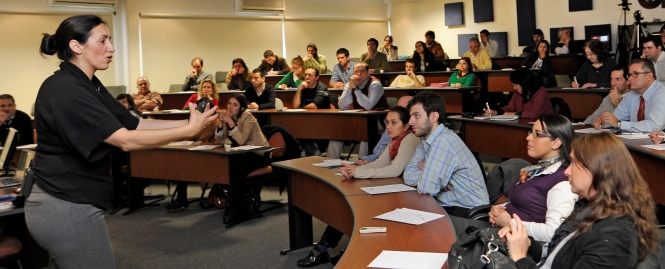
One of the latest trends is the use of a design-oriented approach in developing business strategies. With a practical approach and clear examples, Dr. Leticia Britos of Stanford University, a visiting professor in the Master’s in Technology Business Management (MGET) program at the School of Business and Social Sciences, demonstrated the application of this methodology to students and graduates at the conference “Innovation: Big Ideas, Small Experiments” at Universidad ORT Uruguay July 4, 2013.
Britos studied biology in Uruguay and holds a Ph.D. in Developmental Biology from Stanford University. However, for years he has been dedicated to innovation and applied creativity, which, he explains, can be applied in a variety of fields.
As director of the National Center for Engineering Pathways to Innovation (Epicenter), Britos says her goal is to bring training in innovation, creativity, and entrepreneurship to all engineers in the United States. There are approximately 500,000 of them spread across 350 engineering schools. In addition, Stanford is working to develop “design thinking” in all its aspects. “The idea is to attract students from all disciplines so that together they can learn a common language for defining and solving problems.”
During the talk, Britos emphasized the roles that are necessary within a company to foster a culture of innovation. These roles are outlined in the book *The Ten Faces of Innovation* by business consultant Tom Kelley.
Anthropologist, experimenter, catalyst, collaborator, trailblazer, director, experience architect, stage designer, storyteller, caretaker: these are some of the key roles needed in a company to foster an environment where innovation can thrive.
“Design thinking is also known as human-centered design,” Britos emphasizes, citing the example of Walt Disney, who, while building his park, would walk through it and crouch down to get to the eye level of a child—his target audience. “Empathy is the cornerstone of this process,” he states, adding: “Opportunities for innovation lie not only in seeing the solutions, but in thinking through and rethinking the problem. All problems are opportunities; the bigger the problem, the greater the opportunities.”
The professor pointed out that academic education generally focuses on analytical thinking rather than creativity or innovation. The generation of ideas is not encouraged, even though “we all have the ability to shape the future.”
“Creativity can be fostered, and that’s what we do at the School of Design,” says Britos, adding, “It takes effort, and you have to practice it.”
“How do we spark the imagination?” the professor asked. One way to do this, she said, is to ask yourself, “What would happen if I did such-and-such?” Britos also referred to another stage of the design process: developing and refining ideas. She explained that it’s important to create many prototypes and test the different aspects of an idea. This is what, for example, Stanford students did when they wanted to improve the experience of going through airport security. They went to San Francisco Airport, experimented, and spoke with passengers. And then they created new ways to make that experience more enjoyable.
“Failure and taking risks aren’t stigmatized. It’s something people talk about with pride in Silicon Valley,” says Britos, who believes it’s best to make mistakes as often and as early as possible before investing too many resources in an idea.
He says that innovators must constantly seek out problems in order to identify opportunities and move on to experimentation. “Always learning” and “thinking about how I can contribute to a culture of innovation” are key, along with a tolerance for risk, failure, and uncertainty.
Britos is the director of Epicenter (National Center for Engineering Pathways to Innovation), a center operated by programme Stanford Technology Ventures programme; she is an adjunct professor in the Department of Mechanical Engineering at Stanford University’s School of Engineering and teaches the course “Creativity and Innovation” at the Hasso Plattner Institute of Design. As a co-founder of the consulting firm Lime Design Associates, she has advised companies such as Google, Microsoft, Oracle, and Citrix on incorporating the design thinking process to foster a culture of innovation.