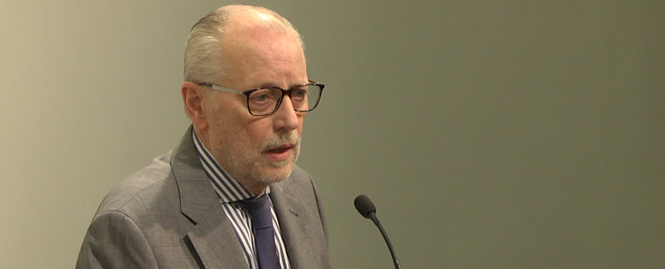
Dr. Juan José Arteaga—Uruguay’s ambassador to Peru from 2008 to 2016—shared his perspective on the political landscape in Peru, just a few weeks before the second round of the election. Arteaga holds a Ph.D. in History and is a professor of Uruguayan Foreign Policy in the Bachelor’s program in International Studies.
The lecture, titled "The Presidential Elections in Peru," took place on Tuesday, May 24, 2016, and was the fourth talk in the annual series organized by the Department of International Studies in the School of Management and Social Sciences.
Peru Then and Now
"I imagine you all remember the famous question posed by Zavalita—the protagonist of Vargas Llosa’s novel *Conversation in the Cathedral*—'At what point did Peru go to hell?'" Arteaga began, noting that, in the past, Peruvians asked themselves the same thing: "At what point did the country slip through our fingers? At what point did failure befall us as a society, as a nation, and as a country?"
The speaker noted that, when he went to Peru, many people still held that outdated view of the country. However, he assured the audience that "today's Peru is very different."
"Economically speaking, Peru is not only a revelation, but also one of the driving forces behind the Latin American economy," he said, noting that the country has experienced—and continues to experience—a period of economic growth despite the region-wide downturn. Furthermore, poverty rates have fallen, while per capita gross domestic product (GDP) and purchasing power have risen.
The former ambassador noted that while the Peruvian economy is doing "very well," it is "detached from politics." Although the country has achieved democratic stability in the current century, his assertion is based on several factors, such as the fragmentation of the political system and the weakness of the parties; these parties lack platforms, there are almost no “permanent parties,” and many politicians do not belong to any particular group.
The runoff election
Arteaga pointed out some unique aspects of the runoff election, which will take place on Sunday, June 5. "It's interesting that neither candidate is what we might call a 'traditional Peruvian.' Both are the children or grandchildren of immigrants," he said, referring to Keiko Fujimori and Pedro Pablo Kuczynski.
She also pointed out that they are not new candidates. Fujimori—the daughter of Peruvian politician and former president Alberto Fujimori—ran in the previous election and lost to Ollanta Humala, while Kuczynski served as Minister of Economy and headed the Council of Ministers during the presidency of Alejandro Toledo Manrique.
"They're definitely neck and neck," Arteaga replied when asked who would win. Although the current outlook favors Fujimori, the percentage of potential blank and invalid votes keeps the outcome uncertain.
The former ambassador quoted Steven Levitsky—a political scientist and Harvard professor specializing in Peru—who argued that the runoff election "is not a conflict between the left and the right." "It is a conflict between the right and the right, with the same economic agenda," he emphasized.
According to Arteaga, there are two key areas in which the candidates differ. While Fujimori’s main weakness is the authoritarian and corrupt legacy of the Fujimori administration, Kuczynski “has been unable to shake the perception that he is a ‘gringo’ technocrat,” a view that does not sit well with the people of the Andean region.
He argued that if Fujimori continues to play up the idea that Kuczynski represents the "Lima elite," he will win. On the other hand, if Kuczynski manages to convince the public that the issue is between Fujimorism and anti-Fujimorism, he could win.
Uruguay and its relationship with Peru
"For a long time, Uruguay looked out toward the Atlantic, with its back turned on its Pacific neighbors," Arteaga stated. However, he said that Peru is an "always important ally" because "it is where one needs to be today," in a region that has become the hub of the regional economy.
He also wished the politician and lawyer Sergio Abreu—who was present at the conference—the best of luck, as he will be traveling to observe the second round of the Peruvian elections in his capacity as head of the Organization of American States (OAS) Observer Mission.
Finally, he expressed his hope that the meeting would help "gain a better understanding" of Peru and called for support for the country—in the form of friendship, aid, and cooperation—since "its growth will also benefit us."
Video:
https://youtu.be/o0pdjB09r5o