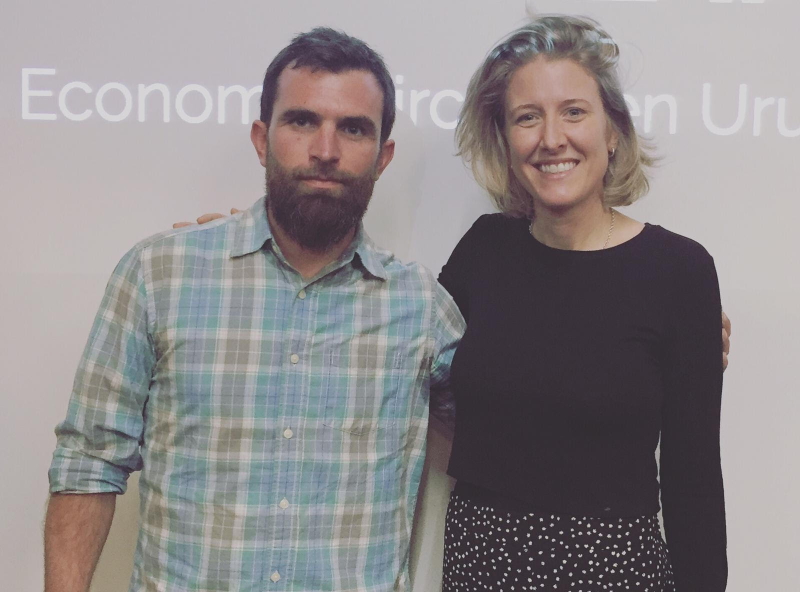
Every summer, Nicole Wyaux spent a few hours a day picking up plastic waste she found along the beach in Piriápolis. She was accompanied by her brother-in-law, Juan Rivero. Even back then, they were concerned about how they could get other vacationers to do the same.
“We began to investigate and realized that financial incentives are always what drive or motivate people to take action, so we decided to create a currency to reward those who recycle and bring in plastic,” explained Wyaux, a graduate of the Bachelor’s program in Industrial Design at Universidad ORT Uruguay.
And so, in early 2019, Plasticoin was launched.
The launch
Once they had fleshed out their idea, Wyaux and Rivero applied to various funding sources and were selected by the National Development Agency (ANDE), where they spent six months undergoing a series of evaluation tests. In late 2019, they were selected and awarded $5,000 to validate their idea.
Finally, January 5 of this year marked the day the Plasticoin project was launched in Piriápolis, the seaside resort where it all began.
“The funding we received from ANDE allowed us to develop the website and some other infrastructure. We had to demonstrate that the business model was viable and that it could work. That’s why we proposed doing it in Piriápolis, because it has a small population and serves as a controlled test case,” said the ORT graduate.
Of the three collection centers operated by the business, two are located in Piriápolis and the third is near a beach in Punta Colorada.
Benefits of Plasticoin
To participate in the project, individuals must be registered on the Plasticoin website.
Next, you can sort the waste at home—which must be clean, dry, and compacted—or you can collect waste from the beach. This waste must be taken to one of the project’s sorting centers so that the plastics can be weighed and the virtual coins credited to the person.
The coins can be redeemed for discounts of up to 50% on yoga classes or Italian pizza, or for buy-one-get-one-free deals on surf lessons or coffee, for example. There are more than 25 participating stores, which can be found on the Plasticoin website, and most of them are located in Piriápolis.
Figures that exceeded expectations
The project received widespread attention and, according to its creator, has been a resounding success so far. “We accomplished in 10 days what we had planned to develop over four months,” said the industrial designer.
Currently, the website has 1,600 registered users nationwide, 300 of whom have participated in a plastic exchange—that is, they have brought plastic to one of the three collection centers and used the currency.
“Those 300 people have brought us more than a ton and a half of plastic, and 800 kilograms of PET plastic have already been sorted and delivered to a recycling facility in Pan de Azúcar,” said Wyaux.
A project that is expanding
The project's success has sparked interest from other departments, which also intend to implement it. This is the case in Montevideo and the rest of Maldonado.
“The idea is to start with a two-month pilot program. In this case, the operation would differ from that in Piriápolis, given that the population and the volume of plastic waste generated in both departments are much higher than in the resort town, which would cause the collection centers to become overwhelmed,” said the graduate.
For that reason, they will initially start by operating at specific locations or events in Montevideo and Maldonado, such as neighborhood fairs or parks. There, they would set up a kind of mobile collection center where people could bring their waste on a particular day. “That collection center would move to different locations every week. That is the pilot program we are working on in both departments,” said the creator of Plasticoin.
In addition, efforts are being made to increase the number of participating businesses where customers can redeem their rewards, as most of them are currently located in Piriápolis.
“The goal of the project is to encourage everyone to make recycling a habit and to promote beach cleanup, as well as household waste sorting,” Wyaux concluded.