From a low-cost prosthetic system for animals to street furniture made from recycled materials, here is an overview of the Integrative Project – ReCreación17 in the field of industrial design.
Homeless Animals
Pablo Fandiño, a student in theIndustrial Design program, collaborated with Animales Sin Hogar (ASH) with the goal of improving the quality of life for dogs that are missing a limb.
To that end, using Coco—a stray dog from ASH—as a case study, he developed a system of universal prosthetics—3D-printed and featuring a tennis ball as a cushion.

Since one of ASH’s main challenges is funding—as the organization does not receive government support—Fandiño had to make this prosthetic system accessible.
During his presentation, he noted that in Spain it can cost up to 750 euros. His project, on the other hand, costs $16 a pair.
Plastic Sheets Uruguay
“Throughout my career, what has interested me most is creating designs that are innovative, functional, and, most importantly, environmentally friendly,” Natalia Burjel explained in her presentation.
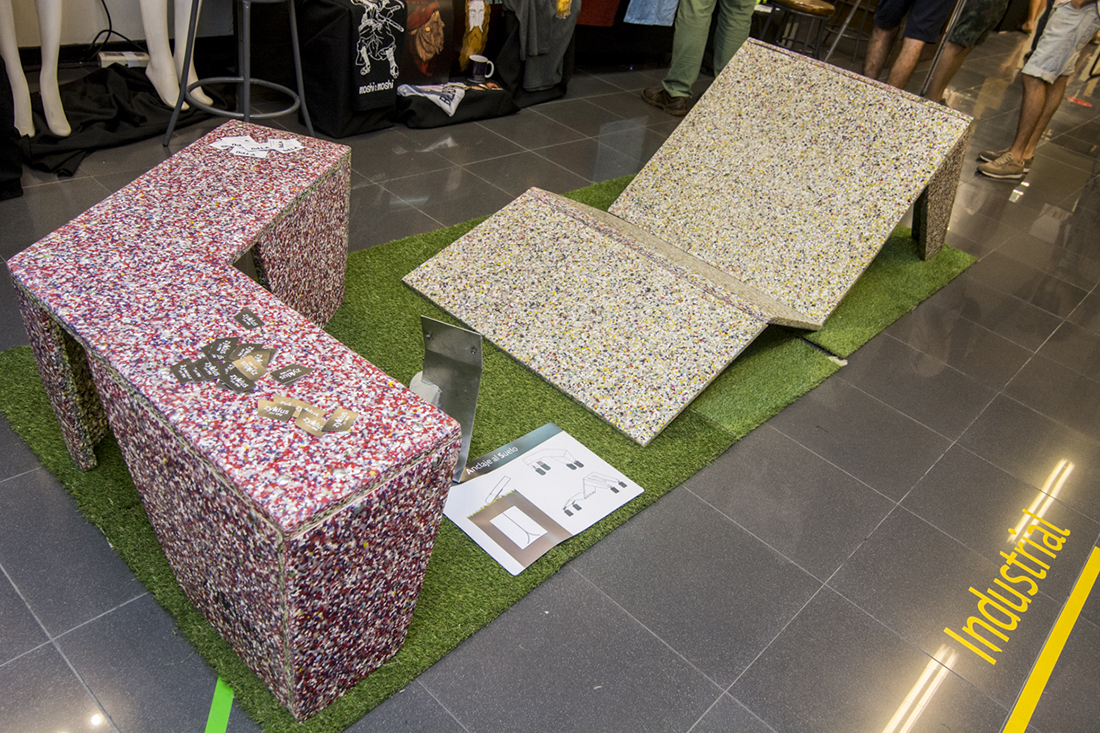
The student worked with Rotoplast - TPU (Tableros Plásticos Uruguay), a company that recycles plastic materials obtained from household and industrial packaging waste.
“Every day, we use and discard products that pollute the environment. Plastic is here to stay. TPU is a company that has decided to take action to prevent further damage by using plastic waste as a raw material.”
That’s how Zyklus came to be: various pieces of recycled plastic that are combined to create urban furniture for public use.
Sámago
“I’m going to present the project I’ve been working on for the past six months. I chose the furniture design and development company, Sámago,” student Clarisa Bielawski began.
Sámagooperates at the intersection of manual labor and computer numerical control technology.
“This technology gives her designs and products a certain distinctive aesthetic that sets them apart from traditional woodworking,” the designer explained.
He added that, after conducting an in-depth analysis of the company—its needs, its target audience, and its production capacity—he worked on designing a line of furniture aimed at a young audience. He noted that certain key concepts were taken into account: design, multifunctionality, and space optimization. He then created Necto.
“Two products were designed: an extendable coffee table and a stackable bench that can serve as a seat, a footrest, or an auxiliary surface. The idea is for them to be versatile and usable in a variety of situations.”