The film industry in Uruguay has grown exponentially over the past 10 years, but what challenges does documentary production face in this ecosystem?
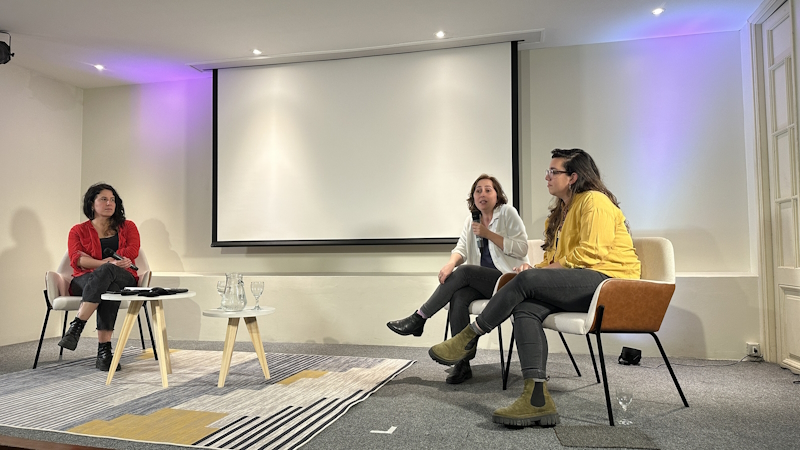
Based on the case study of El retrato de mi padre —a personal documentary by director Juan Ignacio Fernández Hoppe, which premiered in theaters on October 5—producer, director, and professor Carolina Campo Lupospoke with Valentina Baracco, also a producer and director of documentaries in our country. Both reflected on the difficulties faced with this type of production, but also on the advantages and opportunities they present. The discussion was moderated by professor Micaela Domínguez Prost.
https://www.youtube.com/watch?v=HZPfmupLOSQ
“When you embark on a documentary project, there are moments of great uncertainty,” said Carolina Campo Lupo, the documentary’s producer. “You have to ask yourself who you’re going to partner with on this project—one that will be long, difficult, and expensive—and consider whether that person is the right fit to be a partner for many years to come.”
Valentina Baracco, who directed her debut feature film *Ese soplo* this year, said that over the course of her life she has crossed paths with many first-time filmmakers, made films, and, in the process, reaffirmed what she loves to do—what she is passionate about.
People already see you as someone who makes a certain kind of personal documentary, so someone comes up to you and says, “I have this idea,” but it’s difficult because there are so many ideas, and not all of them are projects or films. I think that as producers, we have a knack for listening to someone else’s idea and being able to say, “Maybe you need to do more research for this to become a project.” It’s also up to you to figure out if a very small idea can turn into a project you’d want to take on.
Valentina Baracco
https://www.youtube.com/watch?v=gR_JVjwKuKI