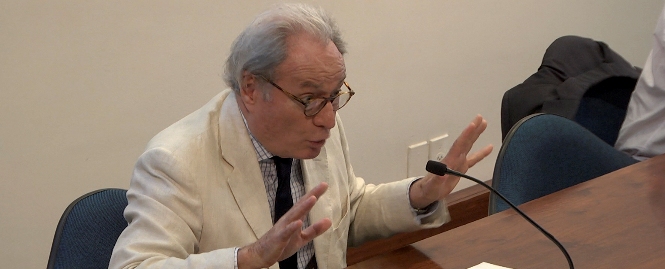
The conference “Backtracking: What Can Be Undone in Trade Agreements? Trump, Brexit, and More” took place on Thursday, March 9, 2017, at the School of Management and Social Sciences and was organized by theBachelor’s Program in Economics and the Bachelor’s Program in International Studies. It was led by Juan Labraga, a professor of International Trade, and Dr. Agustín Espinosa, a professor of Diplomatic Law and International Institutions.
International trade
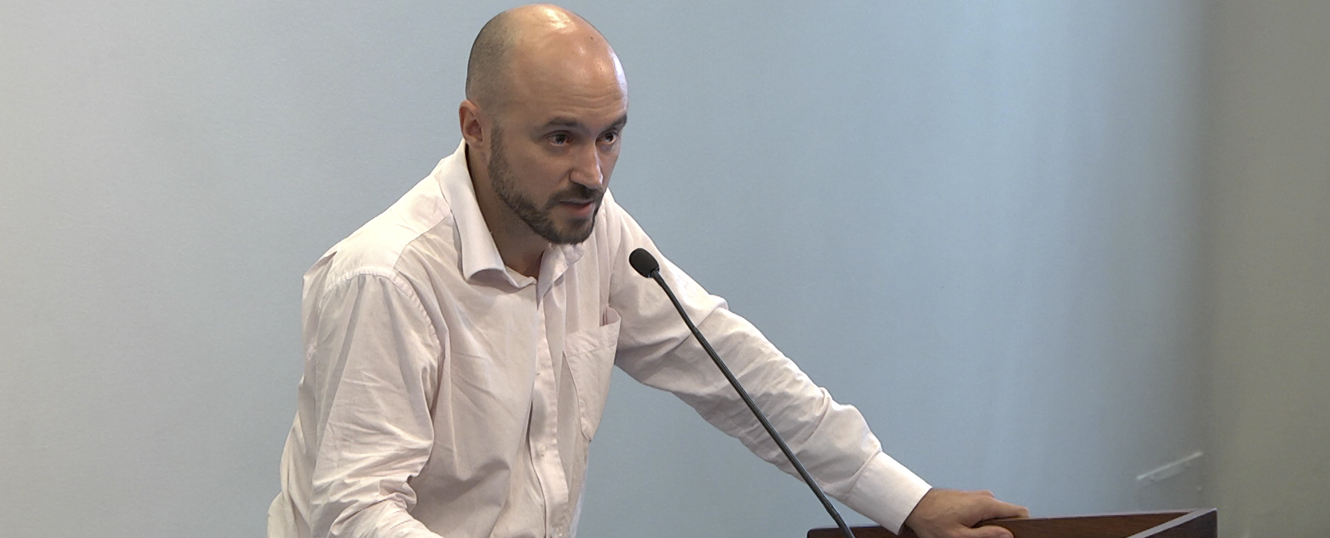
According to Labraga, in the 20th century, international trade consisted of “goods crossing customs borders.” In the 21st century, in addition to goods, services also cross borders.
“The design of the garment we’re all wearing was likely created in one country and manufactured in another. That’s a service embedded within a product, and a technological shift has made that possible,” Labraga explained.
He also noted that this process is linked to the decision of where to locate each stage of production. “We have to stop thinking simply in terms of goods or services crossing the border. Companies and service providers also move based on their decisions to locate or relocate,” the professor added.
The global context
According to data from the International Monetary Fund, during the second half of the 20th century, 70% of global Gross Domestic Product (GDP) was generated by the United States, the European Union, and Japan. In contrast, in the 21st century, these countries account for approximately 50% of global GDP, while the rest of the world has grown to account for the other 50%.
In recent years, with the revolution in information and communication technologies (ICT), commercial services have expanded. In other words, many tasks can now be performed remotely via the Internet. However, the core of international trade remains the trade in goods.
“The rules of the game are changing in various areas. And the trend is toward more and more matters being handled electronically,” Labraga said. This leads to problems such as unemployment and, in some cases, discontent with globalization.
What can you expect?
Labraga believes it is unlikely that countries will shut themselves off from technological change. He therefore asserted that the same protectionist policies of the past will only lead to a small-scale relocation of industries—once again toward developed countries. “Policies are reversible; I can raise tariffs, I can renegotiate agreements, but the Internet is the underlying phenomenon: it remains a constant force, it is there, and I do not see it as reversible,” the professor concluded.
Venezuela's Current Status in Mercosur
“The Mercosur Council is currently meeting in Buenos Aires to discuss the Mercosur agenda, but the focus has surely been on relations with Venezuela,” said Professor Agustín Espinosa.
He explained that this country signed the protocol of accession to Mercosur in 2006, but has been a Member State since August 2012. Its rights have been suspended since December 12, 2016. In light of this situation, its withdrawal as a Member State has been initiated. This means it would cease to be a member of Mercosur in that capacity and would revert to being an Associate State or whatever status is determined at that time.
Possible Exit from Venezuela
A legal panel has been appointed to address the situation in Venezuela. However, the country may not wait for the outcome and may decide to expel Venezuela. According to Espinosa, this could happen at any moment.
“That brings us straight to the potential commercial implications. And there we encounter something we are all familiar with: the volume and significance of trade between Venezuela and its other partners,” Espinosa said.
The possibility of Venezuela withdrawing from the agreement under the Treaty of Asunción would have significant consequences. In the case of our country, these consequences would be particularly felt in the dairy sector. “Last year, it became Uruguay’s largest buyer of dairy products,” Espinosa said.
The professor referred to Chile and Venezuela’s withdrawal from the Andean Community of Nations (CAN). “The withdrawal of some countries from integration processes already occurred last year. This is nothing new for Latin America,” he noted. “They exercised the same rights, and nothing happened. The countries continued to maintain very strong political, economic, and diplomatic relations. This does not have the magnitude of Brexit.”
However, Espinosa believes that a member state’s withdrawal from the process is a negative development. “I believe that being part of Mercosur, even with all its current shortcomings and weaknesses, is a positive thing for Venezuela, and that fulfilling commitments is good for everyone,” he concluded.
Video of the event:
<iframe width="560" height="315" src="https://www.youtube.com/embed/pawqRIhDdrc?si=1xjdQbrGMRYgAcuh" title="YouTube video player" frameborder="0" allow="accelerometer; autoplay; clipboard-write; encrypted-media; gyroscope; picture-in-picture; web-share" referrerpolicy="strict-origin-when-cross-origin" allowfullscreen></iframe>