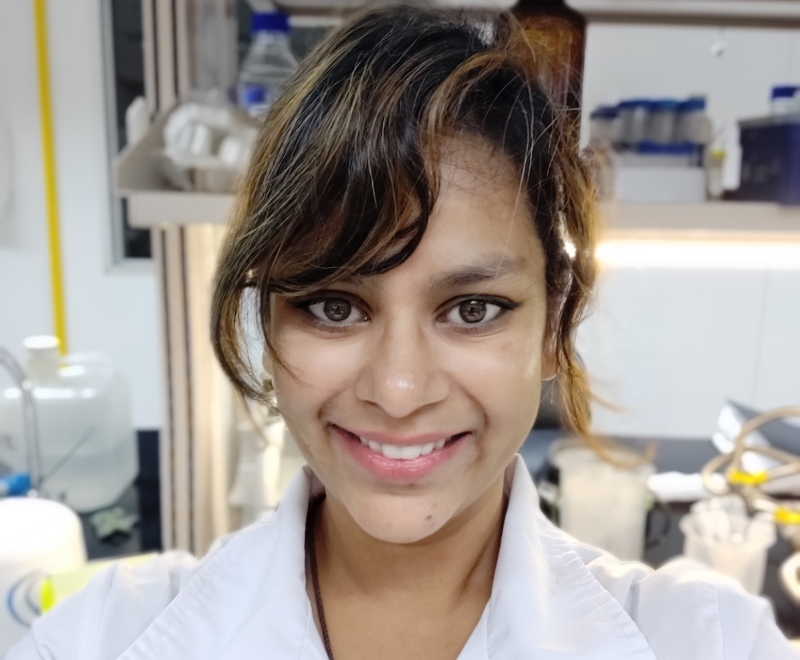
Her last name makes her blend into the background, but her accent does not. Correa is of Indigenous descent and arrived in Uruguay in 2014 without knowing a single word of Spanish. But language was never a barrier; her passion for science—and, in part, love—has taken her to different parts of the world.
After earning her Bachelor of Science degree from the University of Mumbai in India, she completed a Master’s in Clinical Research at Cranfield University in England. When she began looking for opportunities to advance her academic career, doctoral programs in the United States emerged as a very appealing option. However, her Uruguayan boyfriend, Alejandro—whom she met in Rome—put her in touch with the Department of Biotechnology at Universidad ORT Uruguay explore other options.
It was the extensive career of Lorena Betancor, a professor of Protein Technology at ORT and the woman who would become his doctoral advisor, that prompted Correa to come to our country. With Betancor’s help, Correa began his studies toward a Ph.D. in Chemistry through the Pedeciba program, and a year later he joined the Biotechnology Laboratory at ORT as a research teaching assistant.
The research
Correa’s doctoral research focused on using biotechnology to develop a solution capable of destroying tumor cells in humans without affecting healthy cells—unlike treatments such as chemotherapy, for example. To achieve this, he used the concept of direct enzymatic therapy, which involves using enzymes not found in our bodies to convert harmless molecules into ones with antitumor activity. These enzymes were integrated into what Correa defines as a nanohybrid.
“A nanohybrid is a structure composed of different materials; in our case, a nanoparticle coated with a layer containing an enzyme, as well as silica and magnetic materials. Enzymes have great potential, but at our body’s normal temperature of 37°C, some do not function optimally; to activate them, the temperature must reach 42°C. To achieve this, we can raise the ambient temperature using the magnetic nanoparticles, which, because they are confined in a small space, generate heat as they move. Once the enzyme reaches the necessary temperature, the prodrug is injected, allowing the enzyme to react and kill the tumor cells,” explains Correa.
As part of his doctoral thesis, the research demonstrated that it is possible to integrate the enzyme into the nanohybrid and activate it remotely to make it function. It remains to be demonstrated that the nanodevice works in vivo.
As the scientist explains, once the tumor is located, the nanohybrid would be injected, followed by the prodrug, and finally, hyperthermia (a rise in temperature) would need to be applied for the nanohybrid to be effective. “It’s a solution that avoids killing healthy cells and also doesn’t require surgery; it can be done simply with injections,” she adds. Precisely because it involves injections, the research was designed for solid tumors, primarily in the trunk area.
When asked about the novelty of this technique, Correa notes that several elements are already being implemented today. Magnetic nanoparticles, for example, are administered intravenously to destroy the tumor using heat. However, according to the new Ph.D. in Chemistry, the heat is not generated solely in the tumor cells, so it can also affect healthy cells.
In addition, research is also underway on combining the prodrug with the enzyme. However, since the enzyme is water-soluble, this is not a viable option for organs such as the stomach, where the acid causes the enzyme to break down immediately.
“With the help of my mentors Lorena and Valeria, I combined various techniques to create a new one. That’s how the nanohybrid came about,” explains Correa.
Future
The committee evaluating Correa's thesis not only awarded her the highest grade but also noted that her research holds great promise for the future. As a result, the scientist's next destination is Spain.
“Now I’m working remotely with Lorena and closely with Valeria at the Aragón Institute of Materials Science. Magnetic heating equipment isn’t very common in laboratories yet, which is why I can’t perform hyperthermia in Uruguay,” says Correa. The goal in Europe is to move away from working with cells in vitro and begin applying the research to 3D cell cultures or mice.
When asked how she sees herself in the future, Correa says she is someone who always has a lot of plans. “Right now, what I’d like most is to focus on clinical research and also continue teaching, as I did at ORT,” she concludes.