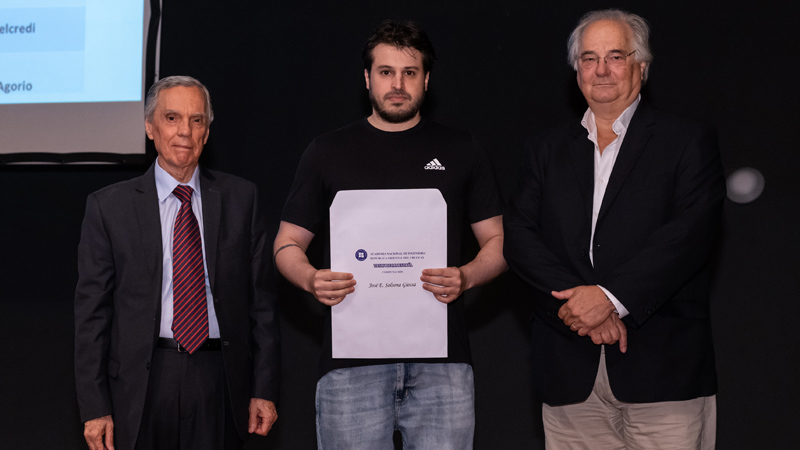
The following projects were awarded prizes:
In the Systems category, first place went to "Fabularis: Generating Controls Using Brain-Computer Interface Technology," a project carried out by Diego Klappenbach, Mauricio Pastorino, and Juan Ignacio Ruíz, under the supervision of Mariel Feder, M.A.
The project involved developing a solution for the client NaxonLabs, a company that works with assistive technologies for people with disabilities, specifically those integrated with electroencephalography. The client’s main product is “Explorer,” a neural data collector that uses crown-shaped hardware to capture and graph a patient’s brain waves in real time. The project involved building an application that detects the voluntary activity of the person wearing the headband and translates these actions into words using a text-to-speech synthesizer or executes predefined actions within the system.
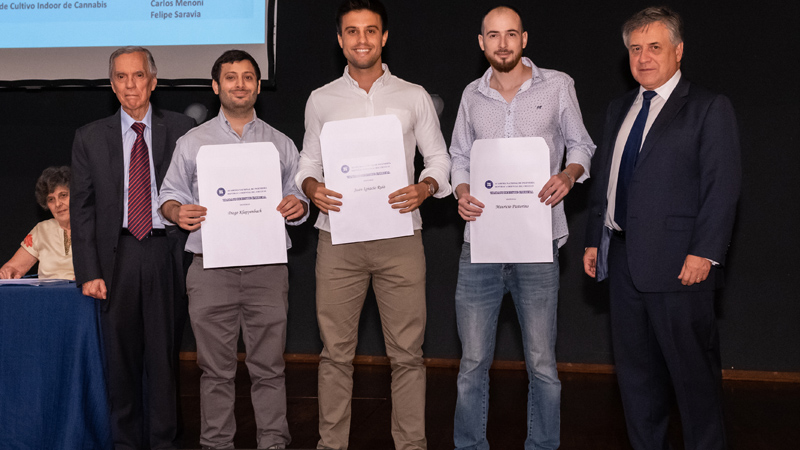
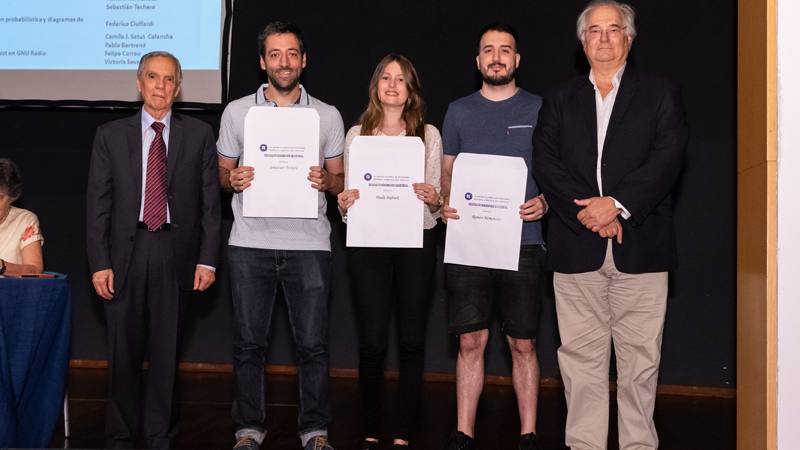
Meanwhile, in the same category, the Reclutech project —a technical testing platform for developers created by Paula Dufour, Ramiro Hernández, and Sebastián Techera, under the guidance of Pablo Hernández—received an honorable mention.
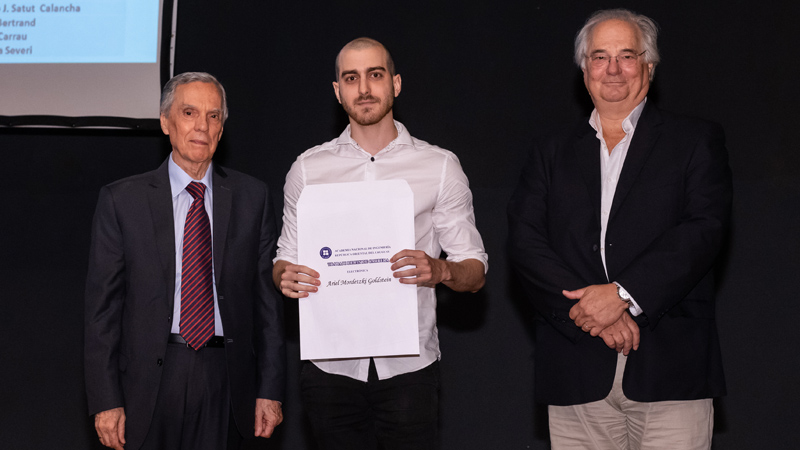
In the field of Electronics, the award went to Ariel Mordetzki’s project “Solving Systems of Equations with Quantum Computing,” supervised by Dr. André Fonseca and Dr. Efrain Buksman.
José Solsona’s master’s thesis, titled “On the Specification and Verification of the PCR Parallel Programming Pattern in TLA+,” won first place in the Postgraduate Thesis in Computer Science category. The project was supervised by Dr. Alvaro Tasistro and Dr. Sergio Yovine.