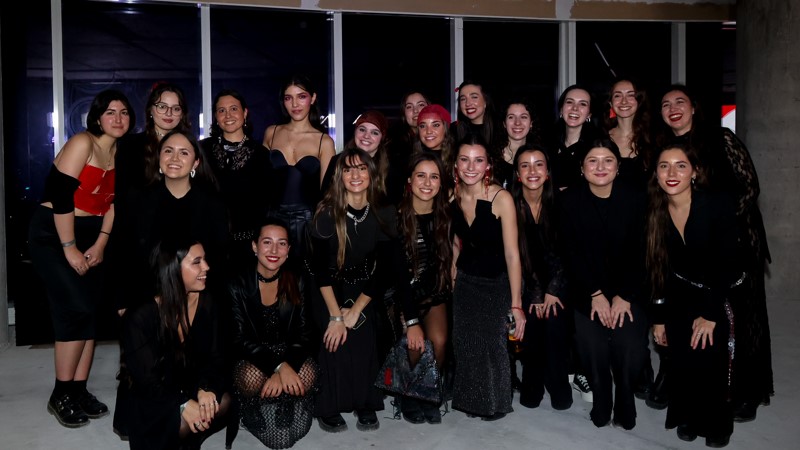
The fashion show took place on the 21st floor, with the theme "The Rhythm of Time," following the students' work during their seventh semester of the Bachelor of Fashion Design program.
“The theme was conceived around the idea that we never have time for anything, that we’re always rushing around, and how time affects us,” said Prof. Magdalena Vilaró, one of the instructors teaching the course and who helped put together the collections.
This collection gave rise to five sub-collections: Morphogenesis, Astro, Inevitable, Antagonistic, and Crystal. All of them featured red, the key color of the evening, which was reflected in the models’ makeup and in many of their most striking outfits.
Two hundred people were invited to the event, including influencers, fashion designers, undergraduate students and graduates, faculty members from the School of Design, and the students’ friends and family.
Guests were greeted by an underground, minimalist setting, featuring a runway that wound its way through the space in zigzags and circles, eschewing the traditional straight runway where models stop and pose. The seating, made from bottle crates, formed small islands lining the runway.
The fashion show featured music by DJ Joaquín Gamborena, who played an electronic soundtrack with sounds that varied to represent each collection, such as surgical instruments, interstellar sounds, violins, camera shutters, breaking glass, and heartbeats.
The event featured the participation of professors Magdalena Vilaró and Ana Darracq, who taught the course, as well as the program’s academic coordinator, D. Ind. TyM Mariana Muzi. Also contributing were Brazilian stylist and ORT visiting professor Lucius Vilar, and Brazilian professor Carol García.
Morphogenesis
By: Valentina Acuña, Guillermina Bauzán, Sofía González, and Victoria Isi.
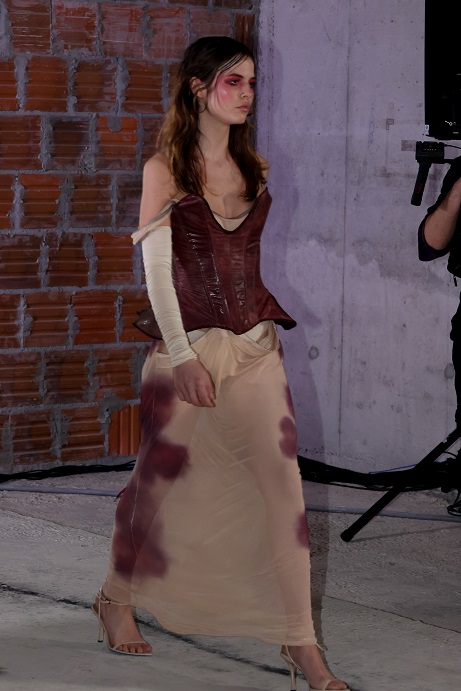
The first collection to hit the runway was Morfogénesis, which used color and materials to convey the desire to stop time and preserve youth through plastic surgery or other cosmetic treatments.
According to a paper written by the students for the course, “the hand of man reaches into his own body, using his own body, through procedures that alter facial features, plump lips, and sculpt figures in accordance with shifting ideals.” These ideals, in turn, are dictated by the market.
The colors that dominated the collection were light beiges, representing skin tone, along with purples, reds, and browns, which symbolized the bruises resulting from surgical procedures performed to achieve that ideal of beauty. The stylistic elements that characterized the collection were sheer fabrics and latex.
Astro
By: María Victoria Barceló, María Eugenia Castillo, Valentina Levy, and Lucía Mier.
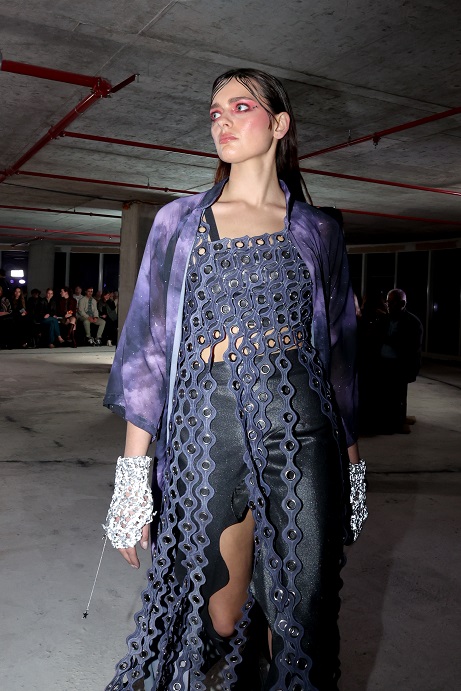
The second collection to be showcased on the runway reflected time from an astrological perspective.
“We explored this desire to understand what the future holds from an astrological perspective—based on what’s happening in the cosmos—and how it affects us,” Vilaró explained about the collection.
The students used a trichromatic color scheme dominated by cool colors, such as blue and gray, along with yellow as a warm color. They also incorporated gold and silver accents to create a “brighter finish,” according to a report written by the students. All of these colors represented the stars and the universe.
Inevitable
By: Tatiana Bacci, Costanza Di Perna, Carla Dorrego, and Melissa Martínez.
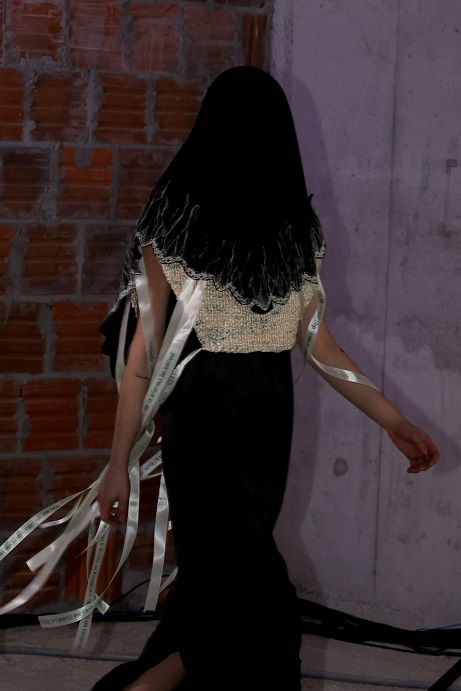
This collection stood out for featuring adult models, with the aim of bringing the issue of ageism—or age-based discrimination—to the forefront. Specifically, the students sought to reflect the struggle of adult women to accept their age and dress as they please, despite society’s judgment.
“It focuses on adult women, who, supposedly because of their age, should no longer dress in a certain way or engage in certain activities because they are no longer young enough to do so,” said Vilaró. In that regard, she added: “The concept of ageism in this case involves framing women within a particular social consciousness associated with that age.”
In response to this issue, the students from Inevitable posed the following questions in their written work: “Why does she long for a past that is gone and fear a future that is yet to come? Why let herself be diminished, if growing older is a relief? How true is the phrase ‘you’re too old for that’? What if all the constraints we have in our minds are just illusions?”
A variety of colors were used: black, brown, blue, red, yellow, cyan, pink, and shades of white, rendered in a gradient to depict a “gradual” liberation from the “darkest repression” to the “most joyful and expressive expression,” in which the woman embraces her age.
This collection also features reimagined tailoring and modern takes on classic embellishments.
Antagonistic
By: Maru Berro, Sol Corsino, Victoria Giménez, Valentina González, and Julieta Machado.
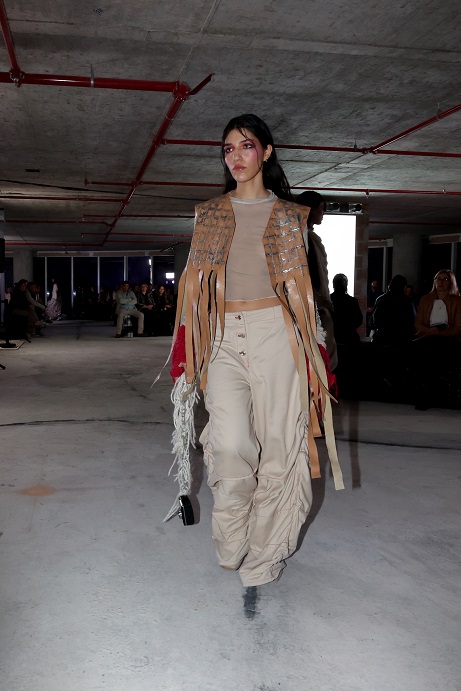
The theme of Antagónico was the way time is portrayed in photographs, as the designers summarize in a written piece. On the one hand, there are analog photos “stored on a shelf,” which can be “touched” and “transport us to past memories.” On the other hand, there are digital photos, which are “endless” and “lost in the cloud.”
This contrast is also evident in the color palette of the collection’s garments: while the analog aesthetic was reflected in shades of beige, brown, and sepia, the digital aesthetic was expressed in brighter colors, such as red and silver.
This collection was also characterized by a blend of natural and synthetic materials.
Glass
By: Sabrina Hernández, Maite Pallas, Emilia Macri, and Gala Vila.
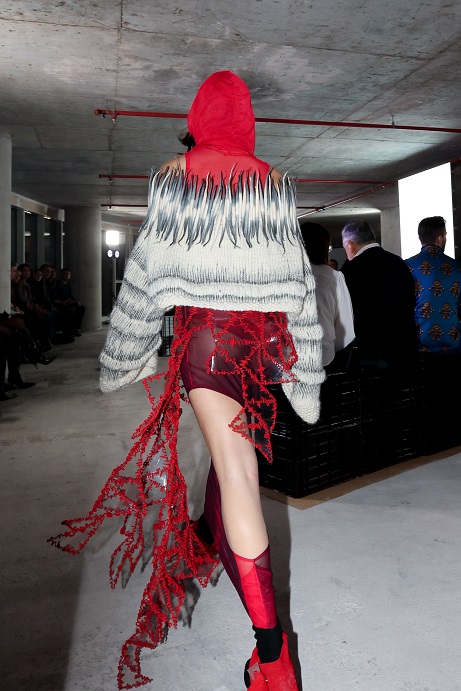
The final collection of the evening was "Cristal," a series of outfits that alluded to the much-criticized "crystal generation"—the very generation to which the students belong.
“A generation that was sheltered—raised so they wouldn’t suffer—and sometimes lacking the tools to cope with life’s difficulties,” Vilaró explained.
The colors that stood out most in the collection were red, blue, and dark gray, while the signature elements were interlocking triangles and pointed details.
This event gave the students an opportunity to explore a theme through five collections, each focusing on a different aspect of that theme. This involved considering the design, fabrics, and colors of the garments, as well as the venue’s ambiance, the music, the runway format, and the makeup.