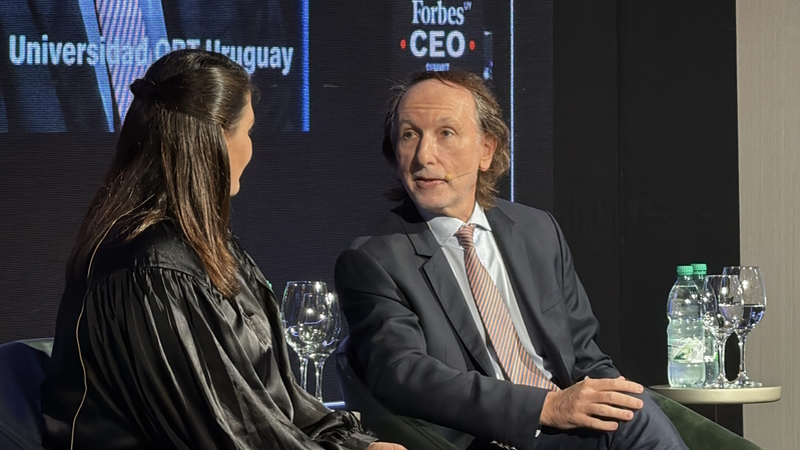
During the interview conducted by María Noel Durán, editor of Forbes Uruguay, which took place on November 27 as part of the Forbes CEO Summit, the rector addressed pressing issues such as the impact of artificial intelligence and distance learning.
Educational Challenges: From the Classroom to the Future of High Tech
"The biggest challenge is adapting to each new situation," said Dr. Grünberg. He recalled how the pandemic forced educational institutions to reinvent themselves in just a few weeks. "The uncertainty was enormous, but ORT teachers managed to learn new teaching methods from scratch," he noted.
Today, artificial intelligence raises new questions about traditional practices such as writing and research. According to the rector, “we must rethink our teaching and assessment systems to cross the educational frontiers that lie ahead.”
The rector emphasized the need for Uruguay to position itself as a high-tech country. "Collaboration between governments, businesses, and universities is key, but currently that engine of development is not functioning properly in our country."
Precision Education: Personalization with Artificial Intelligence
Dr. Grünberg introduced the concept of "precision education," inspired by the trend toward precision medicine. "Not all students are the same. A standard classroom setting fails to meet the needs of both those who learn quickly and those who require more support," he explained.
Artificial intelligence makes it easier to create intelligent tutors to personalize education, but skills such as empathy and leadership remain uniquely human and cannot be delegated to technology.
"Teaching these inherently human skills is key in a world that demands citizens capable of continuous learning," he said.
Hybrid learning for young people
The rector highlighted how Universidad ORT Uruguay integrated technology to address new challenges. He explained that ORT has invested in HyFlex® classrooms, which combine in-person and remote students. In addition, ORT records classes for later viewing.
He explained that these initiatives respond to a growing preference among young people for remote and multimodal education. However, he cautioned about generational gaps in communication: "Young people don't answer the phone; they operate by different rules, and that also poses a challenge for educators."
With these remarks, Dr. Grünberg made it clear that the education of the future will be defined by its ability to adapt, be personalized, and strike a balance between the human and the technological, all while keeping collaboration at the forefront as a driver of development.