Happy employees, satisfied customers. This seems to be the “formula for success” in business, according to human resources (HR) specialists. However, according to a Gallup poll, only 13% of employees worldwide are engaged in their work. How to foster that engagement and capture employees’ interest has become the big question.
Faculty members from Universidad ORT Uruguay these topics Universidad ORT Uruguay during the roundtable discussion “Reimagining the Employee Experience Through Design Thinking” at the 2018 Recruiters Forum, organized by the Association of Uruguayan Human Resources Professionals and PRO Universitarios magazine, on Thursday, April 19, at the Radisson Montevideo Victoria Plaza Hotel.
The roundtable panel consisted of Eduardo López de Leo, associate professor in the Department of Human Resources; Virginia Fasano, MBA instructor in the Master’s Program in Human Resources Management; Ximena Fernández, coordinator of the Human Resources programs; and Federica Abella, facilitator of experiential creativity workshops atthe Center for Innovation and Entrepreneurship at Universidad ORT Uruguay.
Experts agree that human resources management in companies focused on employee engagement has shifted toward analyzing employee experiences. In certain sectors, such as information technology, the primary focus—starting with talent acquisition—is on building strong employer brands; that is, on the positioning, image, and reputation an organization has as a workplace, both for current and potential employees.
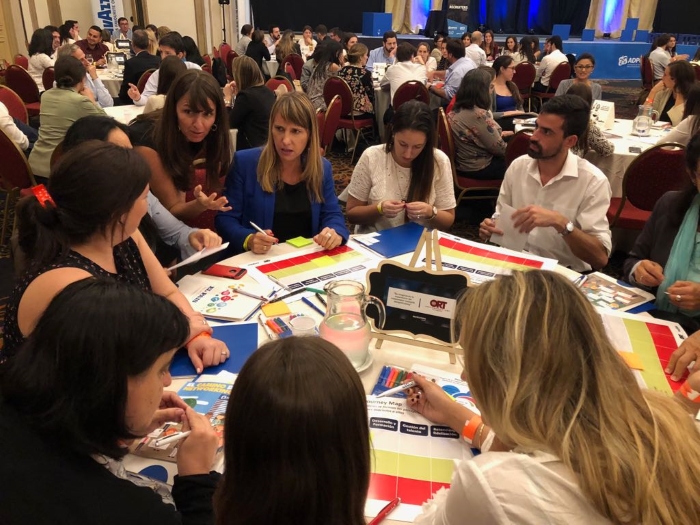
During the roundtable discussion, the experts introduced participants to a method for gaining a deeper understanding of their employees’ realities through a process known as design thinking. They were asked about the company’s current situation, and through brainstorming, they proposed improvement measures aimed at increasingly aligning employees with the organizational culture.
The Employee Journey Map was also presented; this tool maps an employee’s experiences within an organization. It is a diagram that illustrates the employee’s lifecycle, from their first contact with the company through to their departure, and highlights the critical touchpoints (those that shape internal brand perception).
“Amid a war for talent among companies vying to recruit employees, millennials prioritize organizational environments that align with their values and beliefs, which is why it’s so important to pay attention to their needs and interests,” says Ximena Fernández.
Fernández also explains that “both the university’s graduate programs and executive programs in human resources incorporate content and experiences related to employer branding, with a strategic focus linked to organizational outcomes in areas such as organizational commitment.”
The second edition of Recruiters brought together human resources professionals, highlighted trends in the field, and provided a set of practical and dynamic tools for developing and managing the employer brand.