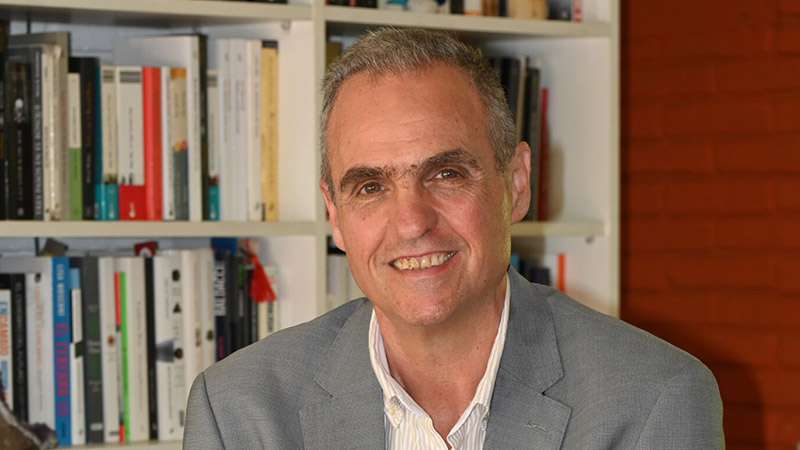
A trip home
After two decades, Renato Opertti returned to Universidad ORT Uruguay. His return, however, is not merely a reunion, but a renewed commitment to the internationalization of education.
“It’s a return to a cutting-edge institution where I worked for many years, where I’ve always felt very much at home, and which is my home, ”he said, recalling his time as coordinator of the university’s Academic Quality Unit and as a professor and advisor at the Institute of Education during the 1990s and early 2000s.
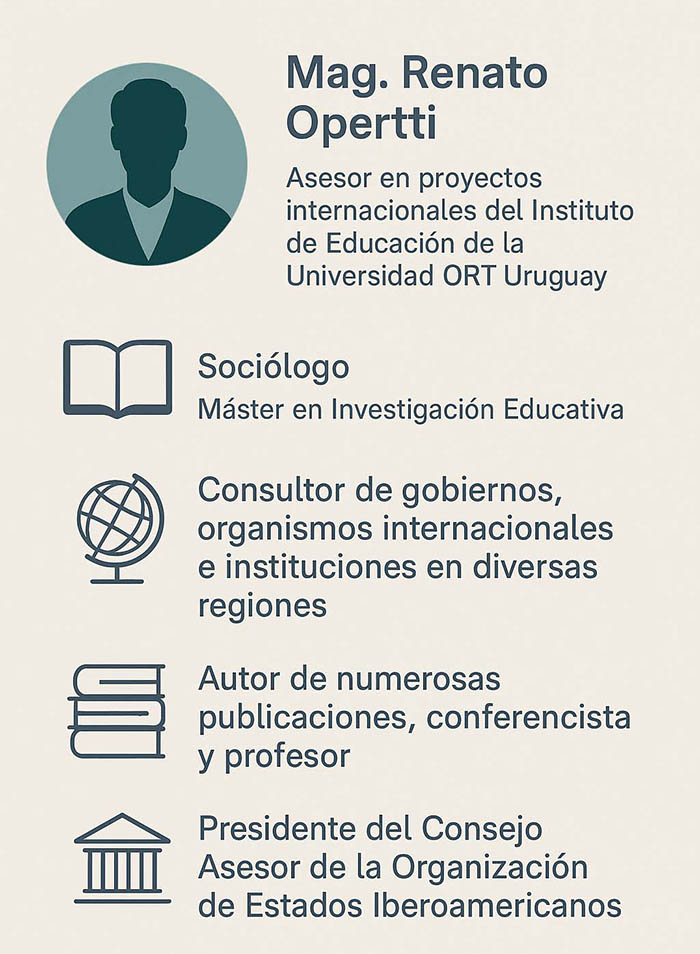
In February 2025, he took on the role of advisor for international projects at the Institute of Education, with the aim of strengthening ORT’s international profile in the field of education. “The university has a foundation of human resources, knowledge, ideas, and proposals that enables it to aspire to a more prominent role in the Ibero-American educational landscape and on a global scale,” he explained.
According to discussions with Dr. Denise Vaillant, dean of the Institute of Education, and her team, efforts to advance internationalization will take various forms. This will involve participating in transnational education projects; continuing to establish networks with universities in Latin America, the United States, Europe, and Asia; offering graduate programs for the international teaching community; and promoting new training initiatives and knowledge production on key topics on the educational agenda, such as learning, curriculum, technology, and inclusion.
ORT has always shown a particular sensitivity to educational issues, so I found it very inspiring to think about renewing our commitment to and confidence in education as a pathway to progress and a vehicle for opportunity.
But it’s not just about expanding networks. For Opertti, the real challenge lies in renewing the way we collectively discuss and shape education. At a time when the value and purpose of education are sometimes called into question, he believes that the Institute of Education can contribute to the educational debate through key ideas capable of transforming “noble aspirations into concrete opportunities” for individual and collective development.
We also aim to foster an exchange that brings together new perspectives and educational stakeholders from the younger generations, the tech sector, the business world, the arts, and society at large. Because, today more than ever,“education means connecting ideas, perspectives, approaches, and communities” in order to understand the complexity of the world we live in.
“We are committed to ensuring that the university serves as a hub for glocal thinking—with a global perspective on the world, yet firmly rooted in the local community,” he summarized. And as he himself pointed out, this new phase is just beginning: “The idea is that all these processes will become a reality within a year or two, built upon the solid foundation that already exists.”
Why education isn't a priority
Opertti was emphatic in stating that education is not currently a priority for societies, nor is it one of the public’s primary concerns.
“If public opinion polls show that issues like security or the economy are considered extremely important—and I don’t deny their importance— yet only 6 or 8 percent of the population considers education to be an important issue, you’ve got a problem,” he said.
In his view, public safety has recently “dominated the education debate,” and countries seem “more concerned with arming themselves than with developing.” Added to this is a communication problem: there is a failure to convince families and communities of “the value and purpose of education.”
Internationally, it is clear that education is not a priority.
“Why aren’t students attending school? Why is there a 62% rate of chronic absenteeism in schools?” Opertti asked. She immediately continued:“We aren’t inspiring a love for education. Something is wrong; perhaps they don’t understand us, or we aren’t able to empathize with the public.” In that sense, in his words, there is a risk of “remaining bogged down and distracted” by internal discussions within the education system, and“failing to listen attentively to what societydemands, experiences, and projects onto education.”
He also noted with concern the findings of the latest PISA assessment, which showed that“one-third of 15-year-oldstudents in Uruguay (who were in the education system) failed to achieve proficiency in language, science, and mathematics.”
“We are facing a situation of functional illiteracy that affects more than just the most vulnerable segments of society. The lack of foundational literacy skills is a universal and long-standing issue in our society,” he added.
According to the Institute of Education’s advisor on international projects, without a basic foundation of skills in reading, writing, math, and science, it is impossible to build an inclusive or democratic society. He compared it to a house: “When the foundation is weak, the structure sways.”
Some key steps for making progress in education
“The social, productive, technological, cultural, and geopoliticaltransformations taking place in today’s world require us to rethink education in both its broadest sense and its specific details,” stated Opertti, who cautioned that this transformation goes beyond simply tweaking a program, making a curriculum more flexible, or expanding coverage. “The era of piecemeal reforms has come to an end,” he added.
That is why it is essential to consider what kind of education is needed to ensure that future generations have the opportunity to live in a sustainable world. It is also important to restore the universalist ethos, since, in his view, education is “an essential vehicle” for instilling universal values such as democracy, inclusion, coexistence, peace, and security.
There is no education without freedom. And, in a way, I think we have neglected freedom in education.
How can this be achieved? Opertti offered some insights into the direction we should take. In addition to tailoring instruction to “find the suit or dress” that fits each student perfectly, it is essential to foster a public discussion on education and to recognize that the responsibility for educating future generations lies with “society as a whole.”
One of the biggest challenges, he emphasized, is “realizing” the depth of the changes required and having a clear understanding of the goals to be achieved: “In education, if you don’t have a clear sense of where you’re headed, the changes will have limited impact and limited scope.”
“We must aspire to a future where education shapes new ways of building civilization. And we must chart a course—a way to ensure that this vision is gradually realized,” he added.
The reason is that countries that are framing the debate at this level will be able to “invest in more sustainable and resilient societies”in the future. Conversely, those who remain stuck in self-referential and endogenous discussions within the education system “will suffer greatly” and, above all, in addition to “penalizing the most vulnerable,” will be “extremely selfish and unfair toward the future of new generations.”
Lessons from an international career
With decades of experience working with governments, international organizations, universities, and public and private institutions, Opertti shared some key lessons for the educational leaders of the future.

“Not assuming that you always have the answer —and not wanting to impose it—was the first one,” he said. “Knowing how to engage in dialogue, understand others, find common ground, and build synergies, so that things can move forward and fall into place, without becoming prisoners of short-term thinking or endless repetition,” he emphasized.
Secondly, the importance of ideas. “After a few years of working in education around the world, I still believe that it is ideas that make a difference. Not buzzwords or quick fixes: ideas about issues, managed and implemented in a way that makes a real impact on people, ”he stated.
He acknowledged that people often prefer to talk about tangible resources—which “don’t spark much controversy”—rather than discussing what and why we educate. “It’s easier to agree on bricks and mortar than on ideas for change, and to stay within our comfort zones and the bounds of political correctness than to challenge the status quo, ”he noted.
Third, the importance of diversity: “No serious project can be built on the basis of hegemonic cultures and ways of thinking. It requires openness, generosity, commitment, and diverse professional teams.”
Finally, we must always keep in mind that our actions must benefit the most vulnerable. “That is where we must be bold in our search for solutions and open to a variety of proposals, in order to improve people’s lives,” he said.
I firmly believe that education changes people's lives.
In closing, he stated that it is essential to “learn to make progress despite setbacks.” What does that mean? “In education, nothing is set in stone, but it is important not to fall into relativism or resign ourselves to thinking ‘it can’t be done’ or ‘that’s just the way it is.’ “You can always move forward if you have courage, boldness, and ideas, as well as the ability to mobilize support and resources to achieve tangible objectives and goals,” he concluded.