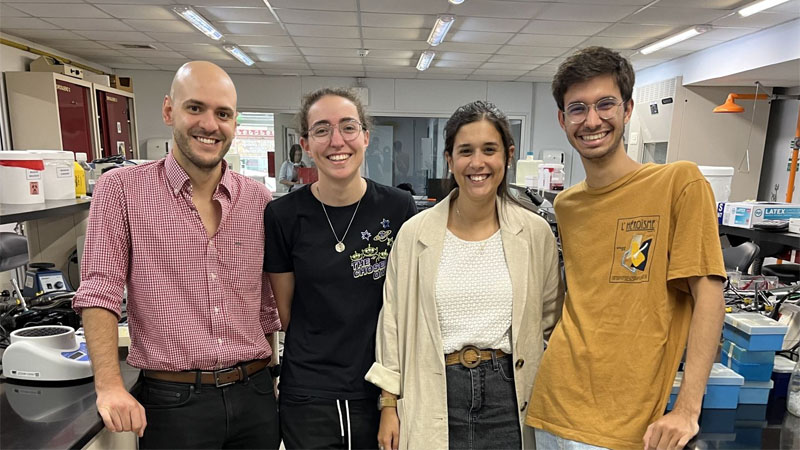
This startup was founded in 2018 by Pía Campot, M.Sc., a biotechnology graduate and instructor; Felipe Machado, B.S., a biotechnology graduate and laboratory assistant; Rodrigo Achigar, Ph.D.; and Diego Saráchaga, M.Sc. It focuses on the study of the gut microbiota as a tool for preventing and diagnosing diseases.
As Felipe explains in this interview, they will soon begin interviewing and collecting samples from 40 children between the ages of three and seven with autism spectrum disorder and 40 neurotypical children, to assess their diet, gut microbiota, and urine metabolites. Based on this, they will seek to identify biological markers that can help take the first steps toward improving the diagnostic process for the early identification of autism.
How and where did this new approach to the company come from?
Enteria has always had an interest in the field of ASD. From the very beginning, we have provided services focused on this area and built a network that has enabled us to work in it. Autism is an extremely complex, multifactorial disorder for which, to this day, there is no known cure or early diagnostic method. We understand the technical complexity involved, but we want to do our part to improve the situation for families.
What are they hoping to achieve with this research?
We aim to take the first step toward identifying biological markers (molecules and microorganisms) that can be used as targets to develop a tool for the early diagnosis of autism. This research will allow us to begin identifying and understanding existing patterns in the gut microbiota and in urine metabolites. We know that conducting a diagnostic test requires a larger number of participants, but the research we are currently conducting allows us to begin identifying patterns so that we can later look for them in a larger study population.
Why is early detection important?
This is important for reducing the uncertainty parents feel, alleviating their anxiety about what their children are going through during the process, and enabling healthcare professionals to take early action.
How long do you think the study will take?
The study will take approximately one to one and a half years.
How do you recruit participants for the study? Do you work with any clinics or universities?
We recruited the study participants through the Research Department of the School of Nutrition at the University of the Republic.
Do you have funding?
We are funded by our own resources and by the National Agency for Research and Innovation (ANII) to carry out the project, and we are collaborating with the Center for Biotechnology Research and Innovation (CBI+I), Universidad ORT Uruguay the Research Department of the School of Nutrition at the University of the Republic.
The relationship between gut microbiota and the autism spectrum has been extensively studied in other countries. Where does Uruguay stand on this issue?
A study on microbiota and nutrition has been conducted in Uruguay, in which we have already participated. The study was carried out by the Research Department of the School of Nutrition, and we provided data processing services. The main difference between this study and the other is, on the one hand, the inclusion of several variables (diet, microbiota, and urine metabolites) in a single trial and, on the other, the use of technologies that allow us to obtain more information from the results. Furthermore, this is now our own project, which we designed and are leading from Enteria.