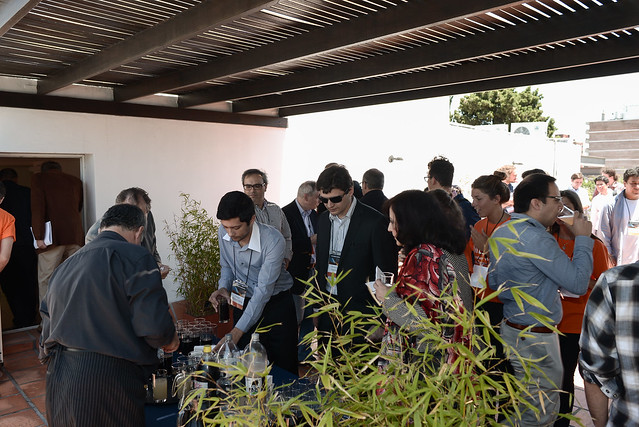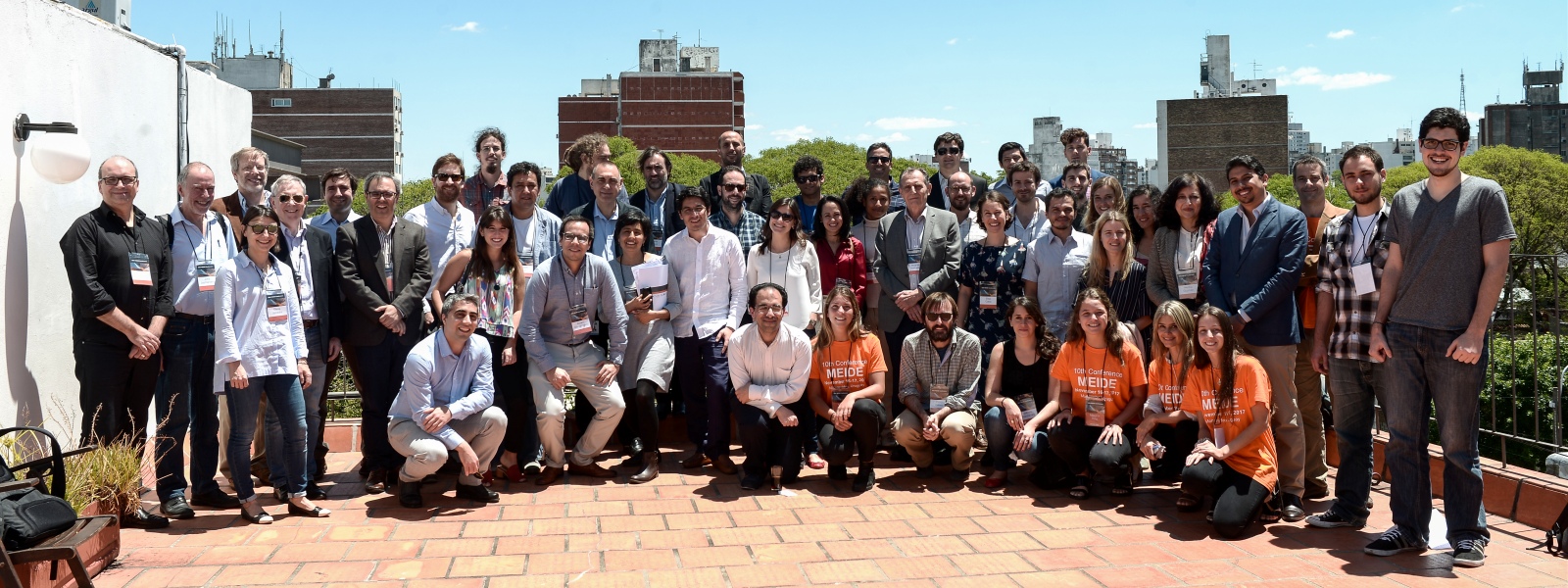
Dr. Jordi Jaumandreu, a professor at Boston University, gave a talk at Universidad ORT Uruguay as part of the “10th Conference on Innovation and Development – MEIDE (Model-based Evidence on Innovation and Development).”
The event featured prominent speakers from Argentina, Brazil, Canada, Chile, the United States, France, and Paraguay, who presented their research to discuss various aspects of innovation and its relationship to economic development.
The event took place on November 16 and 17, 2017, and was organized by the School of Economic Sciences at the University of the Republic, the School of Management and Social Sciences at Universidad ORT Uruguay the Center for Economic Research. It also received support from the Inter-American Development Bank and the South American Network for Applied Economics.
Innovation is defined as any type of novel action undertaken by a company, individual, community, or government. It goes hand in hand with development, as these practices can help reduce poverty, solve environmental problems, and improve the distribution of wealth.
Some of the topics discussed included the current impact of technological changes on public policies related to the labor and productive sectors, the obstacles faced by those seeking to innovate in Latin American countries, and the industrial growth experienced by countries such as China and Vietnam.
One of the keynote speakers, Jordi Jaumandreu, presented a study of 70,000 Chinese manufacturing companies conducted over a 10-year period (1998–2008) and explained the importance of accurately measuring productivity so that it is not distorted by sectoral heterogeneity in demand.
To grow, a company can increase production and lower prices, or expand demand by improving product distribution. Therefore, by separating productivity from demand, one can identify the reason for the company’s growth. “It’s not the same whether a company is growing due to higher productivity or higher demand,” said Jaumandreu.
The expert also pointed out the difference between product-focused and cost-focused advantages. In China’s case, most companies focus on the latter. This means that the country’s industry managed to reduce product costs but did not focus on achieving high quality.
To illustrate the importance of offering a high-quality product, the researcher cited the example of the instant noodle company Tingyi, which, despite doubling its price, improved its distribution and managed to break into new markets thanks to its superior quality compared to the competition.
Currently, Chinese companies are wondering how to improve the quality of their products in order to maintain their market position. The research found that a segment of the Chinese market focuses on creating high-quality products. However, focusing on improving quality leads to higher input costs and, consequently, higher final costs.
Finally, Jaumandreu emphasized that while productivity and heterogeneous demand are two distinct issues, they are related, and that focusing on the latter is just as important as focusing on the former.
Video of Dr. Jaumandreu's lecture:
https://youtu.be/O1_lSuWSbz4?si=gCkQHpPFS7PHQUo2
Image gallery: