https://www.youtube.com/watch?v=EpP-zhdE344
His first major project was a robotic arm, but he’s eager to keep exploring so he can create new designs. In this interview, he tells us about his experience, the research he’s conducted, and the new challenges he’s facing.
What does the robotic arm project involve?
The robotic arm project was a personal challenge aimed at learning more about electronics, 3D design, and programming. With this in mind, I set out to develop a simple robotic arm. First, I designed each part of the robot in Onshape, a CAD software program. The second step was to source the necessary components, such as the ESP32 development board, which I chose because of its affordable price and because it includes a built-in Wi-Fi module. Servo motors are very expensive in Uruguay, and since I didn’t have a large budget, I had to settle for some that were less powerful and not as reliable. The third step was to develop the software to control the arm.
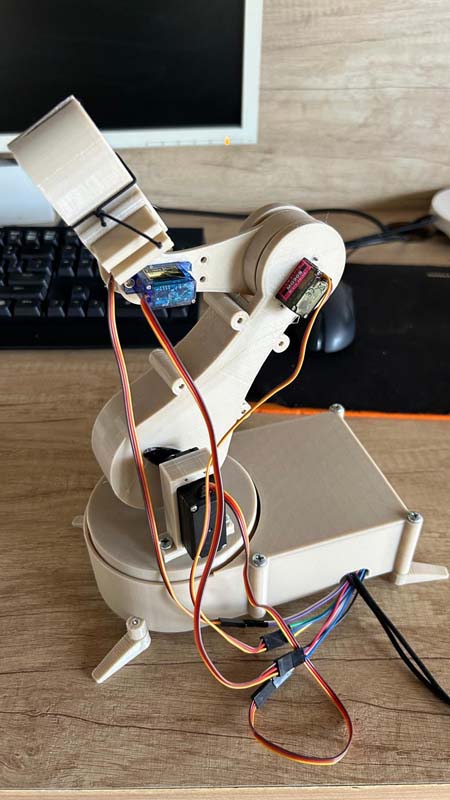 Several ideas came to mind: the first was to use a physical remote control, but that was one of the simplest options, and I wanted a more interesting challenge. After doing some research, I came across a Google library called Mediapipe that had exactly what I needed. It allowed me to process video in real time, using artificial intelligence to detect points on the hand (called “landmarks” in the library) and create gestures that corresponded to the robotic arm’s movements.
What did you like most about getting involved in robotics?
What I like is that the end result is something tangible; it doesn't just exist in the world of ones and zeros, like a pure software development project might. It has a bit of both worlds. I also find it very rewarding to be able to share it with others. Generally, everyone finds this field fascinating, and it's easy to connect with people who know nothing about electronics but still find it extremely interesting.
What was the biggest challenge you faced while developing the robotic arm, and how did you overcome it?
Without a doubt, the biggest challenge of the project was ensuring that each system functioned properly and in harmony with the rest.
In other words, getting the connections between the microprocessor and the motors right, and then ensuring that communication between the ESP32 microprocessor and the computer worked properly, as well as making sure that the gesture recognition code sent the information correctly.
It seems simple, but when something goes wrong, it's hard to figure out which system is causing the problem.
To resolve this, I focused on making absolutely sure that each system worked properly on its own, conducting extensive testing on each one individually.
What new skills or knowledge did you gain while working on this project?
One thing I discovered while working on this project is that there are many powerful tools available for free, such as Google's MediaPipe library, which is at the heart of the project.
That’s why I’d say that learning how to research and read documentation is essential. By this I also mean that often you don’t need to reinvent the wheel—you just need to learn how to use it.
Do you have any robotics-related projects you'd like to work on in the future?
I would like to develop a robotic dog modeled after those created by the American company Boston Dynamics.
What I find interesting about this project is teaching the robot to walk by integrating it with a reinforcement learning model.
With this approach, the robot would gradually learn to walk without having to be manually instructed on the movements it needs to make.
Learn about theElectronics Engineering program