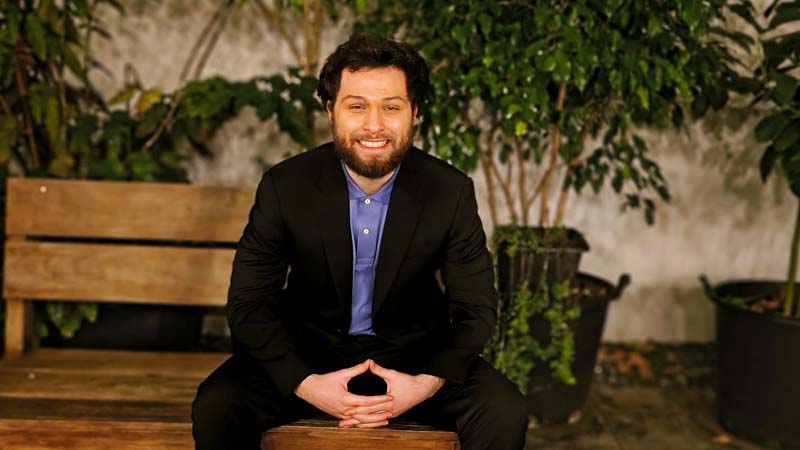
For seven months , he will serve as a research student at the Japanese university before taking the entrance exam for the master’s program, where he will delve deeper into optical systems design and electromagnetic theory while continuing to improve his Japanese. With a clear research plan and a passion for optics, Lucas aims to become an academic and cultural bridge between Uruguay and Japan.
A scholarship that opens doors
Lucas was selected as Uruguay's representative for the 2025 MEXT scholarship, funded by the Japanese government. This scholarship covers all graduate school expenses, including travel, medical and academic costs, and a monthly stipend.
“For students from countries with fewer resources in certain areas of research, such as Uruguay, this opens the door to cutting-edge projects and international collaborations,” he explains.
The selection process consists of three stages: submission of documents, a written exam, and an oral interview. For graduate programs,applicants are assessed on both Japanese and English proficiency. “The steps are explained in detail on the embassy’s website, and the staff in the cultural section assisted me every step of the way, which I greatly appreciate,” he notes.
Once thatinitial screening is complete, the second stage begins: obtaining a provisional acceptance letter from the university and approval from the professor who will supervise the research. “In my case, I already knew which university I wanted to attend, so I contacted the lab in advance at Utsunomiya University,” he says. Once that acceptance is received, the process is complete.

A dream forged at ORT
Lucas decided to tailor his entire college education toward achieving this goal: “I was drawn to academic life from a very young age, and when I enrolled at Universidad ORT Uruguay, I set my sights on pursuing a graduate degree in Japan.” His interest in the MEXT scholarship began in 2018, while he was still in high school, when he visited the Japanese embassy to learn about study opportunities.
Hearing the news that I had been selected was an unforgettable moment.
“I felt that getting up at 5 a.m. to study Japanese was totally worth it. It was the best decision of my life.”
The Road to Optometry
It all started when he took the courses on Electromagnetism and Electromagnetic Waves: “I knew that was where my future lay, although I wasn’t sure which subfield. Physics is such a vast field that it’s easy to lose focus,” explains Lucas.
Between his sixth and seventh semesters, he explored various fields, such as computational electromagnetics and antenna design. It was during his eighth semester that a classmate, Sebastián Fraga, suggested he focus on optics. “I realized that was the right path for me. Optics combined what fascinated me about both subjects and left out what appealed to me the least.”
From then on, he spent the next three years pursuing his studies on his own and taking advantage of opportunities such as working as a research assistant to Dr. Efraín Buksman, a professor of physics in the School of Engineering.
What captivates him most about this field is its quiet presence in everyday life: “Vision, cameras, optical fibers, screens… Optics is, after all, the art of manipulating light to achieve a specific purpose.”
A clear research plan
During his time as a research student, Lucas will not take any formal courses: he will devote himself entirely to the laboratory where he will later conduct his research, and will continue to do so until he takes the entrance exam in December.
“I used these past few months to conduct independent research through courses on topics that aren’t typically covered in class but are very useful in a laboratory setting,” he explains.
Notable among these are MATLAB programming applied to metamaterial optics—a topic he explored in his undergraduate thesis under the guidance of Professor Enrique Maciel—and the implementation of ray tracing.
At this stage, he will focus on the design of imaging systems under the guidance of Dr. Nathan Hagen. “We will also study Lagrangian optics as applied to complex optical systems and explore issues related to the Poynting vector as a starting point for new lines of research,” he adds.
At the same time, he will strengthen his command of technical Japanese through classes designed for advanced university students. Regarding the master’s program entrance exam, which he will take in December, he says, “It will be a demanding challenge, but I’ve been preparing since October with specific exercises and specialized textbooks.”

Living in Japan: Culture, Language, and Adjustment
Lucas is no stranger to Japanese culture. He has traveled there before and acknowledges that this makes the adjustment process easier: “Although the hardest part will always be the contrast between the two societies. While Uruguayan society is warmer and more cheerful, Japanese society is cooler and more serious. But this experience can serve as a cultural bridge.”
He has been studying Japanese since 2019 and speaks highly of the teachers who guided him: “I owe my life to each and every one of them. I wouldn’t be here if it weren’t for them.”
He is particularly excited about the chance to explore places he hasn’t visited yet, such as Tochigi City or the Oya History Museum in Utsunomiya. “They have a melancholic yet mystical atmosphere that fascinates me,” he says.
Advice for those who dream of studying abroad
For those thinking about applying for a scholarship abroad, Lucas has a clear message:“Come prepared. Those who fund your studies expect a return on their investment. Before you apply, you need to have three key elements in place: a research plan, a lab to work in, and a topic you’re passionate about. Research shouldn’t become a routine; it has to be something that inspires you.”