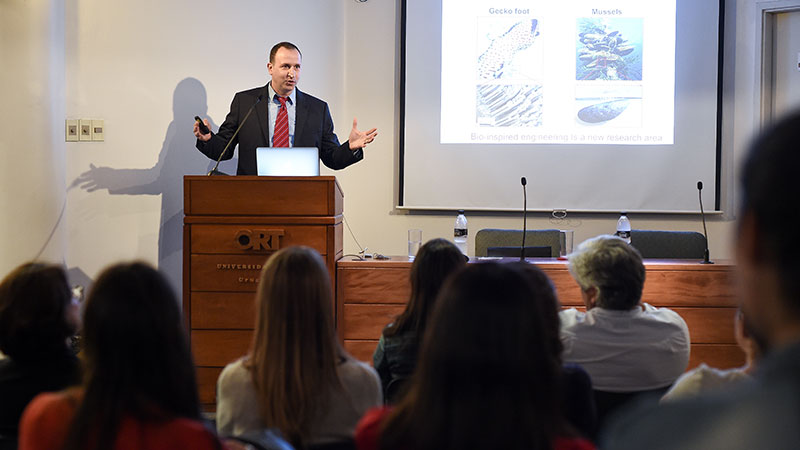
Creating a laboratory-made adhesive similar to the one some reptiles use to move along walls, or mimicking the protective mechanism of a species of algae for use in the pharmaceutical industry to minimize the side effects of certain medications, are just two examples of how science can draw inspiration from nature to solve problems.
This is one of the areas of research pursued by Dr. Boaz Mizrahi, an assistant professor in the Faculty of Biotechnology and Food Engineering at the Technion – Israel Institute of Technology, one of the world’s leading technological universities, who was in the country from April 24 to 26 and visited Universidad ORT Uruguay.
During his visit to Uruguay, organized by the university, the Israeli Embassy in Uruguay, and the Biotechnology Research and Innovation Center (CBI+I), Dr. Mizrahi delivered a lecture titled “Bio-inspired Materials: Fundamentals and Applications” on Wednesday, April 25, at Universidad ORT Uruguay.
The expert's connection with the university began in 2017, when two biotechnology engineering students expressed interest in participating in an exchange program in Israel.
Dr. Mizrahi hosted the students for six months in his laboratory at the Technion and served as their thesis advisor, as part of his ongoing collaboration in the field of nanobiotechnology with the university researcher Dr. Lorena Betancor.
As part of his visit, Mizrahi attended the presentations given by the young female students from the university who had visited him in Israel, and he delivered a talk focusing on the strategies science uses to design useful materials based on complex mechanisms found in nature.
Mizrahi also met with the Directorate for the Development of Science and Knowledge at the Ministry of Education and Culture, the Sectoral Council for Biotechnology at the Ministry of Industry, Energy, and Mining, the Pasteur Institute of Montevideo, and the National Agency for Research and Innovation of Uruguay.
