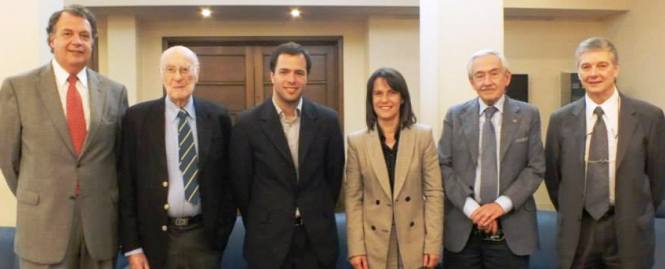
Juan José Riva holds a bachelor's degree in International Studies from Universidad ORT Uruguay is a member of the International Trade Department in the School of Business and Social Sciences.
He currently works in the Political Affairs Directorate of the Ministry of Foreign Affairs. In 2013, despite not being an economist, he won the First Prize from the National Academy of Economics for his paper “Competitiveness in Uruguayan Companies: Factors Ranging from the Exchange Rate to the Structure of Government Agencies.”
Riva discussed the main contributions of his work, government efforts to improve competitiveness, and how he managed to win an economics prize even though it wasn't his field of expertise.
-What was the research that won the National Prize in Economics?
-The basis for the research I submitted for the award was my undergraduate thesis for my Bachelor’s degree in International Studies, which I wrote under the supervision of Marcelo Gil. The thesis focused on the government’s efforts to promote exports. Based on that study, we observed that Uruguayan businesses lacked the capacity to export, and that is where competitiveness comes in.
When the opportunity arose to submit my thesis for the National Economics Prize, I was working on another project with Julio Lacarte Muró, who serves on the Board of Directors of the National Academy of Economics. I told him about my thesis, and he recommended that I submit it because it was highly relevant.
From there, I made a few adjustments. I looked at it from the perspective of a Uruguayan exporter and considered the challenges and advantages of selling to the rest of the world.
At first, I looked at the exchange rate, since at the time there was a highly critical report from business associations regarding the low value of the dollar, which was causing a loss of competitiveness. In a second phase, I analyzed the free trade agreements.
I also took into account information barriers—that is, the efforts made by the government and various sectoral institutions to raise Uruguay’s profile internationally and, at the same time, to ensure that Uruguayan producers are aware of the tools available to facilitate exports.
Finally, I examined the logistical aspect, drawing on a thesis from Universidad ORT Uruguay Diego Martínez Da Rosa, Diego Placeres, and Matías Eustathiou. That study concluded that Uruguay placed a strong emphasis on external infrastructure—that is, ports and airports—while devoting little effort to internal infrastructure, such as roads and rail networks. All of this is reflected in the country’s competitiveness.
 -In your work, you state that dependence on agricultural commodities led to a deindustrialization of exports. How did you come to that conclusion?
-It’s a rather controversial topic, and when I presented it at the university’ s International Trade seminar, our professor, Isidoro Hodara, said it was a matter of perspective. I believe that when commodity prices rise, resources—including human resources—flow into that sector. As a result, industrial companies that generate added value lose their labor force because they can’t afford to pay as much as the agrocommodity sector.
Furthermore, a country with inflexible labor laws (and I’m not saying that’s a good or bad thing) means that companies adding value to their production don’t have much room to maneuver either. On the other hand, if commodity prices rise, a lot of money flows in and the exchange rate goes up, which ultimately affects the export industry that adds value.
For example, Paraguay has been the fastest-growing country in Latin America thanks to an export boom in soybeans and beef. However, it sells 50% of its beef to Russia, and its markets are highly undiversified. It is also one of the most deindustrialized countries because all its resources are channeled into that sector. Industries employ fewer workers, wealth distribution is limited, and as a result, growth is relative.
-How do infrastructure and exchange rates affect companies that add value to their goods?
-As for the exchange rate, if it rises, Uruguayan products become more expensive in dollars than those in the rest of the world. When it comes to transportation routes, it’s almost a cliché to say that it costs more to send a truck to Rivera than to ship a container to China. On top of that, commodity prices have risen across the board, including oil.
So if a business owner who adds value to their product faces delays due to poor road conditions, they have to pay the driver more and spend more on fuel because oil prices are high. And workers, for better or worse, are more expensive than in other countries. This makes value-added goods more expensive than others. That is the problem with competitiveness.
-How do trade agreements with the region affect us?
-It is a competitive disadvantage in relative terms. While Uruguay has access to large markets such as Argentina and Brazil—countries whose economies have grown—this aspect must always be viewed from the perspective of the countries that sell the same products as we do. This includes both countries that sell meat, like Uruguay, and countries that sell software and design, like Chile.
Chile, for example, has greater access through free trade agreements to markets with much larger populations that are becoming increasingly affluent. Its ability to access markets is greater than ours, which puts us at a disadvantage.
-In your work, you also pointed out that there is an overlap in the responsibilities of agencies dedicated to promoting exports.
-Uruguay XXI performs certain tasks that are also carried out by the Directorate of Intelligence and Trade and Investment Promotion within the Ministry of Foreign Affairs. Both entities fall under the same ministry. Currently, Uruguay XXI is headed by a diplomatic official, and there is clear coordination between the two, though this depends on the authorities’ willingness to cooperate. However, on occasion, their leaderships end up doing the same things.
Added to this is the role of non-governmental organizations that promote their products, such as the National Institute of Viticulture. If you don’t have a strong government and leave promotion to the private sector, you’re not being democratic, because the most organized sector will have a greater chance of getting promoted. If the government is strong, it gives everyone the same ability to export.
-Do you think the government is doing enough to diversify markets?
-I think so. Since I started looking into this issue, I’ve seen efforts being made. For example, in 2013, when trade relations with Argentina became strained, the Ministry of Economy and Finance and the Ministry of Industry, Energy, and Mining launched the Market Diversification Fund, which provided assistance to exporters who were heavily dependent on Argentina.
Uruguay XXI is doing a great job, and offices have been opened abroad with specialized staff at the embassies. This helps boost competitiveness.
-What do you think is the main contribution of your work?
-In short, it provides a very clear overview of the government agencies involved in promoting exports. It offers a detailed analysis of the government and places it within the context of a high exchange rate, few trade agreements compared to other competing countries, and a weak domestic logistics infrastructure—which is ultimately what Uruguayan exporters face when competing against their rivals.
It goes without saying that we are more or less competitive due to the exchange rate. Sometimes people look at it solely from the perspective of the exchange rate, but that is merely a temporary factor.
-Were you surprised to have won the prize even though you're not an economist?
-There aren't many of us non-economists who've won it, but I think the thesis was very focused on the subject. But yes, it did surprise me. In any case, I always felt I had the tools to do it. And I also had the support of my thesis, where my advisor was the economist Juan Labraga. I think those who graded it looked at it more from the perspective of public administration than from a strictly econometric point of view.