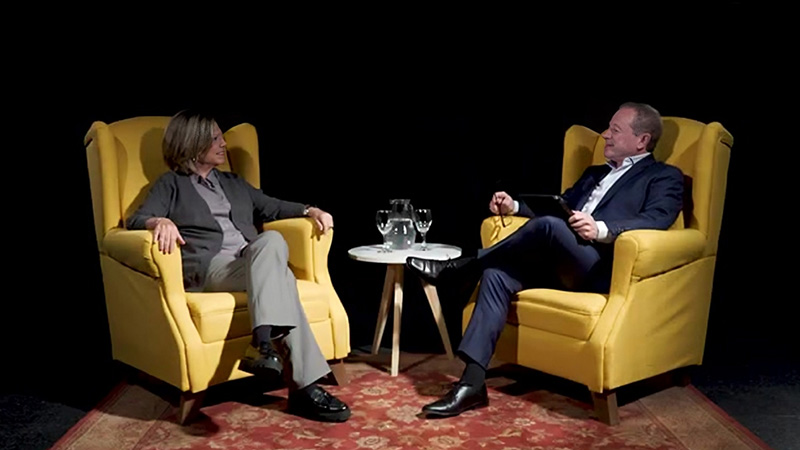
In the “Sobresalientes” interview series, the dean of the Institute of Education at Universidad ORT Uruguay on the rise of artificial intelligence, reflected on the lessons learned in the wake of the COVID-19 pandemic, and, among other topics, highlighted the aspects that make teaching a profession unlike any other.
Three questions
Should training focus on competencies or content?
“There is no such dilemma,” replied Vaillant, who emphasized the importance of both elements. While a competency-based approach “is undoubtedly better” than a list of content, the dean of the Institute of Education stressed that, in order to be competent, students also need to “know certain content.”
Should we develop an educational model tailored to our country, or should we look to international examples?
There are no set formulas, though it is possible to identify “the ingredients of a good formula.” In his words, those working today in the fields of education, teacher training, or research know what works and what doesn’t. “Then each country will have to determine the adaptations it deems necessary,” he explained.
What tools are essential for navigating an uncertain future?
Reflecting on one’s own practice is an essential part of teaching. “There is no other profession in the world where your experiences as a student have such a profound impact on your professional performance,” he explained. Often, what teachers do in terms of classroom discipline “is not so much what they learn from educational textbooks or training workshops,” but is instead closely shaped by their own experiences as students.
https://www.youtube.com/watch?v=dM0s9P1llj4&t
Three opinions
What kind of future should we be educating for?
In her view, the key to university education lies in designing educational programs for students who are about to enter the workforce with “a perspective that looks both back and forward.” And, above all, it is essential to focus on fostering the core competencies they need—competencies that will enable them to develop new skills in the future.
At the same time, he emphasized that the COVID-19 pandemic has highlighted the need to build resilience and to cope with uncertain situations. “I believe that these skills do not arise spontaneously, but must be promoted and cultivated,” he summarized.
Artificial Intelligence
Historically, education systems have had to adapt to the emergence of various technologies. Although artificial intelligence could potentially “stifle curiosity”—an essential driver of learning—the dean stated that the digitization of society essentially “challenges the ways we teach and learn.” Above all, it calls into question the method of assessment, which “cannot remain the same,” but should instead focus on reflecting on the knowledge acquired.
Cell phone use in class
Vaillant has no problem with students bringing their phones or tablets to class. In fact, he noted that they are useful tools that encourage discussion, exchange, and reflection.
Three memories
The innovative experience that impressed you the most
Although he has had the opportunity to travel throughout much of Latin America, he singled out Colombia’s “La escuela busca al niño” program. Due to the armed conflict, many students were not attending class. So, about eight years ago, Vaillant went to learn about the initiative in which teachers visited vulnerable communities to convince families of the importance of getting their children back to school. It was one of the experiences that left the deepest impression on her because, as she explained, it demonstrates the power of what committed teachers can achieve, even under the most difficult conditions.
The two role models who shaped her
Teresa, Vaillant's first-grade teacher, left a lasting impression on him. She sparked his love of reading and his interest in education.
She also mentioned the professor who accompanied her to teach her first class at the Faculty of Humanities at the University of the Republic, after many years of living in Switzerland. She remembered him particularly for the confidence he instilled in her, as he had extensive experience in the classroom.
His first class in Uruguay
It was a shock. She had been a teaching assistant in Switzerland, working with small, highly organized groups. In her Bachelor’s program in Education, she found herself in an overcrowded classroom where there weren’t enough seats. However, she admitted that it was that shock that sparked her interest in new teachers and led her to research the transition into the teaching profession.