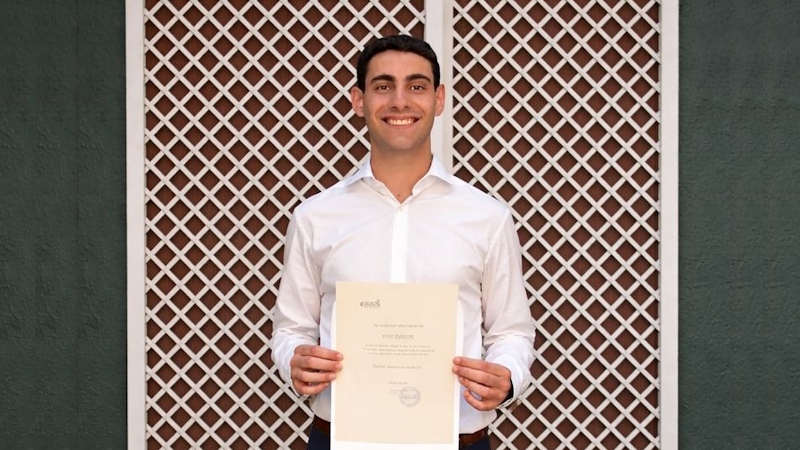
The SEU announced the results of the fifth edition of the 2025 Master’s Thesis Award —dedicated to the memory of Daniel Vaz—and awarded second place to Daniel Misail for his research titled “The Strategic Role of Bank Promotions in Retail Markets,” conducted at the Center for Monetary and Financial Studies (CEMFI) in Spain.
This recognition is significant news for the academic community and, in particular, for ORT, where Misail earned his bachelor’s degree in economics and took his first steps in research. “I am extremely proud,” says Misail of the award presented by the SEU.
The thesis was the result of months of hard work and great effort, and this award is a wonderful recognition of that entire process. It is very heartening and motivating that an institution like the SEU values the academic contribution of this work.
Bank discounts: Do they always benefit the consumer?
In his master's thesis, Misail examines a phenomenon that is part of everyday life for Uruguayans: the discounts offered by banks when customers pay by card at certain businesses, such as restaurants or ice cream shops.
“In Uruguay, we use this type of promotion a lot, but they aren’t as common in other countries. That’s what sparked my interest: understanding why they exist and what their actual effects are,” he explains.
At first glance, discounts seem clearly beneficial to consumers. However, the study shows that the impact is more complex. To sustain these promotions, many retailers adjust their prices, and consumers tend to choose where to shop not only based on preferences or convenience, but also on the availability of discounts.
The main finding of the research is that, under certain conditions, these promotions can actually harm consumers, even though they initially appear to be beneficial.
The thesis identifies the scenarios in which consumers, retailers, and banks may be better or worse off compared to a situation without discounts.
Research experience at ORT
Before pursuing his master’s degree in Spain, Misail worked as a research assistant in economics at ORT, a period he considers pivotal to his academic development.
Working alongside faculty members and researchers in the department allowed him to develop a strong foundation in rigorous methodologies and gain a deep understanding of how knowledge is produced in economics. In fact, this academic guidance was instrumental in his decision to apply to and be admitted to CEMFI.
That research experience was crucial in encouraging me to take the plunge and pursue a master’s degree in Madrid—and in helping me get accepted. Without that prior experience, I would hardly have made it to where I am today.
Two publications in 2025: financial inclusion and education
In 2025, as part of his ongoing research in ORT, Misail contributed to the publication of two academic articles.
In the first, alongside Néstor Gandelman and Rodrigo Lluberas, he analyzes the effects of Uruguay’s Financial Inclusion Law, which made it mandatory to pay wages through financial institutions. The study shows that the measure significantly increased the number of people who began receiving their wages through a bank account and explores whether this increased access to banking services translates into changes in access to credit and savings.
The second study, conducted in collaboration with Néstor Gandelman and Santiago Acerenza, examines the impact of the neighborhood on the educational trajectory of young people in Montevideo. Beyond the obvious differences between higher- and lower-income areas, the research seeks to isolate the specific effect of the neighborhood: how much does the neighborhood influence the number of years of education attained, while holding other family and socioeconomic characteristics constant?
Both articles address the same underlying concern: understanding how institutions and context influence people’s economic decisions and opportunities.
A new chapter in my career in Spain
In September, Misail began working at RBB Economics, a consulting firm specializing in competition issues.
There, he focuses on analyzing, among other issues, the potential effects of corporate mergers or anti-competitive behavior on prices and consumer welfare.
It's a very challenging job that allows me to apply academic tools in a business setting, providing direct consulting services to major firms.
Looking ahead to the coming years, his goal is to continue developing professionally in the field of economic competition, take on increasingly complex projects, and remain involved in research.
The SEU award not only recognizes an outstanding thesis, but also honors a graduate whose career combines a solid academic background, scholarly output, and international influence.