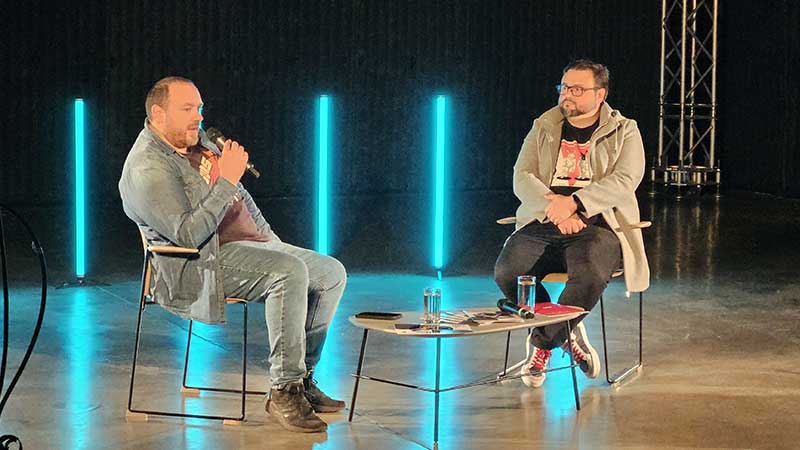
"The Technical Program in Photography and Audiovisual Post-Production 'arose from the audiovisual sector's need for professionalization,'"said the academic coordinator, Mag. Gerardo Castelli, during the launch at Reducto Hub.
The needs Castelli mentions stem from the arrival of streaming platforms in Uruguay around 2020. At that time, there was an exponential increase in content production, which led to a greater demand for specialized workers. Today, the cinematography and post-production departments are the ones with the greatest need for specialized professionals.
There is a growing demand for high-quality visuals, at a time when more and more films and TV series are being produced.
Gerardo Castelli, M.A.
The Photography and Audiovisual Post-Production Technician program aims to meet that demand: “to train technicians who have the ability to work on a set, operate camera and lighting equipment, and understand how to film with the equipment we have today,” the program coordinator explained. “Technicians who can then post-produce that image, work on color and composition, to meet the quality standards that are in demand internationally.”
One of the distinctive features of this program is that the Photography and Data Management component will be taught at Musitelli, using their equipment, so that students can “work under the conditions they will face on a film set in the future.”
Color to accentuate dramatic arches
At the launch, Castelli spoke with colorist Daff Schneydher, who has been working in color grading for films, TV series, and commercials for 15 years. He has worked for Oriental Films, Paristexas, Aparato Post, Sastre, Barraca Post, Remo Animation Studios, Taxi Films, among others; he has developed advertising projects for markets in Latin America, the United States, and Europe, for brands such as HBO Latin America, MTV, Mattel, Coca-Cola, P&G, Telefónica, Verizon, Unilever, PepsiCo, and SABMiller. In 2014, he foundedColour Studio, Uruguay’s first boutique fordigitalintermediate andfinishing, specializing in color grading for advertising and content, restoration of audiovisual material, feature films, and documentaries. There, he has developed projects for Prime Video, Disney, Netflix, HBO, Discovery, Univision, RTS, Telefé, Canal 10, and Teledoce.
I view color correction as an extension of the photographer's work.
Daff Schneydher
-
What does the post-production process look like when a project comes in?
There are two ways to approach projects.
When we enter pre-production, we have a lot of meetings with the directors and cinematographers to get a sense of what they want to do and how they want to present it. Based on that, we develop what are called “lutz,” which allow us to visualize the footage on set in a way that closely resembles how it will ultimately look.
The other way is this: once the film is shot, I usually get a rough cut; without consulting anyone, I take my notes, mark key scenes, and then meet with the director and cinematographer. I ask them about their intentions and the direction of the visuals, give them my feedback, and from there, we begin working on post-production and the final stages of the project.
-
To what extent can someone in color correction or color grading contribute to or leave their mark on a film?
I often see the colorist’s role as being similar to that of a gaffer for the photographer in post-production; so what we do is respect the photographer’s vision—how they wanted the image to look, how they wanted to convey the story—and, furthermore, we trust that they’ve communicated directly with the director so that they share a unified vision.
In my case, when it comes to color grading, I aim to accentuate the dramatic arcs in each scene because, just like sound mixing, color grading involves a process of psychologically influencing the viewer—we decide what to highlight, what to obscure, and what to simply let the viewer see. This also allows us to manipulate the way the narrative interacts with the viewer, and ultimately, we seek a balance between sound, audio mixing, cinematography, staging, and color grading.
-
Ten years ago, color wasn’t considered an important factor in Uruguay, but it has become increasingly significant. How do you view this growth in the Uruguayan audiovisual market? What needs will arise in the future?
It’s been a long process, and fortunately, we’ve had support. Musitelli was a key source of support for us; I feel he served as a sort of trailblazer who helped the rest of us refine our processes and get organized.
Ten years ago, my partner Germán Noela and I came up with the idea of starting a color grading company, but it wasn’t a common venture because we had just completed the transition from film to digital. We started the company and realized we needed to teach our clients the right way to achieve the results they wanted; generally, people would just adjust the contrast and saturation and call it a day, but the process goes far beyond color correction.
Color grading itself is just a tiny part of the process; a workflow is established around color grading, which is linked to production, post-production, and even distribution. As professionals, we need to understand these stages, how they relate to one another, and how to make the most of them. When we optimize these processes, we can get much more out of the resources we have and achieve even better results.
Those are the kind of professionals we need—people who aren't just artists (though it's important that they are artists and that they're very skilled at expressing their art)—but who also understand the process and how those stages fit together.
-
Uruguay has established itself internationally in terms of technical quality and equipment. However, it has not yet achieved the same status in post-production. What can we do to change that?
Setting aside the financial aspect—which is often a determining factor—I feel that this issue can be resolved by taking action. We’ve been doing a lot and achieving very good results, but the problem is that sometimes we can’t do everything we’re asked to do because we’re short-staffed. So, if we start training technicians to fill those gaps, we’ll be able to meet the demands that the international market is placing on us.
https://www.youtube.com/watch?v=scM5q3rxdAg