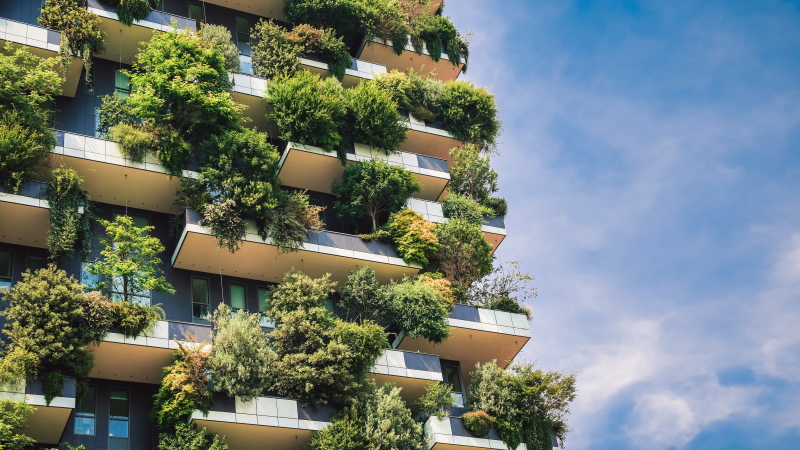
The climate crisis is becoming more and more evident in the daily lives of societies around the world. Prolonged droughts, climate instability, and other natural phenomena are becoming increasingly common in virtually every part of the planet, and it is up to all of us to take action to protect it.
While it is true that the political will of the major powers and of all countries in general is essential to bringing about significant change, it is also imperative for the professional sector to adopt more sustainable practices, use natural resources more responsibly, and, at the same time, capitalize on the growing market demand.
That is why the Faculty of Architecture at Universidad ORT Uruguay the Specialization Diploma in Sustainable Architecture, a graduate program that offers professionals in the fields of architecture, engineering, and construction training focused on the development of bioclimatic strategies, as well as the integration of energy efficiency and renewable energy principles.
Why do buildings pollute so much?
Spanish architect Daniel Ruiz Lolo, a professor in the university’s graduate program in Sustainable Architecture, attributes this to two main reasons: energy consumption during a building’s lifespan and energy consumption in the manufacturing of construction materials.
"A building's energy consumption over its lifetime is linked to heating and cooling. For example, a typical office building with all-glass facades has its air conditioners running 20 or 24 hours a day throughout the summer," says Ruiz Lolo.
Meet all the instructors for the Specialization Diploma in Sustainable Architecture
"Furthermore, 'most traditional building materials consume a great deal of energy during manufacturing, in addition to their transportation and on-site construction. Concrete, steel, and glass have a high carbon footprint because the energy used to produce them comes from fossil fuels—such as oil, gas, or coal—which are necessary to operate at extremely high temperatures,' the professor adds."
Thus, a building’s energy consumption can be measured based on the energy used to prepare the construction materials, as well as the energy used to provide comfort and good living conditions throughout its lifespan. However, “any material can be sustainable, because what matters is the design,” emphasizes Ruiz Lolo, noting that, for example, it is more sustainable to maintain and renovate an old concrete building than to tear it down and build it from scratch with wood, or that it is more sustainable in Uruguay to build with brick than to import wood from a Canadian forest, since transportation also involves unnecessary energy consumption. "One material is more sustainable than another depending on various factors," he states.
Are renewable building materials more expensive than traditional ones?
According to the professor, “more sustainable” materials may require more maintenance than traditional ones, which results in additional financial costs. However, these financial costs are directly linked to energy costs, and over the lifespan of a building constructed with more sustainable materials, the energy costs associated with the manufacture and use of traditional materials would never be reached.
"When we talk about sustainability," says Ruiz Lolo, "we always take its lifespan into account—that is, what will happen to this building over the 50 or 100 years it lasts, until it is dismantled or disappears. A wooden building can be dismantled, and you can do something with that wood; or, in the worst-case scenario, it will be burned to generate energy. Concrete, on the other hand, will most likely end up being demolished, generating waste and debris, because it is almost impossible to recycle."
In short, the short answer is, once again, that it depends on several factors and how the cost is measured: whether it’s a new construction, a renovation, or whether it’s in Uruguay or Canada (material shipping costs). If the cost is measured based on maintenance, it depends on the type of construction: “If I want to build a factory where I need huge light fixtures, doing it with wood would be very expensive. The same goes for a shopping mall. However, an office building would be competitive. Or a residential building,” he says.
He also points out that if a concrete building is constructed with "the right insulation, the right orientation, and enough openings to let in light but not too much, among other things, I can create a perfectly sustainable building using traditional materials (which will consume little energy throughout its lifespan)."
Is building with wood riskier? Is it more flammable?
"That's a fear people have," says the Spanish professor. When architects design a building, he explains, they anticipate how it will withstand fire and calculate how long it will take for the structure to collapse.
Ruiz Lolo explains that any wooden building is just as strong as a concrete one, and the calculation is that it can withstand an hour of fire—which is the time needed to evacuate everyone inside. "When there's a fire in a building, it eventually burns down. No building escapes burning, whether it's made of concrete or wood."
"What's more," he continues, "wooden buildings are often more resistant than those made of concrete or steel, because when a wooden beam starts to burn, it burns on the outside, charring in layers, and eventually the fire can no longer penetrate it. If you make the beam large enough, the fire won't reach the inside, and the beam will continue to hold up. In contrast, steel or concrete beams reach a point where the temperature is so high that the steel in the center bends, and the beam breaks and falls."
What are the main obstacles to the development of sustainable architectural projects in Uruguay?
For both Ruiz Lolo and architect Eliseo Cabrera, the academic coordinator of the graduate program, the main obstacle is a lack of information, which leads to misconceptions such as higher costs, lower durability over time, or the belief that wooden structures are "more flammable," as well as a need for greater flexibility within the construction industry.
"If I want to undertake sustainable architectural projects, I need professionals who know how to carry them out. It’s difficult to change the way the system works if I come up with something too innovative; I’ll run into technical problems because the teams lack experience. However, architecture is moving in that direction; we live on a planet with dwindling resources, and we must learn to do things with fewer resources, including energy," says Ruiz Lolo.
What are the main challenges in developing sustainable architectural projects?
According to the Latin American Energy Organization (OLADE), 23% of energy consumption comes from residential, commercial, and service buildings, and based on the United Nations’ (UN) Sustainable Development Goals (SDGs), “we are committed as a country to creating more sustainable cities” and reducing that consumption, explains Cabrera.
There is a trend, then, toward working in a sustainable manner that transcends industries, markets, and professions, and that “stems from an obligation born of the crisis facing humanity and the planet,” says Cabrera. Therefore, he argues that training in sustainable architecture at a time when projects must be sustainable by UN mandate “complements and enhances one’s education, leading to better jobs, projects, and, consequently, higher pay.”
"There is a growing demand for sustainable architecture, and more and more clients will be seeking these services. Furthermore, countries themselves are increasingly introducing regulations and standards in this area because they want to reduce the amount of energy consumed by cities—after all, that energy expenditure has an impact on the country's economy," says Ruiz Lolo.
Along the same lines, Cabrera emphasizes that the economic impact is felt on various levels, such as the social level: "If strategies related to bioclimatic design and sustainability were implemented in all homes, it would undoubtedly bring significant economic benefits and, consequently, social benefits as well, because we would pay less for the resources we use."
"If we are aware of what is happening in the world, it is clear that we need to start educating ourselves and taking action right away when it comes to sustainability," Cabrera emphasizes, because it would be beneficial on many levels. "This graduate program," he concludes, "offers top-notch training to technicians and professionals in architecture, engineering, and construction," and provides valuable tools to better address the climate crisis we are facing.