Verónica Braida, Pía Campot, Eliana Nervi, and Carolina Tartaglia, students in the Biotechnology program, are working on their final thesis project, which involves creating a collection of freshwater microalgae and designing a photobioreactor to produce biofertilizer.
The goal of this innovative project is to install and integrate it into a self-sustaining school, to help reduce levels of anthropogenic carbon dioxide (i.e., carbon dioxide generated by human activity) inside the building, support wastewater treatment, and obtain microalgae biomass to use as an eco-friendly fertilizer for the school’s garden.
How did the project come about?
The project was conceived as a way to contribute and incorporate a biotechnological element into an existing initiative: the construction of a self-sustaining school in the department of Canelones.
What is your goal?
The first step is to establish a collection of microalgae. This is done by collecting water samples from various locations across the country and isolating the different microalgae found in them. Once has microalgae has isolated, they are identified morphologically and molecularly, allowing us to determine which algae are in the collection and store them for future use.
In addition, a laboratory-scale photobioreactor (measuring 30 by 20 by 3 centimeters) is being designed and built. This project is being carried out in collaboration with the team at the Design Laboratory at Universidad ORT Uruguay.
Once the system is set up, the growth of the various isolated microalgal strains is studied to determine which of them, if any, exhibit the highest productivity in the designed system.
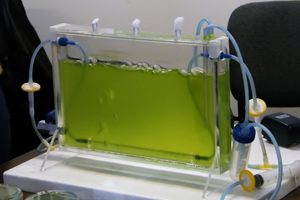 The next step in the project is to scale up the reactor. To do this, the reactor’s performance is studied at the laboratory scale in order to optimize the design and operating conditions, after which a pilot-scale reactor will be built and installed at the school.
It will measure 70 by 170 by 5 centimeters, and its primary purpose is to produce biofertilizer for use in the school’s organic garden, as well as for the potential treatment of wastewater. In addition, methods for generating biofuels and bioelectricity are being tested on a laboratory scale.
Where will the school be located, and who is in charge of its construction?
The school will be located in Jaureguiberry, Canelones, and will be built in 2015. The project was initiated by a group of young Uruguayans in collaboration with a U.S. company that specializes in sustainable architecture.
Once completed, the school will be donated to the National Public Education Administration (ANEP) so that the local community can make use of the facilities.
What are the features of the photobioreactor?
Microalgae cultivation can be carried out in open systems (lakes, ponds) or in closed systems such as photobioreactors. These can be described as enclosed, illuminated culture vessels designed for the controlled production of microorganisms, which is an advantage over open culture systems because it allows for the control of variables such as pH, temperature, and CO2 concentration. 
In addition, photobioreactors help minimize contamination from external agents and result in less water evaporation. There are several types of photobioreactors, such as tubular and flat-plate photobioreactors.
These structures are notable for having a large illuminated surface area relative to their volume, making the most of both solar and artificial light because they are constructed from transparent materials.
Is this the first time something like this has been done in Uruguay?
Yes, in fact there are very few research groups in Uruguay dedicated to the study of microalgae and their applications. In addition to building the photobioreactor, part of our project involves establishing a collection of freshwater microalgae, which marks the beginning of future research on these organisms in our country.