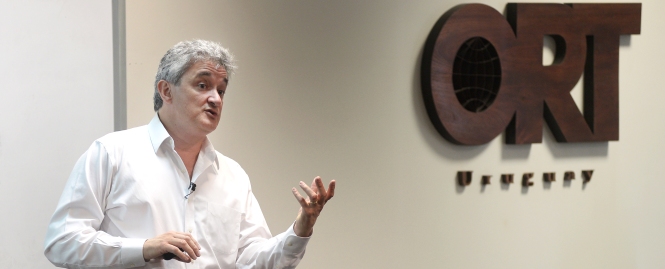
“Risk management is like turning on a flashlight in a dark room,” said Dr. Lorenzo Preve during the conference “Talent Risk Management,” organized by the CPA Ferrere Risk Management Chair.
The event took place on Thursday, September 24, 2015, at the Graduate School of the Faculty of Administration and Social Sciences. Preve, director and full professor in the Department of Finance at IAE Business School and director of the Risk and Uncertainty Management Research Center, spoke about the convergence of risk management and human talent management.
A recent and comprehensive discipline
Risk management is a relatively recent discipline, and its integration with talent management dates back only a few years. The expert noted that the Enron scandal in 2001 highlighted the need to professionalize risk management.
Preve began studying risk management in 2003 and discovered that companies were not taking high-impact variables into account. “Most of the risks that were measured and managed were those that were easy to quantify using econometric models,” he said.
“The big problem is that there are other factors that are just as serious—or even more serious—and that cause much greater volatility in corporate returns.”
Preve argued that we must dispel the notion that “what cannot be measured cannot be managed,” and pointed out that “there are risks we know how to measure but do not know how to manage.” He cited the volatility of oil prices as an example, noting that it is impossible to predict how they will behave in a changing environment.
Globalization also affects risk managers. “Risk management is becoming increasingly comprehensive,” he said, adding that companies expect analysts “to know things we don’t always know.”
Risk Management and Talent Management
Talent risk management stems from collaboration between risk management professionals and talent management experts. According to Preve, talent management in a company involves ensuring that current employees want to stay in their positions and attracting new employees interested in joining the organization.
According to the speaker, companies need to change the way they view talent. He contrasted the traditional approach to talent management—which focuses on each employee fulfilling a specific role—with a more modern approach based on “collaborative models” (such as Wikipedia) that rely on individual contributions.
“Good people are constantly receiving job offers,” he said. He also pointed out that with today’s technology, it doesn’t matter if the worker and the company are in different countries, since “many jobs are remote.” On top of that, many people work for more than one company.
Risk mapping applied to talent management
The risk map is a tool that takes into account both the likelihood of risks occurring and their potential impact. Preve explained how she applied this approach to talent risk management to anticipate employee turnover, mitigate its impact, and improve human resources policies.
“The risk of losing talent within a company depends on two factors: the likelihood that the person will leave and the person’s importance to the organization,” he explained. He thus identifies four broad categories into which a company can classify its employees:
- People who are not key to the organization and are unlikely to leave
- People who are not key members of the organization and are very likely to leave
- Key people in the organization who are unlikely to leave
- Key figures in the organization who are very likely to leave
According to the expert, the human resources policies of these groups “need to be completely different.”
Plan ahead for better management
Preve said he is particularly concerned about the reasons why people quit their jobs and identified three main reasons:
- The employee is dissatisfied or angry with the company
- The worker is overqualified for the job he does
- Companies are emerging in the market that require workers with specific skills
When all three factors align, it is highly likely that the employee will leave their position. “The key is being able to predict these changes” and knowing “how to manage the risk of losing the quality of our workforce.”
“Companies can do much more in terms of talent management” by anticipating incidents than by “simply managing human resources,” he said. However, he acknowledged that it is very difficult to conduct research in this area and implement a risk management index in companies.
To conclude his talk, Preve drew on his experience as a sailor to illustrate the value of risk management. He stated that effective risk management “is like turning on a lighthouse” in the dark, allowing one to determine with much greater certainty which course to take.