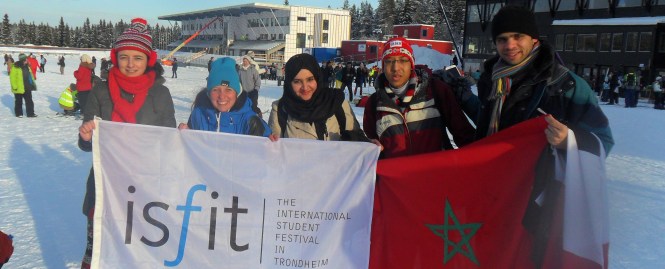
Carla Fontana, a student in the Bachelor’s program in International Studies at Universidad ORT Uruguay, participated last February in the International Student Festival in Trondheim (ISFIT), a student political debate festival in Norway, after receiving a full scholarship.
ISFIT is the largest student festival with a thematic focus, which always addresses political and social issues. This year’s theme was Global Trade, which was broken down into 17 discussion workshops. The university student chose “Power” because it was the topic most closely related to her field of study.
Fontana first heard about the program on Facebook, when a friend told her she had taken part in it. “The application process was very simple. I was surprised, because you had to choose which workshop you wanted to attend and write a couple of essays. One was about what makes you special and your career goals, and in the other, you had to explain why you chose that workshop and what it could offer you. Then there was a section where you could apply for a full scholarship with one more essay,” she said.
And that’s exactly what he did. He applied for a full scholarship and was awarded one—a privilege granted to only a handful of students. In addition, he was one of 450 young people selected to participate in this program, for which a total of 6,000 people had applied. Only four students from Uruguay were chosen.
Young people from around the world gathered in Norway from February 7 to 17 to discuss and exchange views on a variety of topics. Fontana explains that from 9:00 a.m. to 4:00 p.m., they participated in a workshop led by four Norwegian students who had organized a wide range of activities as part of ISFIT.
“There was a lot of debate activity. For example, there was ‘speed debating,’ which worked like speed dating. You had one minute with each person to discuss a different topic, and that was the time you had to talk and share ideas,” he explains. Each day focused on a different topic, and they were given materials to help them prepare.
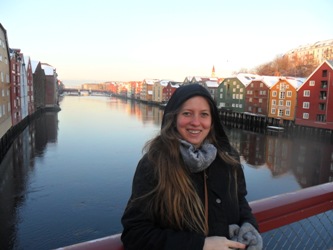 As an anecdote, for example, he recounts that he was assigned to a group representing the Arab League, and one of the participants offered a completely different perspective. “In my group, there was an Algerian who had a perspective that was totally different from anything I’d seen in the study materials,” he says, adding: “There was a lot of respect and openness to listening. They told us that the important thing wasn’t reaching an agreement, but rather listening, exchanging ideas, and seeing the other perspective.”
ISFIT also features discussion groups that are highly relevant to today’s world. In the 2013 edition, three conflict zones were selected, and students from both sides were invited to discuss the situation in their countries. Afterward, these students shared with all participants what they had learned during these dialogue sessions. “It’s incredibly moving and valuable because it builds strong bonds and makes you see everything in a different light,” said Fontana.
In addition to these activities, ISFIT featured lectures by international political leaders from around the world. Fontana recalls in particular John Hope Bryant, an advisor to U.S. President Barack Obama. “He told us that he was investing in us, not the other way around. He stepped down from the podium and walked among the crowd. It was on another level.”
This international forum also features a highly significant event eagerly anticipated by all: the Student Peace Prize. This year’s recipient was Majid Tavakoli, who is currently serving a nine-year prison sentence for his criticism of the Iranian regime and his fight for democracy and human rights. In addition, Min Ko Naing, a student from Burma, traveled to Norway to personally accept the award he received in 2001 but had been unable to collect at the time because he was also in prison.
After her time at ISFIT and having participated in academic programs in the United Arab Emirates, Canada, and Chile, Carla Fontana is now planning to establish an organization in Uruguay to support civil society. “The idea is to do a lot of groundwork within civil society—to engage people in public policy, fundraising, and reporting violations. This trip really accelerated that process. Some contacts are going to collaborate on this project,” she says.
“It’s my way of giving back to Uruguay as much as I can,” says Fontana, who plans to apply for a position at an international organization once he graduates. “I have a background in international security, and there isn’t much of a foundation for that here,” he explains.
After serving as the editor for the *Letras Internacionales* journal for the Bachelor’s Degree in International Studies, Fontana also worked as a teaching assistant and volunteered with the United Nations in Canada. She is currently completing an academic internship in the Department of International Studies, where her responsibilities include editing and proofreading academic texts by other researchers, conducting research in collaboration with faculty members, managing databases, and organizing events.