“Education has become more accessible in terms of quantity; now we must ensure that quality is equally accessible.” This statement by Ana Lopater, director of the Council for Education Training (CEF), largely sums up the state of education in Uruguay and throughout the region.
In Latin America and the Caribbean, fewer and fewer young people dream of becoming schoolteachers, leading to a decline in the status of the teaching profession. This is the conclusion reached in the book *Profession: Teacher in Latin America. Why Has the Teaching Profession Lost Its Prestige, and How Can It Be Restored?*, which was presented at Universidad ORT Uruguay Tuesday, September 4.
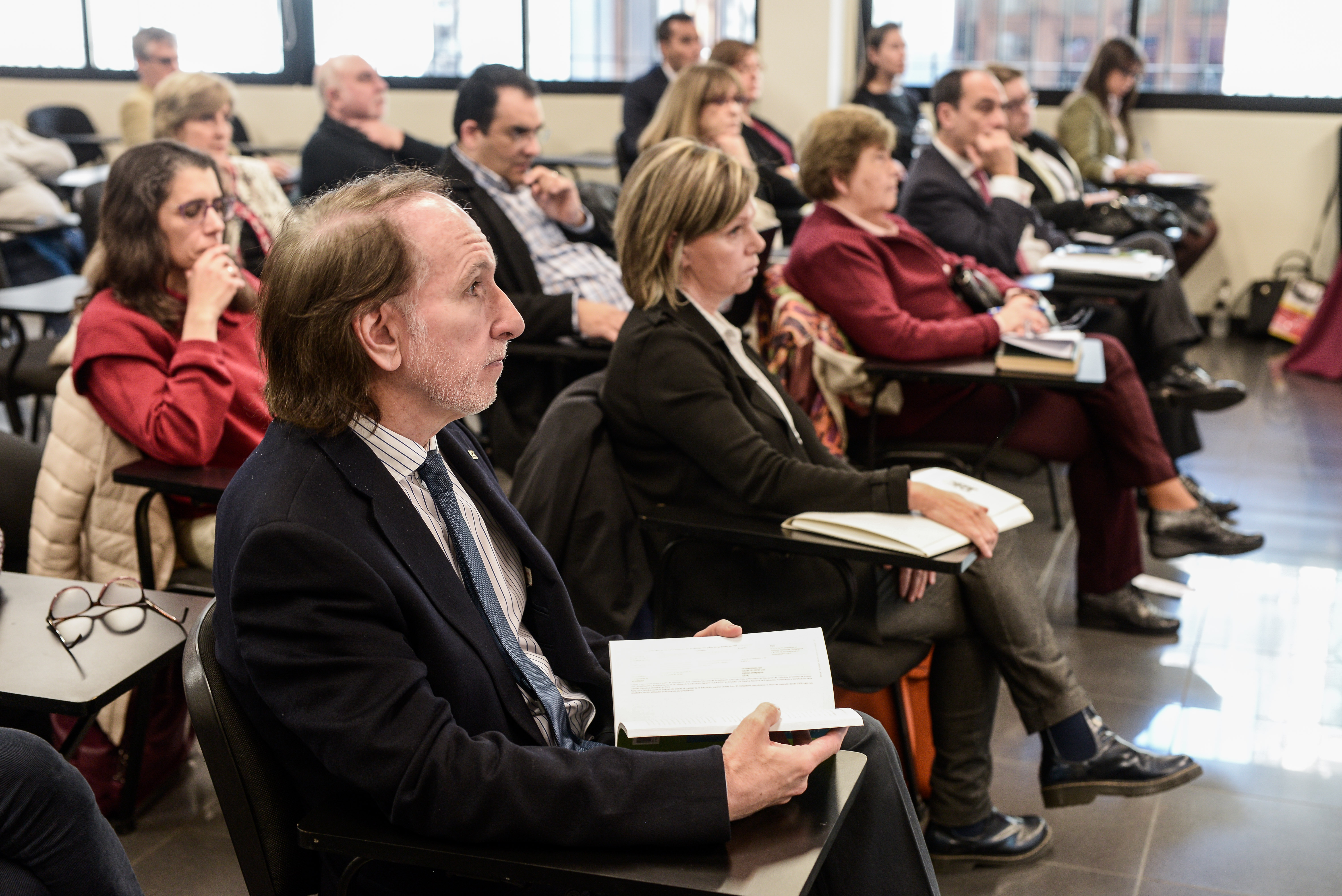
The ceremony, organized by the Institute of Education at Universidad ORT Uruguay, was opened by the rector . Jorge Grünberg, and was attended by representatives from the Inter-American Development Bank (IDB): Marcelo Pérez Alfaro, lead education specialist, and Fernando Cuenin, head of operations.
The book was presented by co-author Diana Hincapié, an economist with the IDB’s Education Division, and was discussed by Dr. Denise Vaillant, academic secretary of the ORT Institute of Education; Ana Lopater, M.A., director of the CEF; and Nilsa Pérez, M.S. in Agricultural Engineering, general director and board member of the University of Labor of Uruguay (CETP-UTU).
In addition, the study examined changes in the profile of Uruguayan teachers and students. As a result of the expansion and diversification of the country’s educational offerings, there has been an increase in the number of people working as teachers, although a large number of them do not hold a teaching degree but teach nonetheless.
This study was presented by Prof. Virginia Verderesse, director of planning at CETP-UTU, and Dr. Ana Balsa, professor and researcher at the University of Montevideo (UM), both of whom are co-authors of the book.
Impact factors
Low salaries and limited pay raises as teachers advance in their careers are some of the factors that make the profession less attractive. In addition, the IDB’s research identified two historical reasons that have contributed to the decline in the prestige of the teaching profession: the expansion of school enrollment and the diversification of employment opportunities for women.
As Hincapié explained, between the 1960s and 1980s, Latin America experienced a rapid increase in school enrollment, which was accompanied by a rise in the number of teachers.
Greater access to basic education led to the hiring of thousands of new teachers in a short period of time. “This resulted in a decline in quality, prestige, and training,” Hincapié said.
In Uruguay, according to data presented by Verderesse and Balsa, the number of people working as teachers increased by 54% between 2009 and 2017; however, the percentage of new teachers with a degree decreased from 55% in 2005 to nearly 10% in 2017. According to the research, the teacher-to-student ratio increased, but there are more teachers with less classroom experience.
Another ongoing challenge in the Uruguayan education system is the low retention rate of teachers at individual schools. Although this retention rate increased slightly according to the study by CETP-UTU and UM, it remains very low. Today, on average, a teacher holds a stable position at an educational institution for one and a half years.
On the other hand, the study notes that in recent decades the labor market has begun to offer women—who make up the majority of students in classrooms—other career options, thereby steering them away from teaching.
“The types of fields women traditionally pursued have changed. While their participation in education remains high, the number of women has also grown in other fields. Today, many talented women are not drawn to the profession,” Hincapié explained.
New profiles
In Uruguay, as a result of increased access, the characteristics of the student body have changed. “The student population we’re working with is different. This new profile requires us to adapt our programs,” say researchers Balsa and Verderesse.
Under the Basic Vocational Training Program, run by CETP–UTU, the students in basic secondary education are older and have non-linear educational backgrounds; in other words, they dropped out at some point and are now returning to school.
As student enrollment rises, the average student has a lower level of educational background. More students are completing high school and coming from households with lower educational levels: as educational opportunities expand, the percentage of students whose mothers attended high school is declining.
The only way
Speaking on behalf of Universidad ORT Uruguay, rector . Grünberg emphasized the institution’s commitment not only to higher education but also to secondary education. “There is no other path to improving higher education than by improving secondary education,” he stated, adding that education is the “only means of liberating societies.”
For his part, IDB representative Fernando Cuenin highlighted the key role that teachers play in rethinking the future of education. “Teachers are central to any effort to address the challenges facing our young people,” he said.
In this regard, the academic secretary of the ORT Institute of Education, Dr. Denise Vaillant, encouraged the pursuit of this type of research, which helps generate systematic evidence: “It provides insights for future research and reflection, and offers data for decision-makers,” she said.
“If we want to know what Uruguay will be like in 20 years, let’s look at the education system today,” Vaillant said. He also explained that while there are “inspiring” reforms today, they have an “expiration date.”
“The training program prepares innovative teachers through collaborative practices, but once they enter the classroom, the system swallows them up because the reality is quite different,” explained Vaillant.
What can be done?
The study presented by Hincapié identifies three key requirements for reversing the current situation: “Attracting, preparing, and selecting future teachers,” explained the co-author.
In this regard, he referred to the development of policies aimed at attracting new candidates by offering more favorable working conditions. “As we improve teachers’ salaries and make them competitive with those of other professions, we will be able to attract better candidates,” Hincapié said.
Another change involves more selective recruitment through transparent and rigorous entrance exams, mentorship programs, and probationary periods.
Image gallery