The data was released during the presentation of the preliminary findings of the project “Educators in the Digital Age: Learning to Teach with Technology in the Initial Training of Secondary School Teachers in Uruguay.”
This is an international cooperation project—led by a group of faculty members from the Institute of Education at Universidad ORT Uruguay the University of Seville—that aims to help improve the quality of teaching and learning through technology in initial teacher education.
Background
“No one changes just because they’re told they have to. Teachers won’t incorporate technology if it doesn’t make sense to them,” said Dr. Carlos Marcelo—professor of Educational Methodology and School Organization at the University of Seville and co-director of the project.
For this reason, the research group set out to explore how 21st-century teachers are tackling the challenge of integrating technology: “How do teachers accustomed to writing with chalk transform into professionals who use a keyboard?”
The core of the project was the learning activities because, according to the visiting professor from the Institute of Education, there is a strong emphasis on what “the teacher does,” and, ultimately, students learn because “they do things.”
Availability of the technology
“One of the findings was the identification of a wide range of technologies that both teachers and students have access to during their initial teacher training,” said Dr. Eduardo Rodríguez Zidán, associate academic coordinator for graduate programs at the Institute of Education and one of the co-leads of the research.
However, what kind of technology was available at the centers? According to the survey, there was a “very wide range” of resources, such as videoconferencing rooms, televisions, and laptops.
Nevertheless, not all fourth-year education students had access to a computer at the time of the survey (August–September 2016).
The project—which was developed in response to the call for proposals from the “Digital Inclusion: Education with New Horizons” Sectoral Fund, launched by theNational Agency for Research and Innovation and the Ceibal Foundation—also revealed that both teachers and students faced difficulties accessing Wi-Fi at the schools surveyed.
What is it used for?
According to the students, technology is widely used in all areas—with the exception of teachers in the core vocational training program. In that curriculum area, one-third of the instructors hardly use it at all.
The researchers, in turn, set out to investigate the guidance provided by teaching methods instructors regarding the use of technology. “They provide guidance on platforms” and “they suggest working on content using technology” were the two most frequently mentioned points. “Working on projects using technology” and “using specialized software” were the least frequently mentioned.
In any case, “showing audiovisual material in class” and “presenting content using PowerPoint or Prezi” were the tasks most frequently performed by students during their teaching practicum.
With regard to technology-based learning activities, they observed a recurring pattern among both teachers and students: communicative activities—those involving dialogue, negotiation, and interaction with others—and assimilative activities—those in which students engage with specific information in a pre-structured manner—predominate.
The activities most frequently carried out by students—and, to a lesser extent, by teachers—are experiential activities—those that expose students to the realities of professional life—and technology-supported assessment activities. The project leaders concluded that the data are consistent with international studies on the subject.
What do education professors say?
According to the interviews conducted, the pedagogy instructors stated that “some things were changing” or that, at the very least, “there was a possibility of change” toward more practical, participatory classes that were more focused on student learning activities.
They also highlighted two major changes in teaching practices. On the one hand, “changes that are general in nature, not specific to a particular specialty,” explained Gabriela Bernasconi, M.A.—academic coordinator ofthe Master’s Program in Teacher Training at the Institute of Education and a researcher on the project.
For example, in terms of communication: there is more interaction between teachers and students, since the classroom environment has changed. This is also true for lesson planning, as technology is now used for that purpose.
On the other hand, changes—which can be considered “best practices” in the use of technology—were identified across various disciplines. Some teachers reflected on the scope of the change.
One of the teachers interviewed asked herself, “Can I be a good teacher without embracing technology or using it too much?” She wasn’t so sure.
Some conclusions
Although technology is widely used, and 82% of students at regional teacher training centers report that the use of technology has changed the way they learn, according to Rodríguez Zidán, a profound shift in teaching practices is occurring “among a smaller percentage of teachers.”
At the same time, he added that “there are differences in usage depending on the disciplines and majors students are pursuing”: it is more general in the social sciences and humanities, while in the natural sciences and mathematics it is more specific, though less extensive in scope.
Furthermore, the research concluded that teachers receive training in the field: “Training in ICT carries practically the same weight as subject-specific and pedagogical training.” The Ceibal Plan is the leading institution for training educators and students.
Rodríguez Zidán emphasized that it is important to “take it a step further,” to shift the model of teaching practices and to think of technology “in terms of learning activities.”
“What we propose is to broaden the scope—so that it is not limited to the so-called ‘hard sciences’—and ensure that all disciplines identify this relationship between technology, learning, and content in initial teacher education.”
Finally, he stated that a major challenge for the future is to “align initial teacher training”—particularly in the area of pedagogy—with the “changing teaching models that student teachers are developing during their practicums.”
Photo gallery of the event
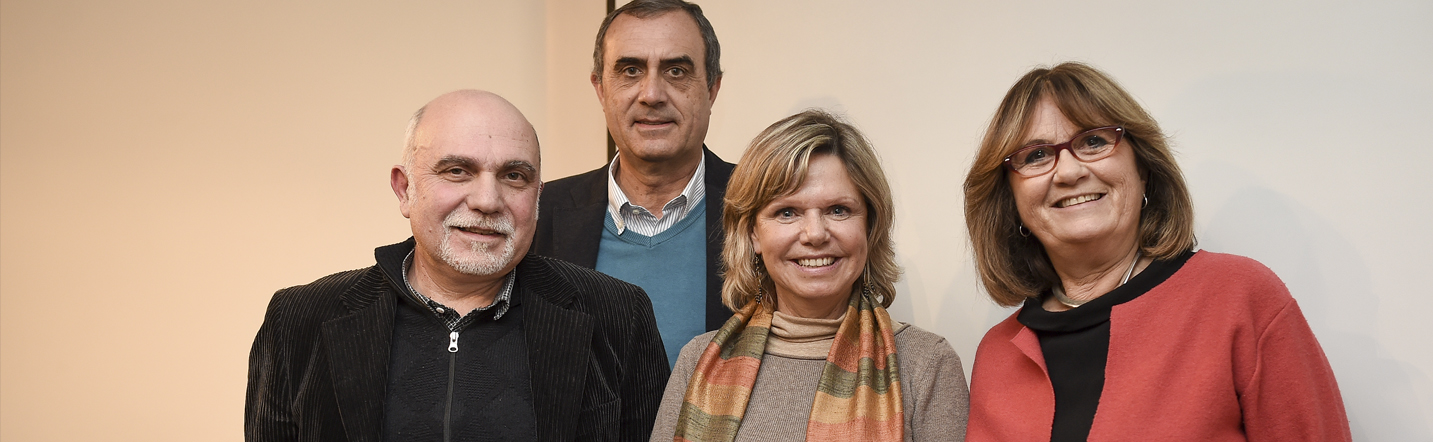
A presentation on the progress of the “Educators in the Digital Age” project was held on Tuesday, June 13, 2017, in the auditorium at the Downtown Campus.