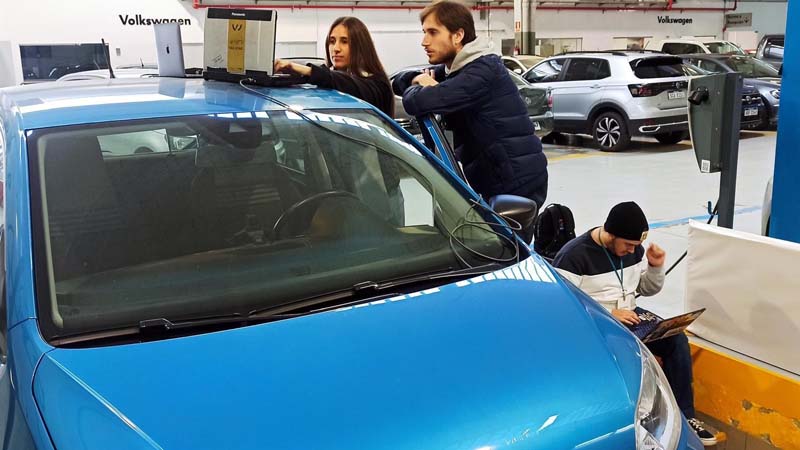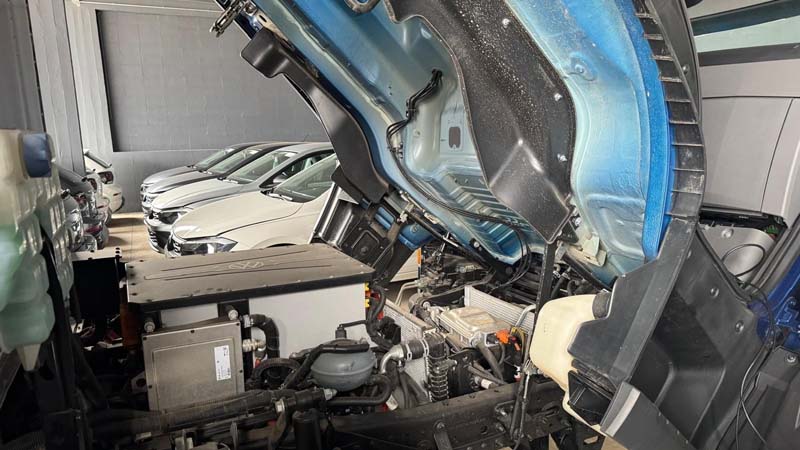
Ignacio Ortiz, Nicolás Valdés, and Pilar Busquets not only focus on real-time monitoring, but also aim to provide personalized recommendations to car owners, offer valuable information for used-car buyers, and provide new solutions to repair shops and manufacturers. This project has the potential to promote the adoption of electric vehicles and contribute to sustainability.
What is the main objective of your project?
The project aims to optimize the service life of electric vehicle batteries by monitoring and analyzing vehicle diagnostic data. By continuously monitoring these batteries and tracking changes in battery wear, the project will enable personalized recommendations for owners on how to best maintain them, provide forensic-grade information for used-car buyers, and could even become a new after-sales tool for repair shops and manufacturers.
What technology are they using?
We use IoT technology to collect relevant battery data in real time by installing a device in each electric vehicle.
This device was provided by Smartway to collect, decode, and report data via telemetry. It allows us to instantly retrieve the data on a web platform for further analysis.
In turn, one of our most ambitious goals is to use machine learning techniques to model the battery’s lifespan curve. This will allow us to quantify and predict the rate of battery degradation based on current usage patterns.
What is it like to work on real cases, and what kind of feedback have you received?
So far, we have worked with two distinct real-world use cases based on vehicle size: leased electric vehicles and electric trucks. Thanks to the support of Julio César Lestido, we were able to work with vehicles from both categories and gather firsthand feedback from both the customers who use the vehicles and the technicians responsible for their maintenance.
We have received very positive feedback from these exchanges, and there are many areas to further explore in our research, given that there is still no consensus on how to analyze the battery data.
Since these are electric vehicles, how does your project contribute to sustainability?
This project contributes indirectly to sustainability, but in a variety of ways. Our research has shown that people in our country still have reservations when it comes to choosing which vehicle to buy. We believe that batteries with a longer lifespan can encourage new users to choose electric vehicles over conventional combustion-engine vehicles, thereby reducing the carbon footprint caused by transportation.
In addition to promoting choice, extending the battery’s lifespan could help delay the point at which it needs to be disposed of. In our country, there is no disposal plan for these batteries, and some European countries are facing significant costs associated with reuse projects.