https://youtu.be/jfAUeYFfqhI
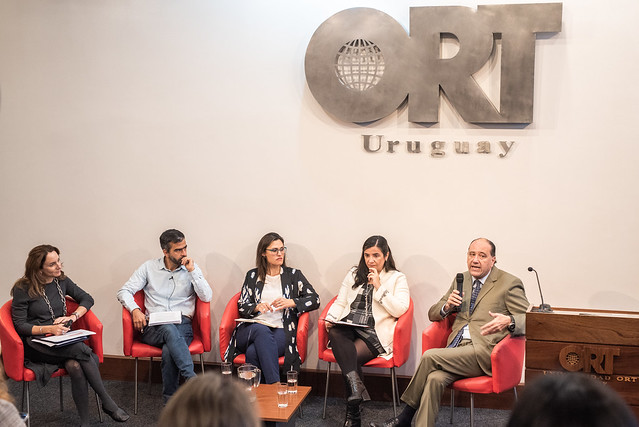
Experts exchanged ideas on the creation and implementation of the telework decree during the conference “360 Telework: Open Dialogue.”
The event—organized by the International Organization of Human Capital Executives (DCH) and the Graduate School of Business at Universidad ORT Uruguaytook place on Thursday, May 12. It was held in a hybrid format (some participants attended in person, while others joined via HyFlex®).
Presenters included Virginia Maruri—who holds a postgraduate degree in organizational communication, is a director at DCH, and serves as manager of human resources and occupational health and safety at SAMAN—; Enrique Herrera—who holds a postgraduate degree in human resources and serves as human resources manager at TATA SA—; Carmen Sanguinetti—who holds a Master of Public Administration and serves as a senator for the Colorado Party—; and María José Poey —Ph.D. in Law and Social Sciences, Legal Counsel at Guyer & Regules—.
Regulations on Telework
Senator Carmen Sanguinetti noted that “teleworking is an indispensable ally.” She explained that it allows people to “balance demanding careers, and it is also ideal for people with disabilities and those who live far from urban centers. It is a highly relevant and valuable way of working for a country like ours.”
Regarding its regulation, he stated: “It’s not that telework wasn’t regulated, but rather that it was governed by labor laws from 100 years ago.” In that sense, this law is important, as it provides a framework for and addresses the various issues surrounding telework today.
“I think this is a law that can be improved, like all laws, but we had to start making progress, and I believe it’s a step in the right direction.”
The Legal Perspective
“I think some companies already had telework policies in place and were already in the process of implementing different work arrangements. On Friday, March 13, 2020, the issue really took off, and there’s no doubt it’s here to stay, ”said María José Poey, Ph.D. in Law and Social Sciences.
From a regulatory standpoint, the expert wondered whether it was necessary to adopt a regulation and concluded that“while it was not necessary, it was desirable.”
The law requires the parties to agree, in writing, on the terms of the arrangement. “The novelty of telework is that employees will be able to freely organize their workday around the hours that best suit their needs, provided they adhere to the weekly limit.”
Additionally, the law stipulates that there must be a minimum break of eight consecutive hours between one workday and the next.
“During their time off, employees are not required to respond to work-related communications they receive.”
The expert also explained that this breaks the general rule that the employer is responsible for providing work tools and covering the associated costs.
However: “The rule that the employer is responsible for the health and safety of workers remains in effect and continues to apply explicitly to telework. Furthermore, the employer must establish a mechanism to ensure that work is performed correctly and safely.”
As for information security controls, “although the regulations don’t say anything specific, I think it’s time to strengthen everything related to information security policies, confidentiality, and so on.”
The paradigm shift
“In our case, at Grupo TATA, about 500 employees began working remotely on March 13, 2020, when the first four cases of COVID-19 were reported in Uruguay,” explained Enrique Herrera, human resources manager at TATA SA.
“In 2018, we started using Google Meet. At that point, we began to wonder whether people were actually getting good results from working online.” Between 2018 and 2022, Herrera said there was a complete paradigm shift.
The focus now is not on whether the work is done well or poorly depending on the method, but on who is performing those tasks.
“When the pandemic hit, we were already somewhat accustomed to using remote work as a perk. During the pandemic, it became the norm, ”Herrera said.
“We had to learn and work hard with the leaders on setting limits on our work hours, writing messages only during designated times, and not at any time. In that sense, it was a challenge and a huge learning experience.”
Culture and flexibility
Virginia Maruri, SAMAN’s manager of human resources and occupational health and safety, stated that “we often blame remote work for issues that actually stem from the organization’s culture.”
“In March 2020, a major part of our work at the plant was managing fear. We had to make an effort to ensure our employees understood that the doctors had to keep going, the nurses had to keep going, and those of us who prepare food also had to keep going,” he said.
“We had to emphasize the importance of work and of what each person contributed in their respective roles. Those who had to continue working in person understood this and bravely kept coming to work. For those who switched to remote work, we made it clear that the only difference was not being in the same physical location, but that this should not affect the quality or quantity of their work.”
The expert emphasized the importance of leaders trusting their employees. If employees prefer to work remotely for personal reasons, it is beneficial to offer them that option. “We are people first, and workers second.”
“If you need to see your employees to believe they’re actually working, the problem lies with you. What the pandemic has given organizations—and I don’t think we can ever go back—is the flexibility of remote work,” he said.
He stated that it is essential“to have the option to stay home if we need to. After that, it’s up to each person to decide whether to use it or not. We’ve taken a giant step forward, and I don’t think we can go back.”
Image gallery: