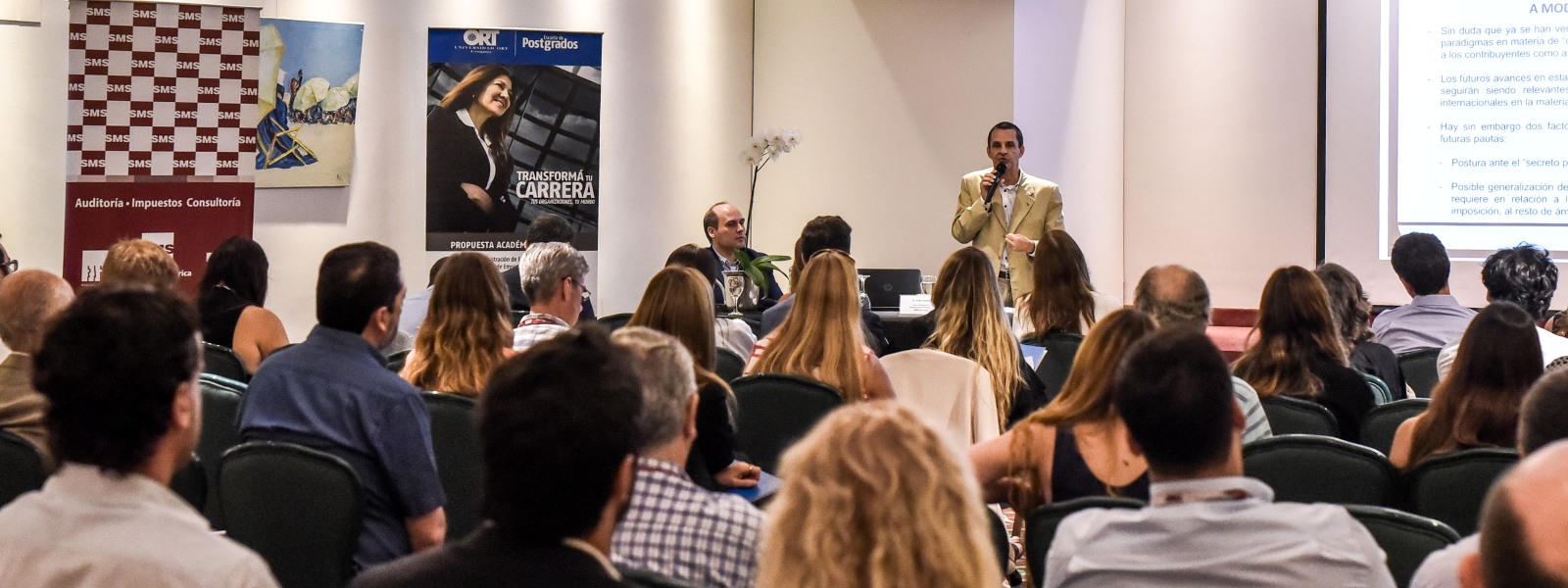
Local and international experts discussed the most pressing issues in the global tax landscape during the 7th Uruguay Tax Conference, a technical and academic event that has become a staple on the calendar for business leaders, tax advisors, academics, students, and regulators in Uruguay and the region.
The event took place on February 22, 2019, at the Barradas Parque Hotel in Punta del Este. The central theme of this year’s event was taxation in new local, regional, and international contexts.
The conference was organized for the seventh consecutive year by the Academic Coordination Office for the graduate programs in accounting and taxation at Universidad ORT Uruguay. The Graduate School of Business has graduate programs in taxation: the Master’s in Taxation and Accounting Standards—IFRS and the Specialization Diploma in Taxation. Through elective courses, students can give their graduate program a significant focus on international taxation.
This year’s conference was sponsored by SMS Latinoamérica and PwC Uruguay, both professional firms that provide tax, audit, accounting, economic, and financial services.
The event was opened by Dr. Nicolás Gambetta, academic coordinator of the graduate programs in accounting and taxation at the Graduate School of the Faculty of Administration and Social Sciences.
Gambetta highlighted the importance of this annual event, which has become a staple for professionals in the tax industry.
The first presentation was given by Félix Abadi, a certified public accountant, professor of taxation, and instructor in ORT’s graduate tax programs, as well as a partner at SMS Uruguay and the law firm Rueda Abadi Pereira.
Abadi spoke about the role of tax advisors in the current climate, as well as the impact of the Anti-Money Laundering Act.
The professor highlighted the major shifts in tax compliance paradigms at both the international and local levels, as well as their impact on both taxpayers and “tax advisors.”
He also highlighted the uncertainty surrounding future developments in this area, as well as the importance of such critical issues as professional secrecy and the Principal Purpose Test under Action 6 of the Base Erosion and Profit Shifting (BEPS) initiative.
Luciana Ávalo, a certified public accountant and head of the Legal and Tax Department at PwC Uruguay, reviewed the latest developments in transfer pricing, a field in which she specializes. Ávalo highlighted the impact of BEPS and its Action 13: country-by-country reporting.
In addition, he presented the changes to the transfer pricing regulations in our country, focusing on the new formal and compliance requirements in this area.
“Tax rulings are no longer merely a compliance issue; they have become a source of controversy between businesses and tax authorities,” he said.
Next to speak was Dr. Roberto Bernales, who holds a Ph.D. in Law from the University of the Basque Country, where he is a professor of tax law, and serves as a visiting professor in ORT’s graduate programs.
Bernales discussed international tax planning in the post-BEPS era and the Multilateral Instrument (MLI), asking, “Are we moving toward a new paradigm in international taxation?”
Kicking off the afternoon sessions, Venancio Trigo, a partner at Guyer & Regules and Grant Thornton and an instructor in the university’s graduate tax programs, presented the main changes to the free trade zone regime, another consequence of BEPS.
The professor reviewed the reasons behind the amendment to the law, the changes regarding services provided to non-free zones, and the exceptions concerning activities permitted in non-free zones.
He also reviewed the new procedures that users must follow, the new staffing requirements, changes in the “retail sector,” and, finally, the latest developments regarding transfer pricing for users.
Next, Pierina de León, Esq., head of the Legal and Tax Department at PwC Uruguay and an instructor in ORT’s postgraduate tax programs, spoke about changes in income taxation related to software.
During his presentation, he reviewed the key developments in the tax treatment of software development and highlighted how, once again, the new international context and the BEPS actions have led to a new tax regime for software development.
To conclude the event, Adriana Piano, a partner at SMS Latin America and professor at the University of Buenos Aires, spoke about Argentina’s national and international context.
The accountant focused her presentation on three main topics: inflation in Argentina and its fiscal implications, the 2019 Budget Act, and the implementation of the tax reform.
Image gallery:

(