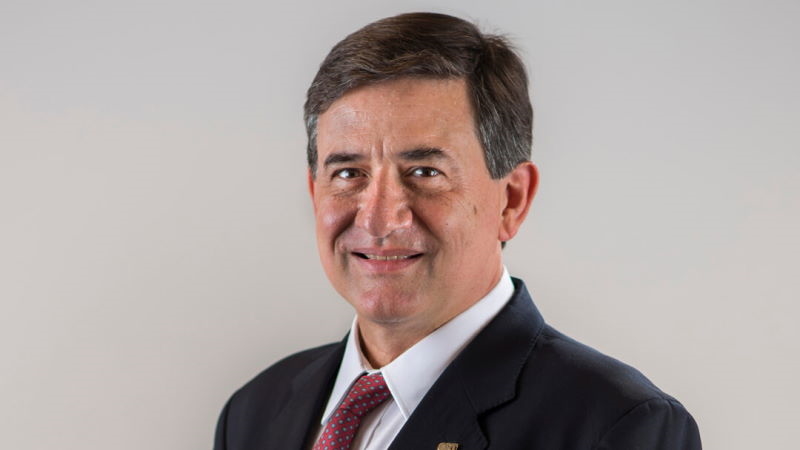
The Honorary Scientific Advisory Group, established in April 2020, is coordinated by Isaac Alfie, director of the Office of Planning and Budget (OPP), and comprises Dr. Rafael Radi, full professor at the Faculty of Medicine of the University of the Republic (Udelar) and president of the National Academy of Sciences; Dr. Henry Cohen, professor at the Udelar School of Medicine and former president of the National Academy of Medicine; and Dr. Fernando Paganini, vice dean of research and professor of telecommunications theory at the School of Engineering at Universidad ORT Uruguay, and member of the National Academy of Sciences.
The experts are tasked with coordinating various initiatives—currently underway within the scientific community—that aim to assess the status of the epidemic, predict its future course, and develop tools to improve the healthcare system’s response capabilities. In this way, the team provides input to help the government decide on the actions to take based on the best available information.
In particular, Paganini is responsible for coordinating groups that work with data. There are teams working in the engineering, economics, and science departments at the University of the Republic, in the Epidemiology Division of the Ministry of Public Health (MSP), and in the private academic sector, among others. The goal is to avoid unnecessary duplication of effort and to ensure that results are shared and communicated.
There are different ways to analyze data: one is to build mathematical models, estimates, and predictions, and another is to address the issue from a control perspective. For example, when a positive case is identified, tracing the person’s contacts and ensuring that they all get tested. Some countries, such as South Korea, have been successful with this type of approach.
Efficiently tracking contacts is part of Paganini’s job. That is why he has already reached out to the development team behind the Coronavirus UY app, which is working on a system to send alerts to the phones of people who have come into contact with someone who tested positive for COVID-19, using GPS data from mobile phones while ensuring confidentiality.
Fernando Paganini holds a Bachelor's degree in Electrical Engineering and a Bachelor's degree in Mathematics from the University of the Republic, as well as a Master's degree and a PhD in Electrical Engineering from the California Institute of Technology (Caltech) in the United States.
His doctoral dissertation was awarded the Wilts and Clauser Prizes. He was a postdoctoral researcher at the Massachusetts Institute of Technology (MIT) and a professor at the University of California, Los Angeles. Since 2005, he has been a professor of Telecommunications Theory in the School of Engineering at Universidad ORT Uruguay.
He is a Level III researcher in the National System of Researchers and served on its Honorary Committee. His publications have received the O. Hugo Schuck Award from the American Automatic Control Council in 1995, the Axelby Award from the IEEE Control Systems Society in 2004, and the Scopus Award from Elsevier in 2010. He is a Packard Fellow and a Fellow of the Institute of Electrical and Electronics Engineers (IEEE).
He has served on the editorial boards of the journals *IEEE/ACM Transactions on Networking*, *IEEE Transactions on Automatic Control*, and *IEEE Transactions on Network Science and Engineering*. He is a member of the National Academies of Sciences and Engineering, as well as the Latin American Academy of Sciences.