 To verify this, the research team spent two months developing an app designed for guitarists amateur to assist with reading song tablature by displaying the chords to be played in a format that augmented reality, in a format consistent with the view template HUD (head-up display) and in sync with the song's playback.
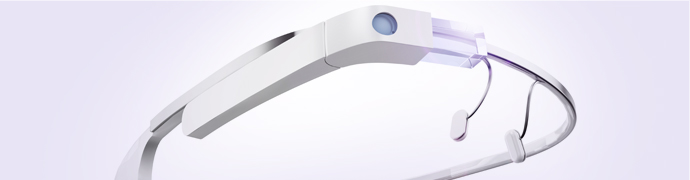
“Google Glass is the name given to the smart glasses created by Google (…), which offer users an augmented reality experience through a visual interface that provides many of the features of an Android smartphone and connects users to Google’s cloud services,” explain the authors in the research paper “Context-Aware Software: Definitions and Development of a Case Study on Google Glass,” published in May 2015.
The research—conducted by systems engineering students Diego Galico, Kevin Natanzon, and Carlos Vega, along with Dr. Martín Solari and Dr. Santiago Matalonga—confirms the growing importance of context-aware software; that is, software developed for ubiquitous devices (integrated into a person’s environment), where the ability to gather relevant information is required in order to dynamically adapt the application’s behavior based on its context.
However, in its specific analysis of Google Glass, the team was able to identify both new challenges arising from the development of context-aware software and criticisms of a tool as mature as Google Glass.
Hardware dependency and cost
Researchers identified certain weaknesses in the Google Glass Software Development Kit (SDK). The most notable limitation is that applications can only run on Google Glass hardware, with no option for a simulator (unlike most smartphone development platforms, such as iOS, Android, and Windows Phone).
“This results in a high degree of dependence on an expensive resource, such as Google Glass hardware, which means that developing for this platform requires a significant capital investment,” the document notes. It adds that the lack of a simulator in the development environment significantly slows down the debugging and testing process.
Limited official documentation
Another major obstacle the researchers encountered was the lack of available documentation. The team had no prior experience using the Google Glass platform for app development, so the development of the prototype served to assess the learning curve associated with this technology.
The results of the process show that some of the technical obstacles encountered cannot be resolved using the official application programming interface (API) documentation, although solutions are available in online forums and developer communities.
“While Google’s documentation is useful for a preliminary overview of design patterns and the specific features of development on Google Glass, from a technical standpoint, it does not yet have the level of maturity or detail expected of a platform of this scale,” the research paper states.
Implementation issues
During the presentation, two examples were given of obstacles that could not be resolved using the official documentation.
On the one hand, the team had great difficulty implementing the voice command “OK Google, open Guitar Pro” to launch the app. Although the code required to link this command to the app’s launch was correct, they lacked the necessary permissions to use commands not registered by Google.
On the other hand, another technical issue that was identified and resolved without the help of official documentation concerned the playback of audio files, where restrictions on supported formats and file sizes were discovered.
Challenges to overcome
According to the researchers, “the effort required to develop the app for use on Google Glass was considerable, due to the relative instability of the platform, which has several unstable points and a lack of concrete guidelines that can slow down development.”
The application successfully met the goals of context adaptation from the user's perspective. However, developers still need access to higher-level abstractions and API features to effectively address the new technical and methodological challenges involved in developing context-aware software.
Google Glass was discontinued in January 2015, a move that was interpreted by media outlets around the world—including The New York Times, Forbes, and the BBC—as a failure of the platform.
However, “augmented reality and context awareness remain a priority for tech companies,” explains Dr. Martín Solari. “There is speculation that Google will soon launch a new prototype, although it will be very different from the previous one,” he adds.