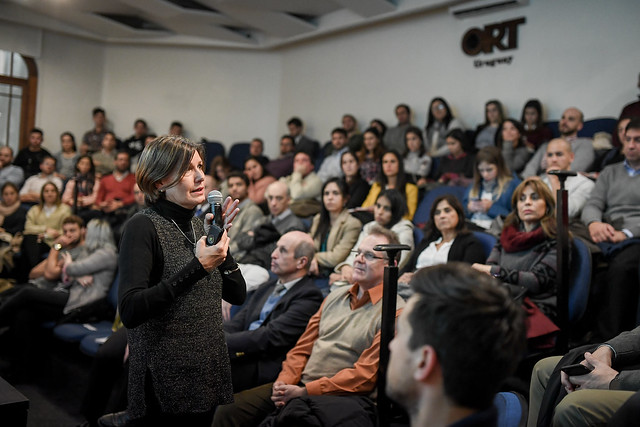
"The holistic sum of experiences people have with a brand—or the consumer journey—has become more complex with the rise of digital media," said Dr. Teresa Cometto, a marketing professor at Universidad ORT Uruguay Unilever's manager of marketing, market research, and media.
The expert elaborated on this concept during the talk titled “The New Marketing Paradigm in a Connected World: Understanding the Customer Journey.” The event was moderated by Dinorah Margounato, assistant marketing coordinator at the School of Business and Social Sciences.
The event featured Valentina Núñez San Martín as a panelist; she holds a degree in Marketing Analysis and serves as the online marketing manager at Facilici, a company that helps users of all kinds find services. She discussed some of the latest trends in the Uruguayan market and shared her extensive experience working as a freelancer.
“The world of marketing is bigger than you can imagine. You can work in any field you can think of. It’s hard to find a career that’s so multifaceted and broad,” said Núñez.
The event was part of the “Living Marketing” series. It took place on Thursday, July 5, 2018, in the Pocitos Campus Auditorium.
Defining the consumer journey
The consumer journey —or buyer’s journey—is a term that, as Cometto explained, loses some of its meaning in translation. The expert defined it as the “holistic sum of the experiences people have with a brand over time.”
"In the past, the consumer journey was simple and linear. Today, it is more complex," Cometto said. "The emergence and development of digital media, such as websites and social media, have had a major impact on the user experience," he added.
Cometto outlined three key steps in the design of the route:
- Identify the buyer
- Map the consumer journey
- Focus and prioritization
What is a buyer persona ? A buyer persona is a “semi-fictional character” based on research that represents a group of people and has specific behavioral patterns and motivations.
How do we define the buyer persona ? The process involves three stages that everyone goes through.
- Consideration: The person is experiencing symptoms of a problem.
- Understanding: The problem is identified, and the options are explored.
- Decision: We will proceed to find a solution to the problem.
Understanding people’s day-to-day roles, family structure, and professional circumstances are some of the key areas to explore when defining the buyer persona.
Personas can be segmented based on their profiles. For example, it is possible to distinguish between shoppers who prioritize online research and those who wait until the last minute to make a decision at the point of sale.
The Importance of Having a Map
The consumer journey map is a tool that visualizes the buyer's experience across various channels. Its creation involves several stages, such as identifying triggers, influencers, and the actions of potential buyers.
“People’s actions aren’t necessarily limited to just making a purchase,” Cometto said. Other possible actions include searching for information and evaluating products before making a purchase, as well as recommending them afterward.
The map is extremely helpful for developing strategies and refining communication details. Cometto explained that it is important to observe how customers interact with different media and demonstrated how this analysis influences brand building.
The expert said that digital media has greatly improved targeted access to specific products. “We’ve never been able to target audiences as effectively as we can now. We used to talk about the importance of targeting, butin our communications we had no way of reaching people directly based on their interests, behavior, or context,” she explained.
Cometto pointed out that many companies make the mistake of trying to reach 100% of the public. Instead, he recommended focusing on the audience that is actually willing to buy.
“To capture people’s attention, content is king. The story is king. As users, we have much more power than we used to,” he said.
Learning again
“There’s no limit to what you can achieve, and the most important thing is to prepare yourself,” said Cometto. “That’s the foundation: having a solid education so we can reach our full potential,” he added. He also recommended “going back to the basics of college whenever you need to relearn something.”
Finally, he discussed the shift from traditional “full-service agencies” to the current landscape, where diversification and specialization are essential. “The best approach is to have interdisciplinary teams working in coordination.”
Image gallery: