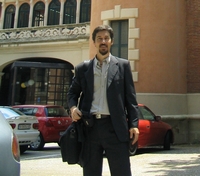
 The coordinator led seminars at
the Erasmus Mundus Master's Program
Álvaro Cristiani, Academic Coordinator of Human Resources at the School of Management and Social Sciences, delivered two seminars onCompensation Systemsin July 2008 at the University of Valencia and the University of Barcelona, aimed at students in the Erasmus Mundus Master’s Program in Organizational Psychology and Human Resources.
Interview with Álvaro Cristiani, Academic Coordinator of Human Resources.
How did the opportunity to lead these seminars come about?
This is a long story, featuring two main protagonists whom I cannot thank enough. It dates back to my time atCarnegie Mellon University and to my debt of gratitude to the person who guided me down this path of resources and organizations: Professor Denise Rousseau. Once in Uruguay and immersed in academic life, I told Professor Rousseau that I wanted to continue my doctoral studies, and she suggested that I contact Professor José Peiró at the University of Valencia. And so, to summarize the stages, I was admitted to the doctoral program and awarded anErasmus Mundus Scholarshipto work on my thesis research and teach in theEuropean Master’s in Work, Organizational, and Personnel Psychology (WOP-P).
How does this relate to your academic work at ORT University?
In every way. In my role as Academic Coordinator of Human Resources, I carry out tasks related to academic administration, teaching, and research. As a visiting professor in the WOP-P Master’s program, I had the opportunity to learn about other academic curricula, methodologies, and, of course, meet outstanding faculty members in various disciplines.
What does "Compensation Systems" mean?
In short, the Compensation System (CS) in an organization refers to all matters related to how people are compensated. Compensation systems play a very important role from both an organizational and an individual perspective. They are designed and managed to achieve certain strategic objectives, aligned with other human resources systems and policies (recruitment and selection, performance evaluation, training, etc.), which feed into and support one another.
Management decisions regarding how to reward employees are particularly important when implementing corporate strategy. Of all the messages an organization conveys to its employees through its human resources policies and practices, the message implicit in how people are rewarded truly communicates the organization’s philosophy—that is, what it values—and its overall strategy.
The main objectives to be achieved are: 1) attracting potential candidates for job openings, 2) retaining good employees, 3) motivating employees, 4) managing compensation in compliance with legal regulations, 5) facilitating the achievement of the organization’s strategic objectives, 6) controlling labor costs to remain competitive and sustain operations.
What did the seminars he gave cover?
Essentially, these are the strategic decisions that every organization must consider when designing its compensation system to achieve its primary objectives:
- consistency / internal consistency
- external competitiveness
- recognition of employees' contributions and differences
- system administration
Who were they intended for?
First-year students inthe European Master's Program in Work, Organizational, and Personnel Psychology (WOP-P) from the University of Bologna (Italy),Paris Descartes University(France), andthe University of Coimbra(Portugal).
What did the experience offer you from an academic standpoint?
The diversity of the students made the courses a very enriching experience. The students came from a variety of disciplines, with different backgrounds and experiences, and brought with them diverse legal frameworks, labor markets, and wage practices.
What stood out most to you about the universities in Barcelona and Valencia?
Just the thought that the University of Barcelona was founded in 1450 and the University of Valencia in 1502 inspires respect and awe. But perhaps what caught my attention most during my time there—beyond infrastructure and resources, faculty, academic research, etc.—is the prominent role the university’s voice plays in daily life and in state policy decisions across various areas. One constantly reads or hears in the media about the technical contributions of university professors, as well as their participation in commissions and public policy decision-making bodies.