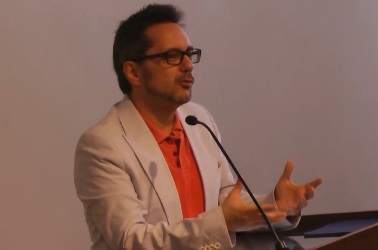
 Dr. Marcos Farias Ferreira, who holds a degree in International Relations from the Higher Institute of Social and Political Sciences at the Technical University of Lisbon (UTL) and has been a visiting professor at Universidad ORT Uruguay 2008, opened the Department of International Studies’ 2013 Lecture Series on April 10 with the topic: “What Kind of Europe After the Sovereign Debt Crisis?”
Farias Ferreira holds a master’s degree in European Studies from UTL and a master’s degree in International Relations Theory from the University of Aberystwyth. He holds a Ph.D. in Social Sciences and International Relations from ISCSP-UTL, where he teaches various undergraduate and graduate courses.
During his visit to the university this year, the professor addressed an issue of great economic and social significance: the European crisis.
Farias told the audience gathered at the School of Management and Social Sciences that whenever he visits Uruguay, there are always major economic developments taking place in Europe. In 2010, he recalled, there was the Greek bailout, “the big sign.” The following year was the Portuguese bailout. And this year, he said, a ruling by the Portuguese Constitutional Court rejected some major cuts, which could lead, he added, to a second bailout for the country. “I don’t know what I’ll find when I return,” he said.
He believes that Europe is undergoing a structural crisis. “It’s creating a sense that a number of things are going to change once we emerge from this crisis,” he said, adding: “The crisis will change the way politics is conducted in Europe; it will change the relationship between member states. It will change the relationship between European institutions, and between those institutions and the member states.”
Since this is not a temporary phenomenon, the analyst asserted that the European way of life is going to change, and the “welfare state” is going to change. “This is not just a financial crisis,” he said, adding, “It is financial, economic, social, and political.”
“Every crisis has led to progress in Europe, and everyone hopes that this crisis will do the same. That, as a result of this crisis, new ways can be agreed upon to move Europe forward,” he said.
Farias told the audience that there is a prevailing view that this crisis originated in southern Europe, in Greece, and then spread to other economies. However, he asserted, the reality is more complex, and this is a notion that must be debunked. “It is an inaccurate and overly simplistic view. The European crisis is the result of many factors.”
“The European crisis stems from the spread of the subprime crisis (the U.S. mortgage crisis) in 2007–2008, and this spread affected economies where the financial system was highly developed (the United Kingdom, the Netherlands, and Iceland). That was the first wave of the crisis. And that is why it is still referred to as a financial crisis—because of that initial spread from North America. Many countries had to bail out their banks with public funds,” the expert stated. Farias said that, later, in a second phase, the crisis shifted from financial to economic, and this caused several countries to see their long-standing problems worsen.
The professor explained that Europe is a highly integrated system, “and that means that in times of crisis, a small problem spreads to all the sectors it comes into contact with (…) and the European Union’s response has been very hesitant.” He said that it has not been possible to make effective decisions, in part because there are differing views on what needs to be done.
“The crisis stems from a combination of imbalances within the European Union. It has little to do with the inability of the southern countries,” he asserted. On the one hand, he said, there are the high current-account deficits and the accumulation of external debt in southern European countries, such as Greece. But on the other hand, he pointed out, there is the surplus and the creditor position of the north. It is a matter of “moral adjustment.”
Farías also spoke about the mistakes that weaker economies have been making. “Navigating the economic cycle in a pro-cyclical manner is quite dangerous,” he explained. He added that not all countries can afford to adopt austerity measures at the same time. As a result, he noted, it will be difficult to emerge from the crisis.
He also emphasized the importance of the European Central Bank and the decisions it makes.
“We are going through a period of transition, and the differences between the states are becoming more pronounced,” he said. According to the expert, a structural transformation is on the horizon. There will be a clash between those who advocate for greater integration and those who demand greater nationalization.
Farias sees two possible scenarios: fiscal union and disintegration. In either case, he is not optimistic. “The differences between the countries will grow.” It is unclear, he said, which country will be able to break free from conditional sovereignty.