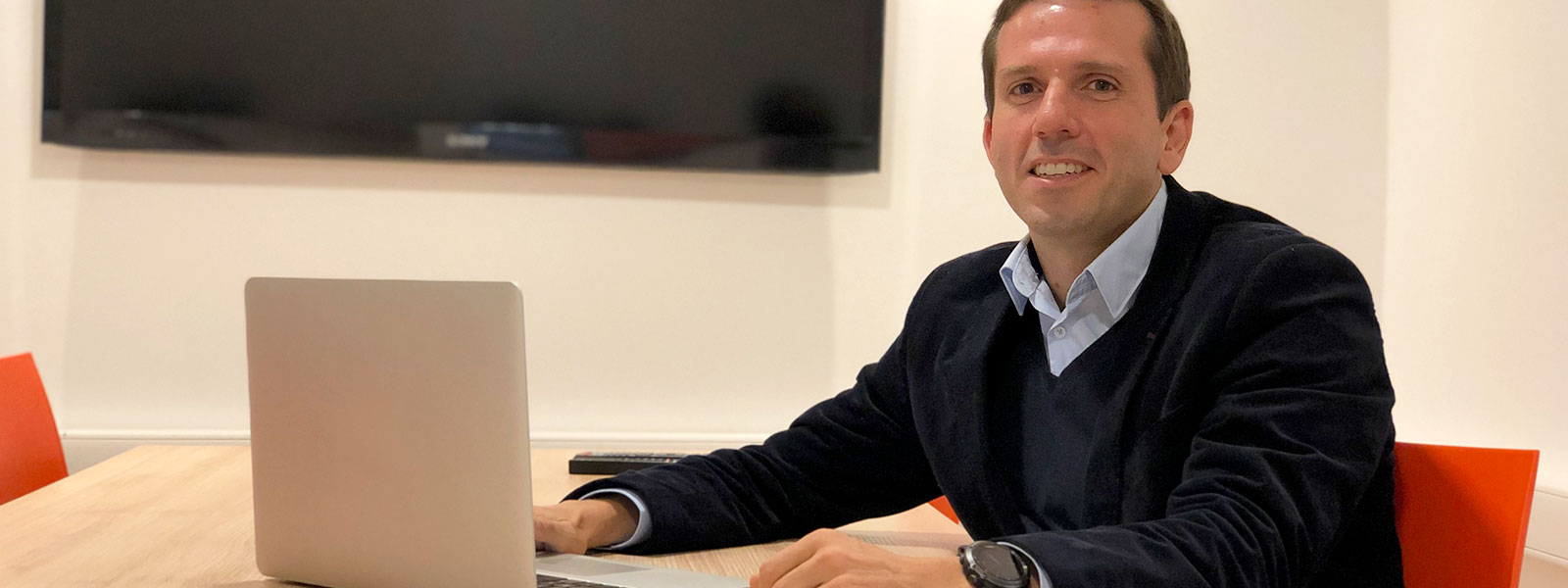
Martín González, who holds a Bachelor’s degree in Management and Administration and a Master of Business Administration (MBA) from Universidad ORT Uruguay, was appointed president of the Interactive Advertising Bureau (IAB) Uruguay in May 2019.
González was the manager of El País Digital; he is a professor in the School of Business and Social Sciences at ORT; and he is the director and founder of KEIRETSU, a consulting firm specializing in three areas: management, digital marketing, and information technology.
How did the opportunity to join IAB come about?
I joined the IAB practically from the moment it was founded. At the time, I was the manager of El País Digital. One of the first roles I held was that of treasurer. Later, when I left El País, I continued to contribute, this time as a member of ORT. At that time, I was part of the training committee.
I founded KEIRETSU four years ago, and I’ve been an IAB member through this company for the past two years. Last year, KEIRETSU worked on redesigning the IAB Uruguay website, which had just celebrated its 10th anniversary but whose website was no longer keeping up with current trends.
What does it mean to you to be president of IAB Uruguay?
It is a great responsibility, but also a tremendous recognition of who I am and the work I have done over the past 10 years, during which I have held various roles in the digital industry.
What are your goals as president of the organization?
Currently, IAB has 56 members. We need to increase that number—especially among advertisers—so they can gain a better understanding of the digital landscape and everything that’s happening in this industry.
Second, we will continue to focus on one of our core pillars—training—and on professional development activities such as working breakfasts, workshops, and the IAB Forum, which this year aims to reclaim its position as a leading event in Uruguay’s digital industry.
Third, since Uruguay is a service exporter, we need to lay the groundwork so that companies from other countries will choose to invest in Uruguayan suppliers. This will allow us to fully harness the talent and professionalism that exists in the country. Due to issues of scale, these capabilities cannot currently be developed in the domestic market.
Fourth, we will continue to work on industry standards, benchmarking against other IABs in the region and around the world, conducting studies on advertising spending, video consumption, mobile devices, and influencers, and focusing on metrics, creativity, and technology, so that we can keep pace with digital growth.
In addition, we will work to develop skilled digital talent. Finally, we will establish a framework of transparency so that advertisers and the market can invest in digital media with confidence.
What is the current state of the online advertising industry in Uruguay? And internationally?
To draw an analogy with its age, the digital advertising industry is emerging from childhood and entering adolescence. has doesn’t yet has financial has to stand on its own two feet, but day by day it continues to grow and mature, and it is imperative that we support it in this growth.
Digital advertising spending has been gaining a larger share of total advertising spending; however, total advertising spending has stagnated somewhat in recent years.
On an international scale, the situation is quite different. The level of maturity varies by country and continent, depending on sociocultural factors and even infrastructure.
Where is the industry headed?
The digital industry is shifting toward mobile. Internet usage is increasingly taking place on smartphones. Therefore, it’s essential to have a presence on smaller screens.
The digital industry is consuming more and more video content. Brands are looking to make an impact with their messages, creating stories and content that capture attention, entertain, and also educate consumers.
In this new trend, media outlets are producing content of journalistic quality. Consumers understand that even if content is sponsored by a brand, if it is valuable in its own right, they will consume it and ultimately thank that brand for the content.
The digital industry is striving for transparency, seeking to eliminate the concepts of fake news and non-human traffic, and focusing on high-quality content and smaller but genuine audiences.