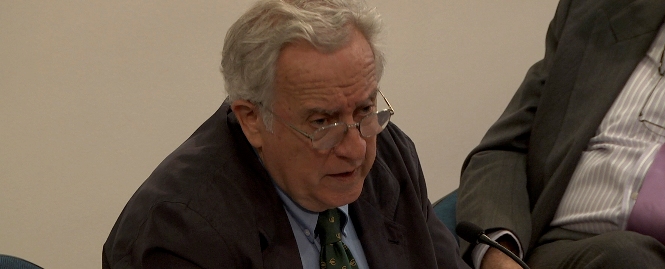
“The European Union (EU) is the worst experiment in cooperation among states, if we disregard all the others,” said Dr. Joaquín Roy, director of the European Union Center of Excellence at the University of Miami, paraphrasing a well-known quote by Churchill.
Roy analyzed the situation of the European Union (EU), as well as the challenges and issues it currently faces.
The lecture “The European Union Today: Relations with the United States and Latin America in the Trump Era” was held on Thursday, March 16, 2017. It took place in the auditorium at the Pocitos Campus and was organized by the Department of International Studies as part of its lecture series.
The European Union Today
“The EU was created to put an end to European wars, to put a stop to that great European pastime,” said Roy, who specializes in teaching and researching that economic and political union.
“It had to come to an end, and a system had to be put in place to make war unthinkable,” he added, referring to the context and origins of the EU.
What is happening today? What are the problems currently facing the European Union? For Roy, the rise of nationalism—fueled by uncontrolled immigration and domestic terrorism—is one of them.
Finally, the speaker—who has authored more than 200 publications, including articles, reviews, and books—cleared up one of the most common myths about the EU. Although it is often believed that a country’s accession to the EU entails a loss of sovereignty, Roy emphasized that this is not the case: “Sovereignty is shared; sovereignty is gained.”
“It’s a nuance that isn’t easy to grasp outside the EU,” he noted. In his view, some of today’s nationalist issues stem from this, as well as from the fact that people often try to convince European citizens that they have lost their sovereignty.
The Future of the EU
As Roy put it, “nothing lasts without institutions.” However, for them to function effectively, they must have two key characteristics: independence and a budget. Otherwise, they are simply “bureaucracies.”
The speaker also outlined some of the possible paths the EU might take in the future. First, business as usual: continuing along the same path and following the established course.
Other options include reducing “the European Union experiment” to a common and single market, or allowing member states that do not wish to move forward on certain integration issues to opt out.
Doing less but doing it more efficiently is a new approach. In other words, it means addressing certain issues in depth while setting others aside.
Finally, take the leap to the federal level and form the European Federation, based on EU member states.
When asked by a student about the best option, Roy said there are five alternatives that will have to be decided by the leaders. “I can only point out that some are leaning toward a two-speed—or multi-speed—Europe.” He also explained that others are proposing to focus more on certain sectors and less on others.
The EU and the World
Roy, who is about to mark half a century of residence in the United States and 55 years of teaching in the American education system, pointed out that the EU is part of a unique global landscape. U.S. President Donald Trump announced the abandonment of multilateralism and cooperation among nations.
This scenario raises a number of questions. “How can we compete or cooperate within this global framework, where there is a powerful push toward unilateralism? What might be the impact on other systems, and particularly on Latin America?” These were some of the questions the speaker posed to the audience.
Video of the event:
<iframe width="560" height="315" src="https://www.youtube.com/embed/ZoymjvwmKDE?si=Ak6G8RFTygI6fueF" title="YouTube video player" frameborder="0" allow="accelerometer; autoplay; clipboard-write; encrypted-media; gyroscope; picture-in-picture; web-share" referrerpolicy="strict-origin-when-cross-origin" allowfullscreen></iframe>