On Monday, November 21, 2016, the defense of the first dissertation forthe Doctor of Education degree took place. After nearly two hours of presenting his work—and answering questions from the committee—Wellington Mazzotti became the first Doctor of Education at Universidad ORT Uruguay.
The research
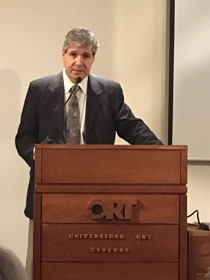 “To identify, describe, and characterize the different paths that teachers take with regard to the integration of technology into their teaching practices.” That was, in Mazzotti’s words, the purpose of his work titled Teacher iTIC Journeys: Educators Exploring the World of Technology.
“What are the different trajectories teachers follow in terms of their use of digital technology in teaching activities? What factors have positively or negatively influenced teachers’ behavior? What critical events alter these trajectories?” These were some of the guiding questions that were raised.
At the same time, Mazzotti explained the methodology used: she combined qualitative and quantitative techniques.
He conducted 22 semi-structured interviews and collected 220 surveys at seven educational institutions—both public and private, located in two different departments as well as in different neighborhoods and towns. However, these institutions had similar resource availability and comparable sociocultural indicators.
The findings
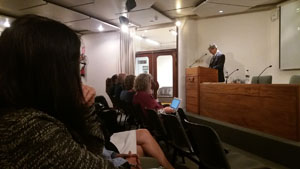 “Incorporating technology into teaching practices does not come naturally or spontaneously to some teachers,” Mazzotti noted, even though, in his view, “it enriches the learning experience.”
According to what he stated during his defense, the integration of Information and Communication Technologies (ICT) into the classroom is influenced by various factors, such as institutional culture, teachers’ beliefs about their benefits, professional development, and competencies and skills, among others.
Furthermore, according to the data collected, two out of three teachers who say they lack technological skills do not use technology in the classroom, while one out of three uses it only on rare occasions.
In contrast, half of those who say they have excellent ICT skills always use them in class, while the other half use them frequently.
In addition, the teacher and mentor at the Institute of Education categorized teaching approaches—with regard to the use of technology—into four models:
- Authentic career path: characterized by continuous growth. Teachers who follow this path are highly motivated and possess strong ICT skills. At the same time, they seek to improve teaching practices through the use of technology.
- A well-established track record: this includes teachers who, at first, did not use technology. However, following a turning point, they began to implement it.
- Incremental trajectory: has consists of three stages and has turning points. In the first stage, teachers did not use technology. Following a specific event, they began to use it, albeit on a limited basis. After a second event, a change in teaching practices occurred.
- Limited adoption: This indicates low-level use of the technology. Despite the organizational context, teachers use it sparingly and with little enthusiasm. However, the potential for change remains.
In closing, he noted that the findings of his research “reflect a very favorable environment” that exists in Uruguay regarding the use of technology in the classroom.
Questions and comments
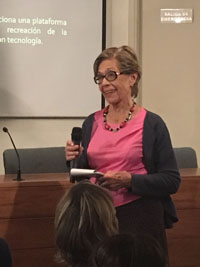 Before the panel posed its questions, Dr. Beatrice Avalos—Mazzotti’s thesis advisor and a visiting professor at the Institute of Education—spoke briefly about the process thus far.
He said it was an “excellent presentation” of a “complex thesis.” At the same time, he noted that those who had followed the process from the beginning could see that it had been an “arduous but very rigorous journey.”
The panel consisted of Dr. Paula Pogré—a researcher and graduate-level instructor at the National University of General Sarmiento—Dr. Eduardo Rodríguez Zidán—a member of the Academic Committee for the Doctor of Education program at the Institute of Education—and Dr. Denise Vaillant—director of the Doctor of Education program at Universidad ORT Uruguay.
Pogré was the first to speak. The external member of the panel described Mazzotti’s work as “serious” and “rigorous.”
For his part, Rodríguez Zidán emphasized that the document, in addition to offering a fresh perspective, provides “categories that help us understand the relationship between technology and education from a different angle.”
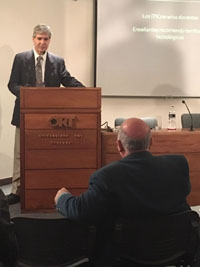 “This is an extremely important study; the paper and the presentation contribute to our understanding of the paths teachers take when integrating technology into their teaching,” concluded Vaillant.
The verdict
After the committee had deliberated, Vaillant was tasked with reading the final report. Before an attentive audience of doctoral students in education, as well as Mazzotti’s friends and family, she noted that the thesis “addresses a relevant topic and is methodologically sound and original in its findings.”
He also noted that the study achieved “excellent integration between survey and interview techniques, the data collection efforts, and the subsequent content analysis.” Furthermore, he stated that “the panel particularly values the inclusion of original tables and graphs that synthesize the contributions of the various authors.”
“This research makes a valuable contribution to the field of knowledge, and sharing it will help shed more light on the benefits of incorporating ICT into the classroom,” he added.
He then congratulated Mazzotti and announced the awarding of the first Doctor of Education degree from Universidad ORT Uruguay.
In closing, Mazzotti thanked Universidad ORT Uruguay giving him the opportunity to continue his education and professional development. He also thanked his thesis advisor “for her wisdom, dedication, and patience.” He also thanked the members of the Doctoral Program’s Academic Committee who, in his words, provided him with academic guidance and advice whenever he needed it.
He did not forget to thank the faculty and administrative staff, his fellow doctoral students, and everyone who made his work possible, “for their selfless support of educational research.”
https://youtu.be/mbpKvqt_ekM?si=ZyQn7q0E436thLl0