The novel, now translated into English, tells four stories, one of which is about the life of Charlotte de Grünberg (president of Universidad ORT Uruguay 1977 to 2024), an eight-year-old Belgian girl who flees the Nazis with her family and endures a series of trials and tribulations.
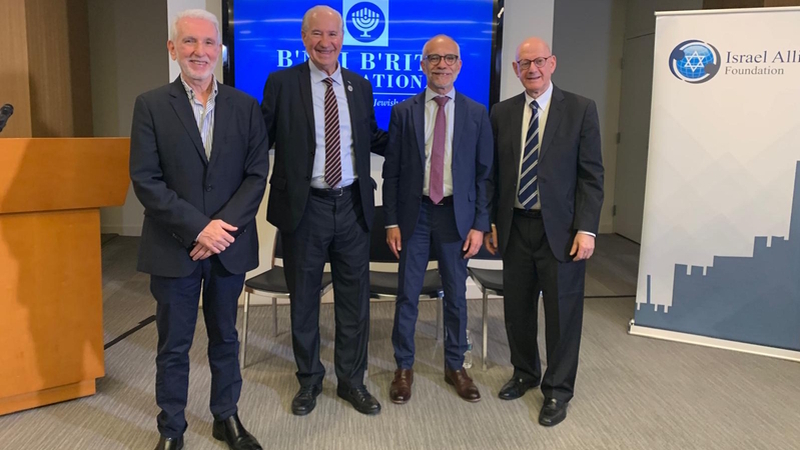
The presentation in Washington, held on April 10, also featured speeches by Uruguay’s ambassador to the United States, Daniel Castillos, and the CEO of B’nai B’rith International, Daniel Mariaschin, and was organized with the support of Adriana Camisar, special advisor for Latin American and UN Affairs at B’nai B’rith International. In addition, the event was sponsored by the Israel Allies Foundation.
https://www.youtube.com/watch?v=1ySn8OwGm_A
https://www.youtube.com/watch?v=x6358MbMfpc
https://www.youtube.com/watch?v=bs0lyZalC7g
https://www.youtube.com/watch?v=jchq3sZGIDI
https://www.youtube.com/watch?v=1CbGAk6MQLY
The event, held on April 16 at the Consulate in New York, featured a speech by the Uruguayan Consul General, Beatriz Núñez Rivas.
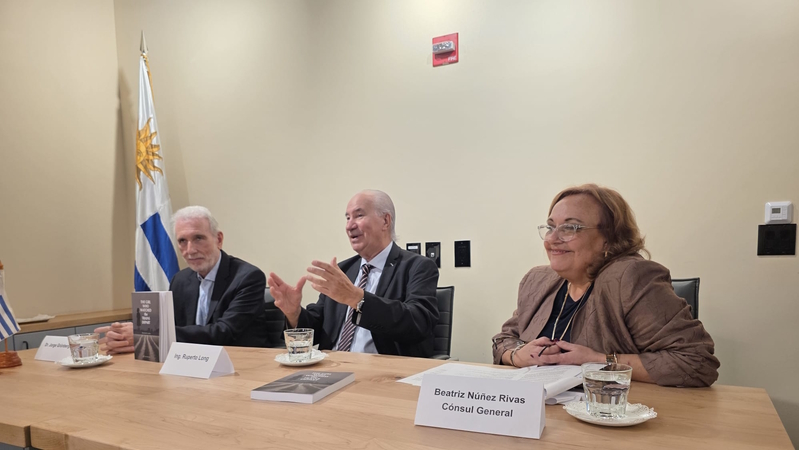
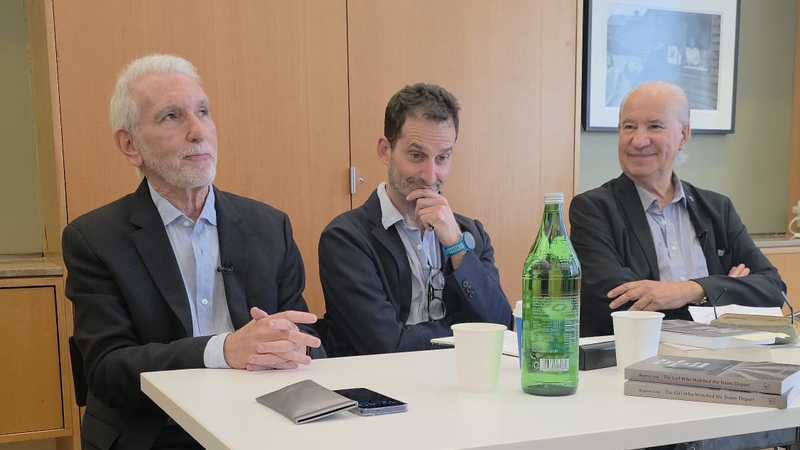
At the event held on April 17 at The New School for Social Research (New York), Federico Finchelstein, PhD, a professor at the institution and historian, also served on the panel. This Argentine-born scholar argued—paraphrasing Charlotte—that “education is an ongoing battle.” Charlotte’s story is “very inspiring” because she went from a “traumatic life experience to founding a university.” She would ask, “Did we learn anything?” Education about the Holocaust must be ongoing and must not stop; that is what Charlotte understood and put into practice, Finchelstein explained.
https://youtu.be/A2IBQ8YFJHw
A key testimony
Mariaschin argued that we are living in a time when there are fewer and fewer Holocaust (Shoah) survivors, a fact that Holocaust deniers view as an opportunity to bolster their arguments and more easily promote their denial. This book, he noted, serves as a response and a crucial testimony 81 years after the end of World War II.
The CEO highlighted the fact that, after the war, Charlotte "rebuilt her life, became a prominent figure in Uruguayan society, and founded Universidad ORT Uruguay."
Charlotte's story is about resilience, courage, and renewal.
Love and Freedom
"It is a privilege and an honor to participate, as Ruperto is not only a writer but also an intellectual, a scholar in various fields, and the author of books on a wide range of subjects," said Ambassador Castillos.
The diplomat explained that we are living in volatile, complex, and uncertain times, with wars and persecution that threaten our civilization, and that this is why it is extremely important to publish*The Girl Who Watched the TrainsDepart* in English and present it in the United States.
"This is a novel, but one based on real historical events set against the backdrop of the Holocaust, which teaches us that love and freedom will prevail." Castillos stated that, with this novel, Mr. Long has put Uruguay on the map, and therefore considers him "a true ambassador." We must "remember the past so as not to repeat the same mistakes that have had grave consequences for humanity," he concluded.

The Making of the Novel
Mr. Long noted that the event organized by B'nai B'rith was taking place just a few days before the Day of Remembrance of the Shoah and the Heroism of the Jewish People. The writer explained that it is "a story that has a lot to do with real life. "
The engineer recalled how the idea for the book came about. During a casual conversation with Charlotte, Long asked her where she had spent the war. Charlotte was taken aback by the question, but decided to briefly share her story with him, even though she had no desire to make it public. After much insistence, and with the support of Dr. Jorge Grünberg and Dr. José Grünberg, Charlotte’s husband, he managed to convince her to share her experiences of the suffering of war, while also expressing her confidence in the future.
The novelist and the director met once a month for two years to reminisce and relive Charlotte’s story together. Long recalled how impressed he was to learn that the protagonist of his novel had been hiding in a wardrobe for a year in the city of Lyon, France.
One anecdote that struck the author was that when Charlotte and her family were in hiding in Grenoble (France), Blima, the protagonist’s mother, seeing that her daughter (who was 10 years old) was bored, invented a domino game for her using Nazi leaflets (since they had no other kind of paper). Long explained that on one side of the makeshift game tiles was the order to denounce Jews, and on the other, the domino numbers. "Blima created something full of light to make her daughter happy, which demonstrates her resilience—that of an ordinary woman who could invent such things in an extremely difficult situation."
Uruguayan by choice
The rector Universidad ORT Uruguay : "My mother was very proud to be Uruguayan, since she had chosen to become a Uruguayan."
He also explained that Charlotte did not speak about her experiences during the Holocaust for decades, and emphasized the positive and therapeutic impact of having shared her story in the context of the war, 60 years after it ended. “For my mother, the positive response to the book meant a great deal: the fact that humanity is not lost,” he noted. She drew a parallel between Charlotte and Anne Frank, but clarified that they were two different stories with different endings.
Dr. Grünberg spoke about the lessons Charlotte learned from her experience during the Holocaust: the phrase “never again” must be accompanied by action; in this case, “never again defenseless”; and that “remembrance is not enough.” “Remembering is important, but we must also learn.”
Speech by rector Washington, D.C.
The presentations were filled with emotion and reunions with teachers (Gustavo Rubinsztejn and Amparo Mercader) and ORT graduates living in the United States.